

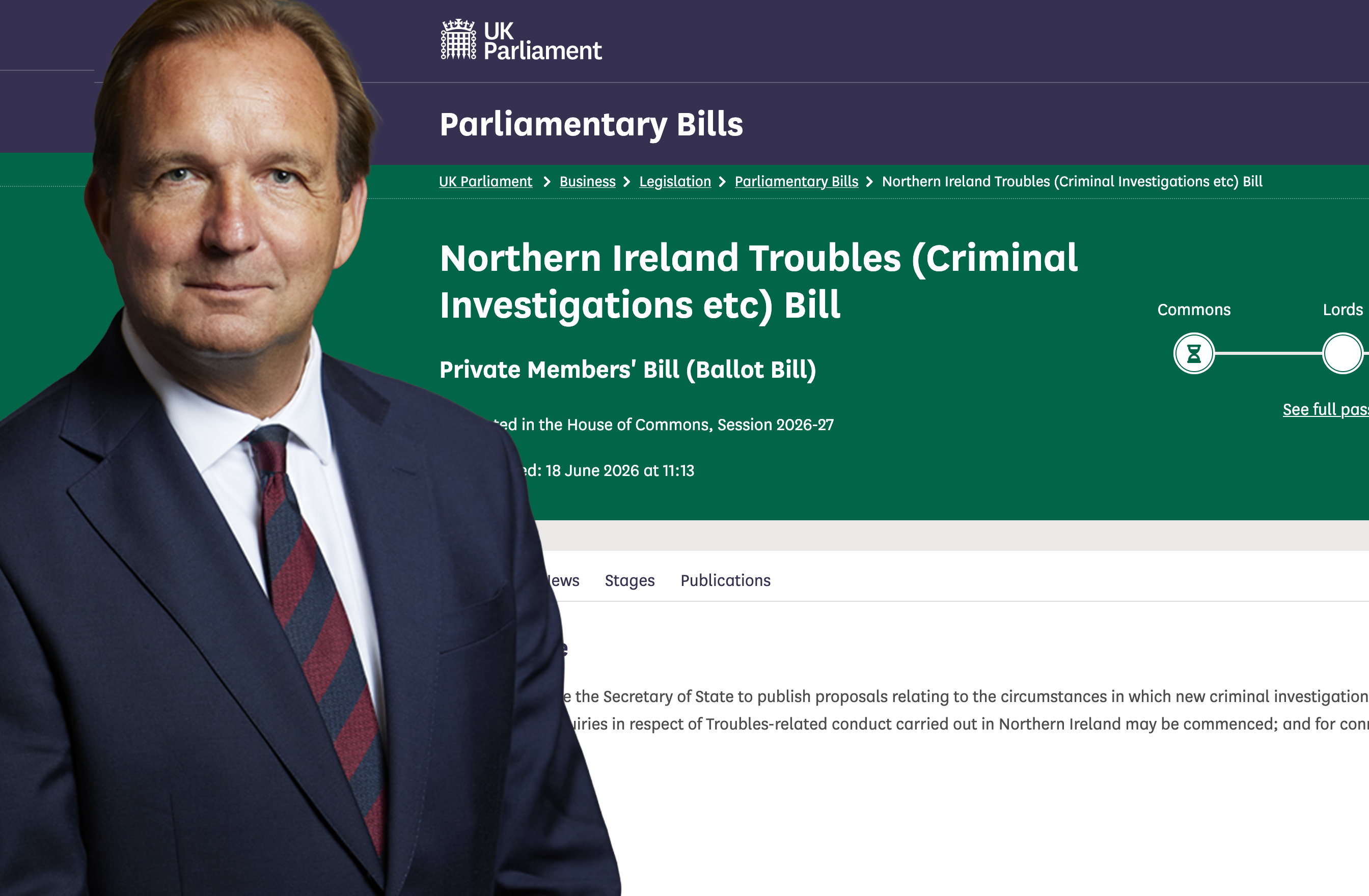
Lincoln Jopp’s Northern Ireland Troubles (Criminal Investigations etc) Bill Private Member’s Bill Second Reading is scheduled for Friday 4 September 2026, the first Friday of the new parliamentary session for Private Members' Bills.
At first sight, the Bill’s long title is fairly restrained:
“A Bill to require the Secretary of State to publish proposals relating to the circumstances in which new criminal investigations, prosecutions, inquests or inquiries in respect of Troubles-related conduct carried out in Northern Ireland may be commenced…”
But Jopp has subsequently told Parliament what he is actually trying to achieve.
Speaking in the Commons on 23 June, he described his proposal as putting into law a requirement that there should be no further investigations, inquests, inquiries or prosecutions unless, in the view of a Supreme Court judge, new and compelling evidence has emerged.
“That is why, when I came tenth in the ballot for a private Member’s Bill, I took the opportunity to attempt to put in law that there should be no further investigations, inquests, inquiries or prosecutions of Northern Ireland veterans unless, in the view of a Supreme Court judge, there is new, compelling evidence,” Jopp told Parliament.
That changes the significance of the Bill.
The question the Government has not answered
Much of the argument over Northern Ireland legacy has concentrated on prosecution. Will veterans actually be prosecuted? How likely are convictions after decades have passed? Should there be immunity?
Jopp’s Bill potentially moves the argument to an earlier and more fundamental point:
When should the state be entitled to put somebody through the process again?
That matters because prosecution is not the only burden.
The process can mean being investigated again; finding legal representation; reconstructing events after several decades; being interviewed under caution; having conduct publicly questioned; and then waiting months or years for somebody to decide whether anything further should happen.
A person does not have to end up in the dock for the process itself to impose a considerable penalty.
That is why Jopp’s Bill could become an important legislative vehicle for the process-is-punishment argument.
A proposed threshold
Jopp appears to be offering an answer: new and compelling evidence, assessed by a Supreme Court judge.
Whether that is ultimately the right formulation deserves examination. There are obvious questions about precisely what would constitute “new” evidence, how “compelling” would be defined, which proceedings would fall within the test, and exactly what role a Supreme Court judge would perform.
Those questions cannot yet be answered from the Bill itself.
The Bill was formally presented on 17 June as Bill 22, but its text has still not been published on Parliament’s Bill page. Subsequent Commons business papers have continued to describe it as “Bill not yet printed.”
We should therefore distinguish carefully between what Jopp has said he intends and the precise legal machinery that eventually appears in the Bill.
But the principle he has articulated is already clear enough to matter.
The Government proposes an extensive new legacy regime. Jopp is effectively asking: What has to change before the state is entitled to investigate the same historical conduct again?
That is a much more difficult question than general appeals to “justice”, “accountability” or the interests of “victims”.
If an incident was investigated at the time, and perhaps subsequently examined again, what new evidence justifies reopening it decades later?
And who decides whether that evidence is sufficiently important to justify putting those involved through another process?
Not simply a Conservative veterans Bill
There is another interesting feature.
The parliamentary record gives the Bill a notably broad group of supporters: David Davis, Alex Burghart, James Cartlidge, Nick Timothy, Mark Francois, Jim Shannon, Ian Roome, Lewis Cocking, John Cooper, Neil Shastri-Hurst and Katie Lam.
That includes Conservatives, as well as Jim Shannon of the DUP and Ian Roome of the Liberal Democrats.
Katie Lam’s involvement is particularly interesting following her recent work in Northern Ireland.
Her documentary brought her into direct contact with people occupying very different positions within the legacy argument: victims, former terrorists, unionists, former RUC Special Branch officers and former SAS personnel.
There is therefore an opportunity to make an argument considerably more sophisticated than: “Stop prosecuting veterans.”
The stronger proposition is: When the state has already investigated an incident, what evidential and public-interest threshold must be crossed before it may put people through the process again?
That principle need not depend upon the identity of the person being investigated.
Why 4 September matters
As a Private Member’s Bill, Jopp’s proposal faces the familiar difficulty of securing parliamentary time and Government support. Its importance need not, however, depend entirely upon whether it reaches the statute book.
A Second Reading gives Jopp and his supporters an opportunity to force the Government to address the principle publicly and on the parliamentary record.
That timing matters.
The Government’s own Northern Ireland Troubles Bill remains before Parliament. Jopp’s Bill therefore provides an opportunity to ask, alongside that legislation, a question the Government has yet to answer satisfactorily: What safeguards prevent repeated historical investigation becoming punishment by process?
There is also a striking connection with Roisin Nugent’s civil litigation.
That case raises a closely related question: what is the legal and evidential justification for reopening an historical military incident when no materially new evidence has emerged?
The answer matters well beyond one case.
If the state is to reopen events 30, 40 or 50 years later, there ought to be an identifiable threshold for doing so.
Lincoln Jopp appears to be trying to put one before Parliament.
That makes 4 September worth watching very closely.
How the Private Member’s Bill process works
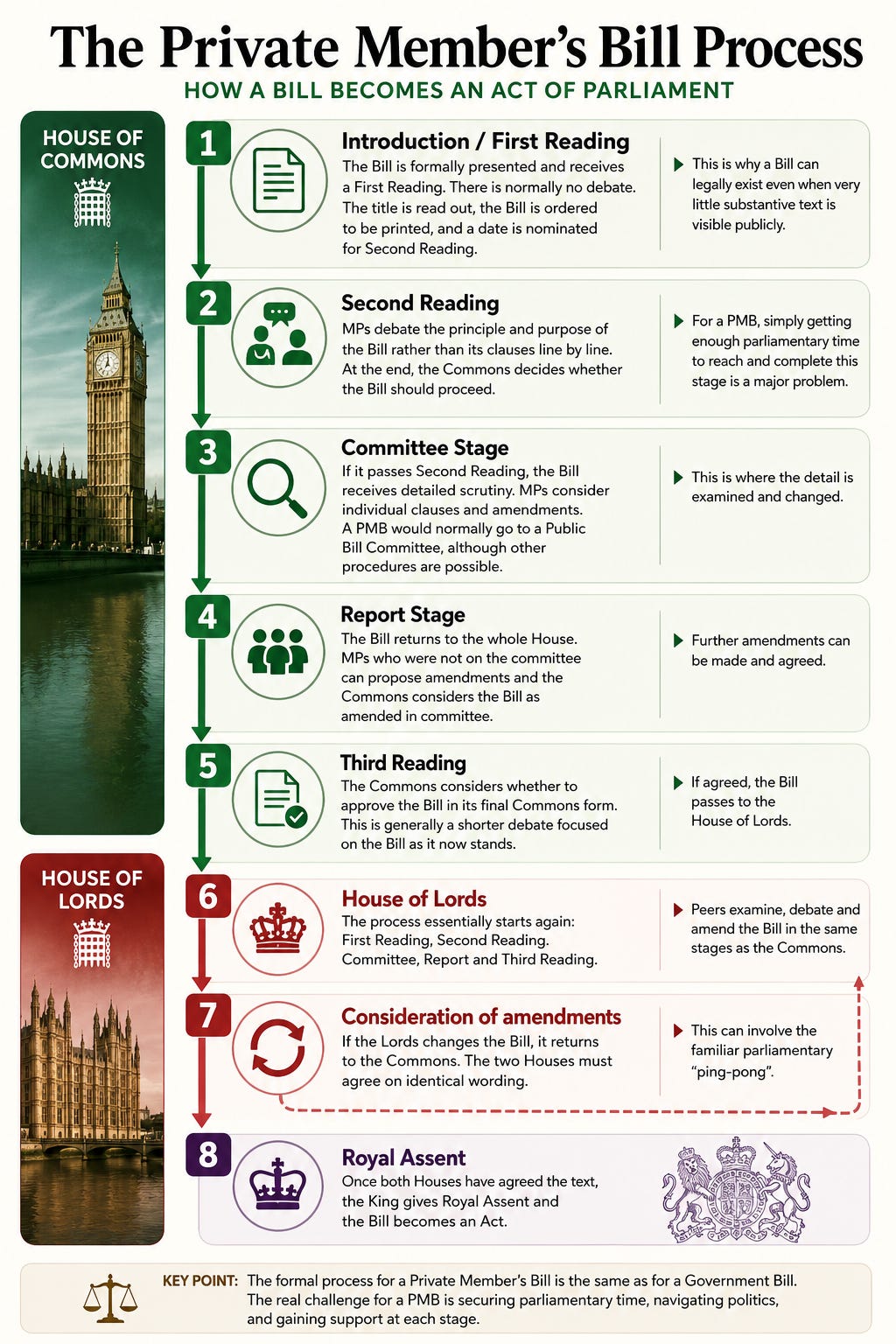
A Private Member’s Bill (PMB) is a Bill introduced by an MP or peer who is not acting as a government minister. It goes through essentially the same legislative stages as a Government Bill, but the politics and, above all, the allocation of parliamentary time are very different.
For a Commons PMB such as Lincoln Jopp’s, the process is:
Introduction / First Reading — The Bill is formally presented and receives a First Reading. There is normally no debate. The title is read out, the Bill is ordered to be printed, and a date is nominated for Second Reading. This is why a Bill can legally exist even when very little substantive text is initially visible publicly.
Second Reading — This is the first substantive hurdle. MPs debate the Bill's principle and purpose rather than go through its clauses line by line. At the end, the Commons decides whether the Bill should proceed. For a PMB, simply getting enough parliamentary time to reach and complete this stage is a major problem.
Committee Stage — If it passes Second Reading, the Bill receives detailed scrutiny. MPs consider individual clauses and amendments. A PMB would normally go to a Public Bill Committee, although other procedures are possible.
Report Stage — The Bill returns to the whole House. MPs who were not on the committee can propose amendments and the Commons considers the Bill as amended in committee.
Third Reading — The Commons considers whether to approve the Bill in its final Commons form. This is generally a shorter debate focused on the Bill as it now stands.
House of Lords — The process essentially starts again: First Reading, Second Reading, Committee, Report and Third Reading.
Consideration of amendments — If the Lords changes the Bill, it returns to the Commons. The two Houses must agree on identical wording. This can involve the familiar parliamentary “ping-pong”.
Royal Assent — Once both Houses have agreed the text, the King gives Royal Assent and the Bill becomes an Act.
The crucial distinction with PMBs is therefore not the formal legislative process but the probability of surviving it.
There are three principal ways Commons PMBs originate:
Ballot Bills get priority because MPs successful in the annual ballot receive valuable debating slots.
Ten Minute Rule Bills allow an MP briefly to make the case for legislation.
Presentation Bills can simply be formally introduced without an initial speech. The route matters enormously because parliamentary time is scarce.
Why the Second Reading date matters
PMBs are primarily considered on a limited number of Friday sittings, which produces a brutal bottleneck.
A Bill listed first on a PMB Friday has a reasonable opportunity to receive a debate. Bills further down the Order Paper may never be reached. Debate can consume the available time, and opponents can sometimes prevent a Bill progressing without having to defeat it in a straightforward division.
Government attitude is particularly important.
A PMB without government support can become law, but in practical terms, a Bill requiring substantial legislation, expenditure, or administrative machinery faces a very difficult path if the Government actively opposes it. Conversely, governments sometimes allow, facilitate or effectively adopt PMBs they find useful.
There is another important hurdle: Money.
If implementation requires public expenditure, a Money Resolution may be necessary before relevant committee proceedings can progress. Only the Government can initiate one. That gives the Government considerable practical control even after a PMB has secured Second Reading.
What this means for Jopp’s Bill
The significance of 4 September 2026 is therefore greater than merely “the next stage”.
Jopp has already crossed the First Reading threshold. Second Reading is where MPs are asked, in effect:
Do we agree with the principle of what this Bill is trying to achieve sufficiently to allow Parliament to examine the detail?
Passing Second Reading would not mean Parliament had enacted Jopp’s proposed policy. It would mean the Commons had agreed that the proposal deserved to proceed into detailed legislative scrutiny.
And that distinction is particularly interesting given the long title:
A Bill to require the Secretary of State to publish proposals relating to the circumstances in which new criminal investigations, prosecutions, inquests or inquiries in respect of Troubles-related conduct carried out in Northern Ireland may be commenced; and for connected purposes.
If the Bill requires the Secretary of State to publish proposals defining when new Troubles-related investigations, prosecutions, inquests or inquiries may begin, the Second Reading debate potentially becomes something larger than a vote on Jopp’s particular mechanism.
It gives MPs an opportunity to debate the underlying proposition:
Should there be a defined threshold governing when the state can reopen or initiate another Troubles-related process?
That could matter politically even if the Bill ultimately dies.
In fact, with PMBs it is useful to separate legislative success from political success.
A PMB can fail to reach Royal Assent yet succeed in forcing a minister to state government policy, exposing an unanswered question, securing a government undertaking, attracting cross-party support, generating amendments to later government legislation, or establishing an idea that the Government subsequently adopts.
For veterans, therefore, 4 September should not be viewed simply as “will Jopp’s Bill become law?”
The more immediate question is whether the Second Reading debate can force MPs and ministers to address the substantive issue Jopp has put on the table:
What threshold, if any, should have to be crossed before the state subjects someone to another Troubles-related legal process?