

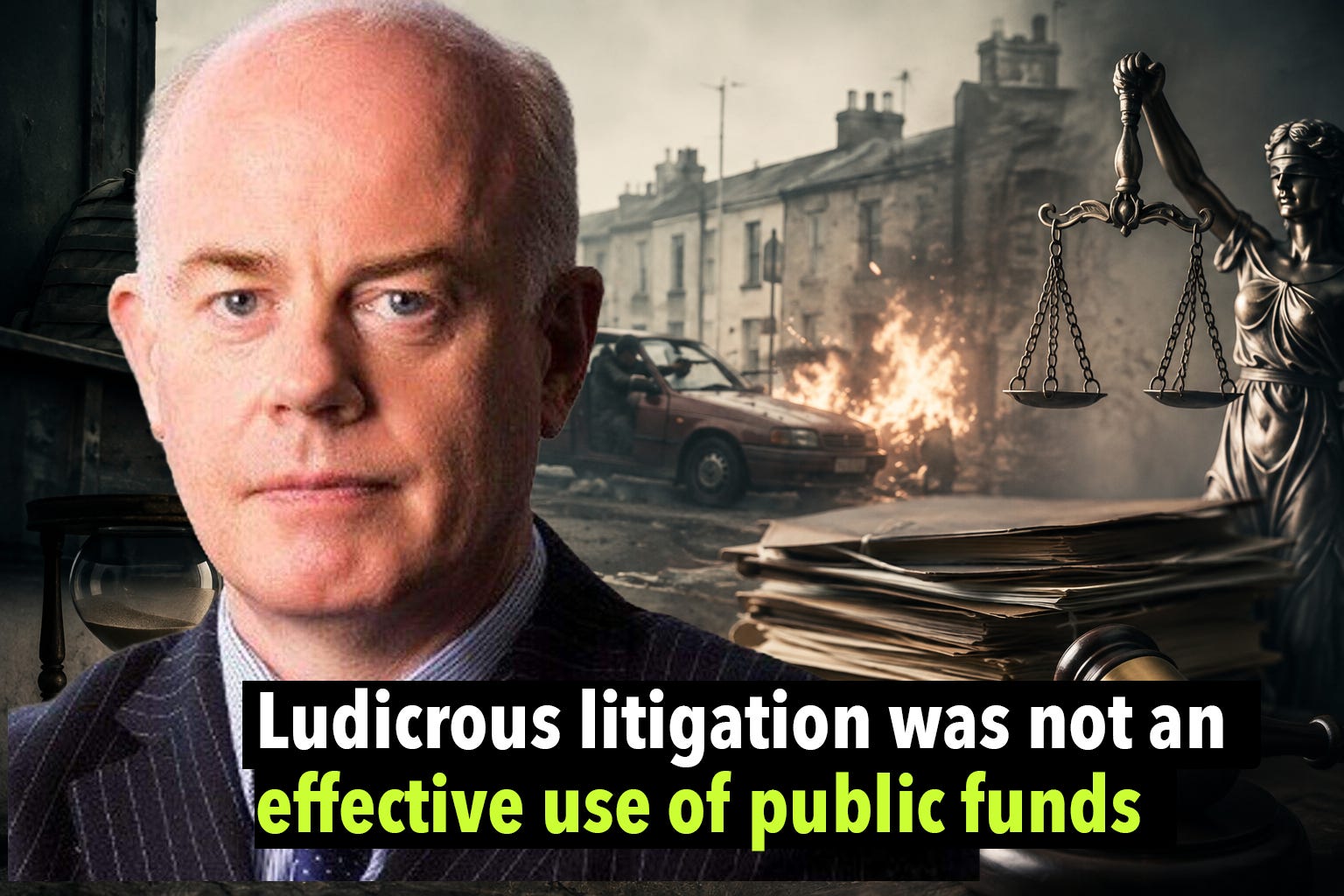
In June 1991, an IRA active service unit arrived in Coagh, County Tyrone, intending to murder a man they believed to be a UDR soldier. He was actually an undercover soldier being used as the intended target in a security-force operation.
When a gunman began to emerge from the IRA vehicle with an AK-type rifle, soldiers opened fire. Three IRA members were killed.
More than thirty years later, following an extensive Article 2 inquest, the daughter of one of the dead men sought judicial review of the coroner’s findings concerning Soldier B.
Mr Justice McAlinden refused leave.
His judgment was unusually forthright. He described the attempt to analyse Soldier B’s eight shots individually as “ludicrous” and “utterly divorced from the reality” of an engagement lasting perhaps one or two seconds. He concluded that the challenge was really an attempt to reopen the merits of the coroner’s findings “under the guise of a judicial review” — and expressly questioned why legal aid had been provided to fund it.
But that wasn’t the end of it.
The case went to the Northern Ireland Court of Appeal.
The appellate court moderated some of McAlinden’s language, but largely upheld the substance of his reasoning. It rejected retrospective “freeze-frame” analysis of the shooting, upheld the approach to Article 2 and the Yellow Card, and concluded that the case would have failed on its merits even if leave for judicial review had been granted.
And on the question of public money, the Court of Appeal made an important observation of its own.
It concluded that the challenge essentially amounted to disagreement with the coroner’s findings and said that this was “not an effective use of public funds even when article 2 is engaged.”
This single case does not establish that legacy litigation generally is abusive or that legal aid for legacy cases is generally being improperly awarded.
What it does provide is something much harder to dismiss: a concrete example in which a High Court judge questioned the provision of legal aid and a three-judge Court of Appeal subsequently concluded that the litigation was not an effective use of public funds.
The latest Salus Briefing examines the judgments in detail: what happened during those two seconds in Coagh, what was challenged more than three decades later, what McAlinden actually decided, and — crucially — what survived scrutiny in the Court of Appeal.
Read the full Salus Briefing Note: When Judicial Review Becomes an Ineffective Use of Public Funds
And so the beat goes on! The justification for one of my brothers in arms opening fire on ARMED members of this IRA ASU, is unquestionably, one hundred percent cent right! Nothing to do with anyone else, who was NOT at the scene of that operation! Our boys did exactly the right thing, they were trained to do,at the right moment; Thus preventing this terrorist team from taking anymore lives! Study this paragraph from the above piece and you have your answer! YES?
"When a gunman began to emerge from the IRA vehicle with an AK-type rifle, soldiers opened fire. Three IRA members were killed."