

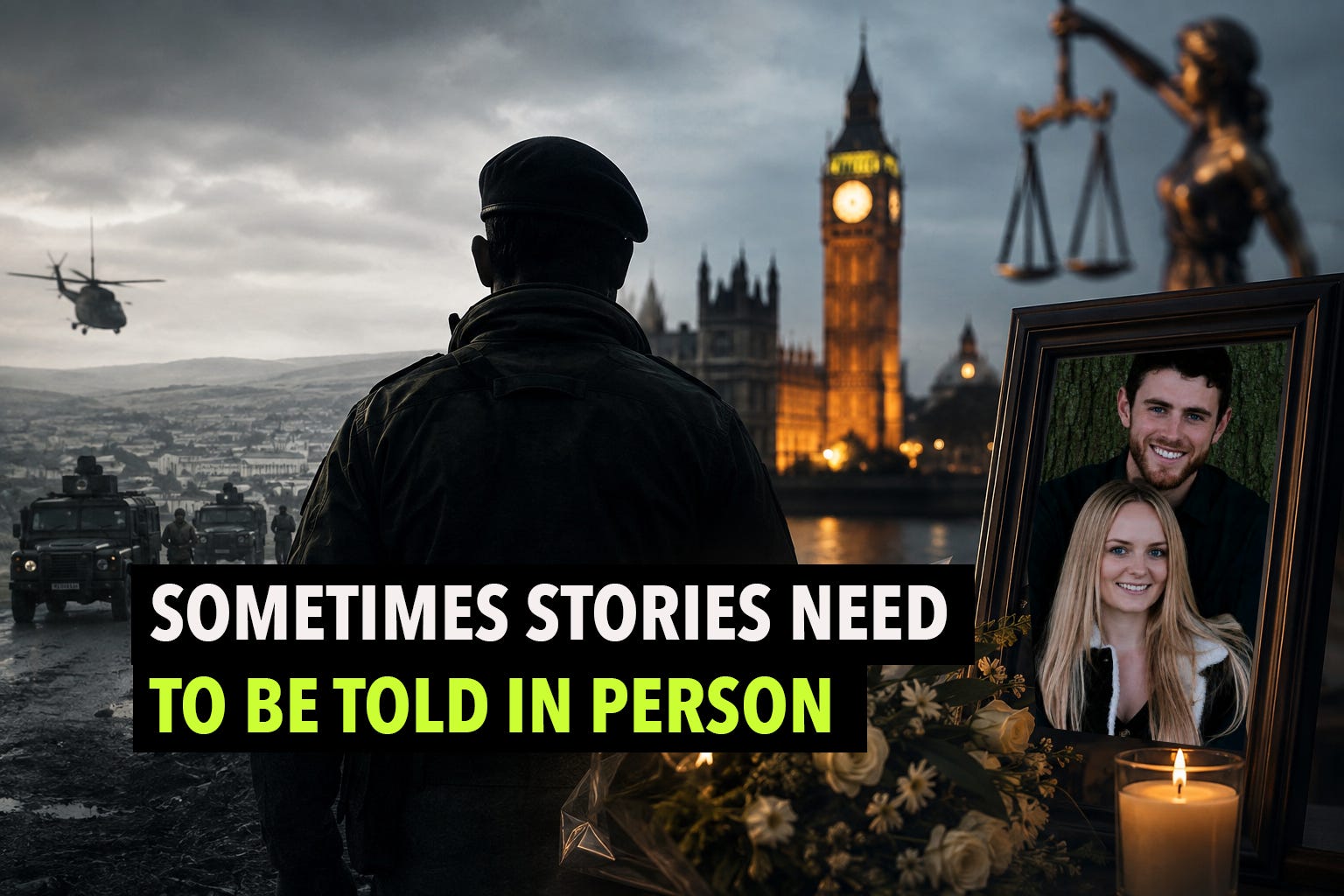
Folks are asking why the battle over Northern Ireland veterans and legacy lawfare has not captured public attention — academics and political science types call it “public salience” — on anything like the scale achieved by the campaign surrounding PC Andrew Harper.
It is a reasonable question. And, a comparison reveals something important about the problem veterans face.
The veterans campaign has not gone unnoticed. For example, more than 200,000 people signed the petition to protect Northern Ireland veterans, securing a Westminster debate. The issue has attracted support from veterans’ organisations, regimental associations, senior retired officers and parliamentarians. It has been aired in articles, letters to editors, and questions in Parliament.
But that is different from becoming a national cause understood instinctively by millions.
The PC Harper case has almost every characteristic required for one.
Andrew Harper was a 28-year-old police officer killed in horrific circumstances while doing his job. There was a readily understood injustice, identifiable offenders and a clear argument about punishment. His widow, Lissie Harper, could put a name, face and voice to the campaign. She could appear on television, speak to newspapers, address politicians and tell Andrew’s story repeatedly.
The proposition required almost no specialist knowledge: This happened. It was wrong. The law should change.
The Northern Ireland veterans issue is almost the opposite communications problem.
There isn’t one Andrew Harper
There are potentially hundreds or thousands of veterans affected by investigations, reinvestigations, inquests, civil proceedings and continuing legal uncertainty. The alleged injustice is often procedural rather than dramatic. The relevant law is complicated. Northern Ireland’s history is contested. Cases stretch backwards over decades. And the Government can deploy the superficially compelling response that nobody should be above the law.
But there is an even more fundamental difference.
Some of the people with the most powerful stories cannot safely tell them.
That is particularly important for former Special Forces personnel.
An SAS veteran involved in legacy proceedings may have been granted anonymity by a court. Speaking publicly about his experiences — even anonymously — can raise the question of whether that anonymity remains justified. There may also be operational security considerations, restrictions on what can be discussed and straightforward legal advice not to talk while proceedings remain possible.
The very thing that conventional public relations would normally demand — put the human being at the centre and let him tell his story — could therefore expose the person the campaign is trying to protect.
That produces an extraordinary communications paradox.
The veterans best placed to demonstrate why the system may be unjust may be precisely the veterans least able to explain publicly what has happened to them.
Compare the two communications environments
The Harper campaign can proceed:
Person → name → face → story → injustice → remedy.
A legacy case involving a former SAS soldier may instead appear to the public as:
Anonymous veteran → letter designation → incident decades ago → complicated legal proceedings → disputed allegation of injustice.
The protections necessary for the veteran simultaneously remove many of the ingredients that make a story travel.
That means the answer cannot simply be: we need veterans to tell their stories.
For many Operation Banner veterans that remains possible and valuable. But it cannot safely be the foundation of a campaign dealing with those most exposed to legacy proceedings.
Nor can the answer simply be more publicity for “veterans against lawfare”.
Lawfare is an argument. Harper is a story.
The challenge is therefore to tell the veterans story without requiring legally vulnerable veterans to tell it themselves.
That means starting with what can safely be established.
Court judgments. Contemporary documents. Parliamentary records. Historical footage. Maps and timelines. Statistics. Official reports. Journalists, historians and lawyers. Commanders and veterans who can speak without exposing themselves or former colleagues.
The public record can sometimes tell a remarkably human story without identifying the individual at its centre.
Consider the Nugent legal action arising from the Coagh shootings.
Its significance to the ordinary reader isn’t principally an argument about Article 2, judicial review or the Yellow Card. Those things matter, but they are not where the story should begin.
The human predicament is much simpler.
A soldier had seconds in which to assess an apparent lethal threat and decide whether to fire. Decades later, those seconds became the subject of an inquest and further legal proceedings. In refusing leave for judicial review, Mr Justice McAlinden’s findings provide an unusually stark account of the realities of making such decisions under operational conditions.
You don’t need the soldier sitting in front of a television camera to understand the question that raises:
How should a democratic state judge, decades afterwards, decisions it required young soldiers to make in circumstances of extraordinary danger?
Once somebody understands that question, the law becomes relevant.
The bigger picture
There is also a much larger story that has been neglected.
More than a quarter of a million members of the Armed Forces served in Northern Ireland during Operation Banner. Hundreds were killed by paramilitaries. Yet for much of today’s British population, particularly younger generations, the operation is either barely understood or remembered primarily through a relatively small number of controversial incidents.
That matters because the public is being asked to form opinions about the treatment of Operation Banner veterans without necessarily understanding what Operation Banner actually was.
So there are really two tasks.
One is to scrutinise what is happening to veterans through the legacy system.
The other is to recover the history of the generation that served.
The second may ultimately make the first easier to understand.
That requires serious public history rather than propaganda: archive material, contemporary records, carefully reconstructed incidents, testimony from those who can safely speak, accounts of soldiers who were killed, and explanations of the operational environment in which decisions were made.
It should acknowledge mistakes, controversy and legitimate disagreement. The purpose is not to tell people that the Army was always right.
It is to show people what these men were asked to do, the circumstances in which they were expected to do it, and what happened afterwards.
There is an important distinction here between recording history and publishing it.
Some veterans may be able to give detailed testimony for an archive under tightly controlled conditions, with restrictions or lengthy embargoes, even though publication would currently be impossible or unwise. Their history need not be lost merely because it cannot safely be broadcast today.
Public communication can meanwhile rely upon the material that can responsibly be published.
That leads back to the Harper comparison.
Why hasn’t the veterans campaign produced its equivalent of Lissie Harper?
Perhaps because, in some of its most important cases, it cannot.
A campaigner in the Harper case can stand outside Parliament, appear on television, speak to newspapers and permanently attach her identity to the cause.
A former SAS soldier facing legacy proceedings may need to do almost precisely the opposite.
He may need to remain unnamed.
He may be unable to discuss what happened.
His former colleagues may be unable to corroborate him publicly.
His lawyers may advise him not to speak.
Security considerations may persist decades after his service.
And publicity itself could potentially jeopardise protections he currently possesses.
That isn’t a minor public-relations inconvenience.
It is one of the central communications problems confronting the veterans campaign.
The people whose experiences could turn an abstract argument about lawfare into a compelling human story may be unable to tell those stories themselves.
The answer is therefore not to search for a veterans’ equivalent of PC Harper.
It is to develop a form of storytelling capable of overcoming the fact that, in this unusual battle, some of its most important protagonists must remain invisible.
Where Veterans can make a difference
There is another consequence of all this.
If the veterans’ battle is inherently difficult to prosecute through mass media, veterans should not assume that national PR can do the job for them.
That makes engagement with MPs at constituency level particularly important.
A veteran does not need to become a national campaigner to influence his Member of Parliament. He does not need to appear on television, attract thousands of social media followers, or persuade a newspaper to tell his story.
He can engage as a constituent.
That changes the communications equation.
National PR requires a public story. Constituency engagement does not.
An MP can meet veterans privately, hear about their experience of Operation Banner and understand their concerns about the legacy system without those veterans becoming public representatives of the campaign.
Nor does the veteran sitting opposite the MP necessarily have to be somebody currently facing proceedings. Indeed, there may be very good reasons why such individuals should not participate.
Other Operation Banner veterans can explain the environment in which they served, what was expected of them, why decisions sometimes had to be made in seconds and what the continuing pursuit of former colleagues means to the wider veteran community.
That also turns an abstract political issue into a constituency issue.
The veteran ceases to be somebody described in a briefing paper as “a former soldier potentially affected by legacy proceedings”.
He becomes one of the MP’s constituents.
That distinction matters.
PR still has a role. It can establish facts, challenge arguments, produce material that veterans and MPs can use, attract journalists’ attention and keep an issue in the public domain.
But it should support human engagement rather than substitute for it.
If the peculiar circumstances of the Northern Ireland legacy battle make it difficult to create a small number of national figureheads, the answer may be to reverse the model: Not one public campaigner trying to reach 650 MPs, but veterans across the country engaging their own MPs.
That will never generate the visible numbers of a million-signature petition.
But visible numbers are not necessarily the only measure that matters.
A few hundred MPs who have actually sat opposite an Operation Banner veteran from their own constituency, heard what he has to say and understood why the issue matters may ultimately be considerably more valuable than another burst of national publicity.
Ready to tell your story?
Begin to make a difference; visit: Salus Archive
The Cornwall "fighting patrol" of 4, 5 or 6 vets has now had meetings with all 6 MPs that represent the county. 4 Labour and 2 Lib Dems. We put across the NI legacy issues in meetings that lasted from 30 minutes to an hour. Guys who had been boots on the ground talked in detail about their own experiences and the hounding of now dead comrades who had the knock-on-the door from the police right up until they died 50 years after their service in Ulster. Younger members of the patrol talked about issues affecting vets on the human rights front. All 6 MPs were positive and supportive. BUT.... they voted as their party whips told them to do. To me, as an NI veteran myself, that is where democracy fails us. 😖