

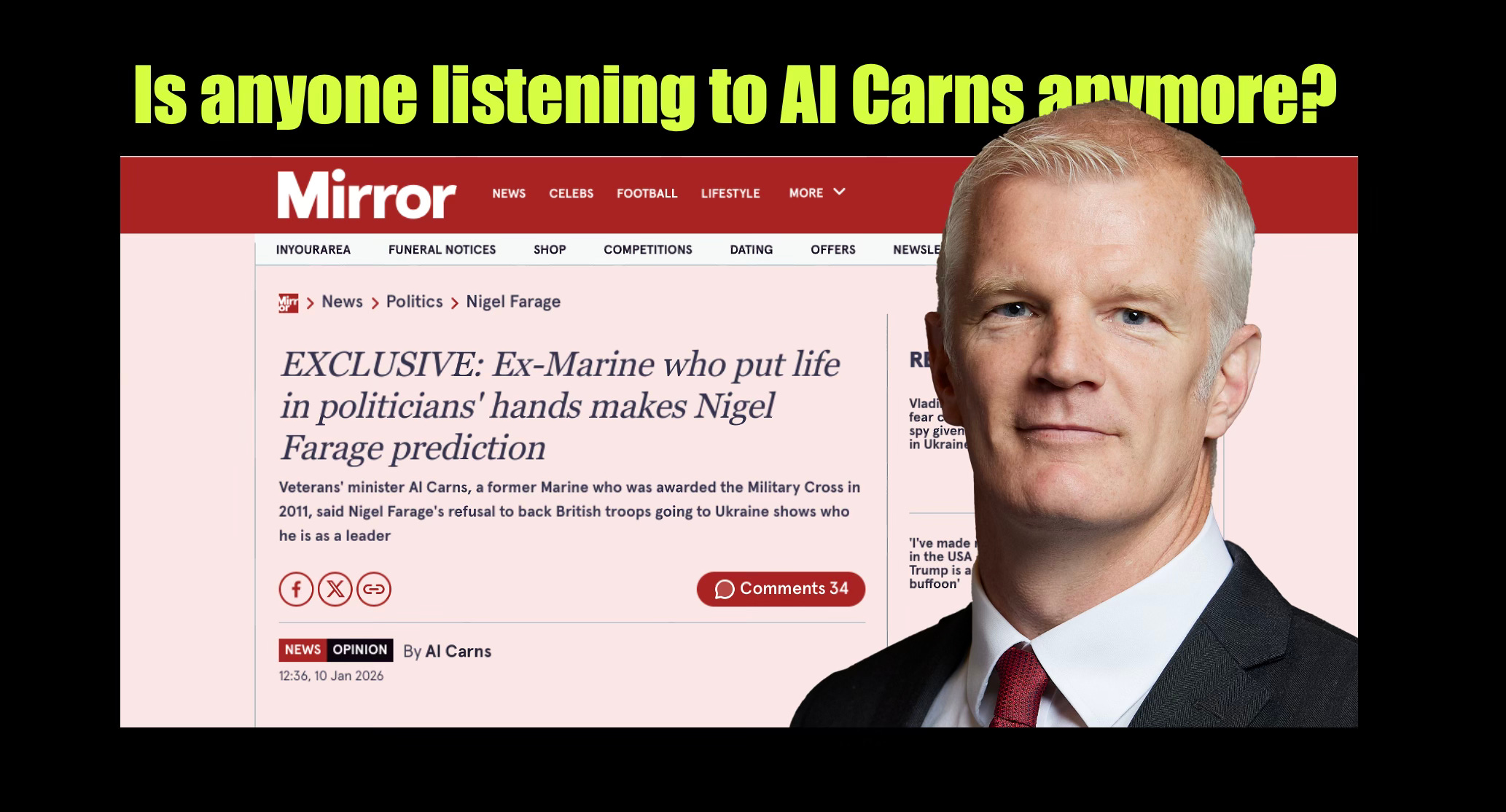
The real takeaway from a recent Mirror story attacking Nigel Farage via an ex-Marine critic is not what readers said — but how few spoke at all.
Only 12 comments. On the Mirror.
For a paper that feeds on outrage and tribal sparring, that is not a neutral outcome.
It’s a failure to mobilise. And in today’s media environment, silence is data.
This isn’t a defence of Farage, nor an endorsement of his views. It’s an examination of what the public response — sparse, repetitive, and weary — tells us about where the ground has shifted.
A story that failed to ignite
The article follows a familiar template: use a veteran as moral authority to discredit a political figure on Ukraine. The assumption is simple — service confers credibility, credibility produces condemnation.
It didn’t work.
Readers didn’t meaningfully engage with what the ex-Marine had said. They sorted the piece into pre-existing mental boxes — “lefty smear”, “party politics”, “Russia TV again” — and moved on.
That’s not engagement. It’s pattern recognition followed by exit.
The voices that did appear — and what they reveal
Even in a thin thread, clear archetypes emerge.
1) The anti-war realist
“Ukraine is not our war… we cannot go to war with Russia… elites will be safe in bunkers.”
This voice isn’t necessarily pro-Russia or pro-Farage. It’s strategic caution fused with elite distrust and nuclear anxiety — a worldview that used to sit comfortably inside mainstream politics, and now floats politically homeless.
2) The Labour–military schism
“How ANYONE ex-military can be Labour…”
Whether fair or not, the assumption that Labour and the armed forces are culturally incompatible is treated as settled fact. That matters because it means the article’s central device (a veteran critic) doesn’t automatically carry moral authority.
3) The ‘lefty smear’ detector
“Another desperate lefty non-story… twisting words…”
These readers aren’t defending Farage so much as rejecting the move. Once a story is categorised as a smear, persuasion ends. Everything that follows is dismissed as theatre.
4) The exhausted RT money argument
The “Farage got paid by Russia Today” line surfaces again, met with counter-claims, dates, accounting minutiae and the word “libel”. No one shifts position. That’s what a dead line of attack looks like: technical, disputed, morally drained.
5) The collapse of veteran authority itself
“I’m ex-military” meets “I’m ex-military and you’re a wally.”
Once veteran status becomes a trump card in a comment war, it cancels itself out. And when that happens, media attempts to weaponise service as a rhetorical cudgel lose their punch.
What didn’t happen matters more
There was no sustained moral argument.
No collective anger.
No momentum.
No dogpile.
The story didn’t feel new, urgent, or costly. It failed to connect to anything larger than party tribalism.
And that is precisely why it died in the comments.
Compare that to “Britain can smell a broken covenant”
Now set this beside what your justiceforveterans.uk post about a “broken covenant” moment: a Telegraph piece about Labour’s legacy plans and special forces warnings that drew more than 2,000 comments overnight.
That contrast matters more than any individual argument in either thread.
The Mirror thread is about a personality conflict (Farage), a familiar insinuation (Kremlin-adjacent), and a veteran used as a rhetorical prop. The public reads it as noise: recycled accusations, predictable camps, low stakes, move along.
The Telegraph comment storm, by contrast, is about something deeper: the fear that the state will use men in war and then abandon them in peace; that legal process becomes punishment; that responsibility stops at the man on the ground while decision-makers walk away. In that thread, the language turns hot — anger, betrayal, and the sense of a moral inversion.
In other words:
One story tries to trigger outrage by telling people who to dislike.
The other triggers outrage because it touches the public’s instinct that a society which breaks faith with its defenders is sawing through the branch it sits on.
And the public knows the difference.
A broader shift the media is missing
This small Mirror thread points to three shifts legacy media still struggles to grasp.
1) Ukraine arguments are becoming material, not moral
Readers are asking about capacity, escalation, equipment, manpower and national interest — not virtue signalling.
2) Identity authority is eroding
“Veteran says X” no longer settles anything. Audiences ask: which veteran, arguing what, deployed for whose benefit?
3) The public is less persuadable and more defensive
People are not being mobilised; they are being sorted. They don’t join debates — they categorise them and leave.
That is not healthy. It’s not “winning the argument”. It’s disengagement.
Silence as a warning
This wasn’t a win for Farage, or for Labour, or for Ukraine hawks or doves.
It was something more worrying: narrative stalemate.
When stories designed to provoke outrage produce only a handful of tired exchanges, it suggests a public that is switching off — and a media class that no longer knows how to speak in terms that carry weight.
The danger isn’t that people are choosing the “wrong” side.
It’s that they stop believing any side is worth listening to at all.
I wish they could get it into their thick skulls that we DON'T GIVE A SHIT WHAT THEY SAY ABOUT FARAGE AND ITS MEMBERS -
WE WILL STILL VOTE FOR REFORM !
THE UNI PARTY ARE DONE FOR !
BYE BYE 👋 !
What is the profile of a Mirror reader? Just asking…..