

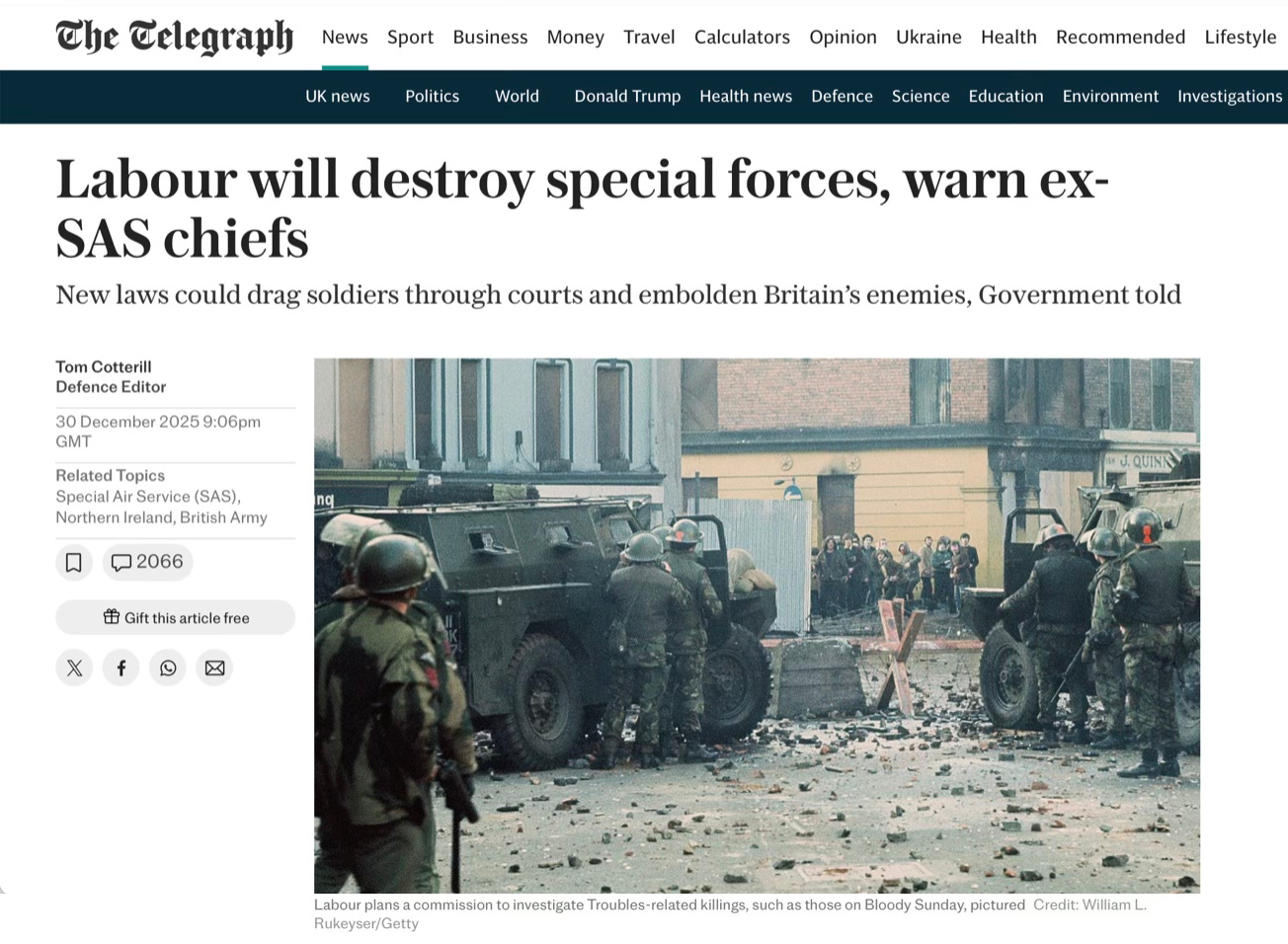
Labour’s Troubles plans have not just stirred unease among Telegraph readers — they have detonated something close to a crisis of confidence in the political class. The SAS chiefs’ warning piece, posted at 9 pm last night and already drawing more than 2,000 comments, has clearly touched a nerve.
This comment storm is a gift. It shows millions of people (via thousands willing to type) instinctively understand the core point: A country that treats its veterans as disposable will eventually find its defenders gone.
Volume and intensity
Generating 2,035 comments overnight places this firmly in the “lightning rod” category for Telegraph stories, signalling that questions of lawfare, veterans and Northern Ireland cut unusually deep with the paper’s core base.
The tone is overwhelmingly one of anger and betrayal rather than normal partisan grumbling, with “traitor”, “enemy within”, “communist”, “Marxist”, “globalist” and “anti‑British” recurring with striking frequency.
Core story readers are telling
Commenters frame Labour not as merely misguided but as deliberately weakening the armed forces and “doing the enemy’s work”, often extending that charge to the broader “Uniparty” and civil service.
The special forces are cast as the last intact symbol of national competence and courage; to drag them repeatedly through the courts is seen as a moral inversion in which terrorists receive amnesties while soldiers face show trials decades on.
Lawfare, legacy and the covenant
Many posts fuse specific grievances — the new Troubles legacy bill, the role of Lord Hermer, ECHR jurisprudence and historic investigations — into one story of “lawfare” hollowing out Britain’s ability to fight.
Running through the thread is the sense of a broken covenant: that men sent to do the state’s bidding, under political and legal authorisation at the time, are now left exposed. At the same time, those who ordered or opposed those missions advance their careers.
Drift towards extra‑constitutional fantasies
A notable subset of commenters talks lightly of coups, “the SAS sorting it out”, or the military “liberating” the country, reflecting how far trust in conventional politics has ebbed in this slice of opinion.
Cooler heads are pushing back, warning that making soldiers answerable to hearsay decades later is corrosive, but that the answer cannot be to fantasise about juntas in a country whose armed forces are meant to defend, not govern.
What this reveals about the moment
Set alongside earlier reporting on an “exodus” from special forces and warnings from senior commanders about the chilling effect of endless inquiries, the reaction shows a public mood primed to believe Britain is disarming itself in the face of mounting threats.
For the Telegraph audience, and no doubt many more, the SAS chiefs’ article has crystallised a broader fear: that a remote legal‑political elite is dismantling both the practical and moral foundations of national defence, and that if that bargain can be broken with special forces, it can be broken with anyone.
The current Political Hierarchys in No. 10 need to be replaced ASAP.
Labour have competent former military MPs who understand the military ethos.
KS has lost the trust of the UK Veterans Community. This will not return.
Reset, reorg move on quickly.
Individuals, organisations and countries will capitalise on Political weakness and do us harm.
Our Veterans Community must have a voice. 😎😎
The progressive left establishment is now the most dangerous threat our nation has ever witnessed.