

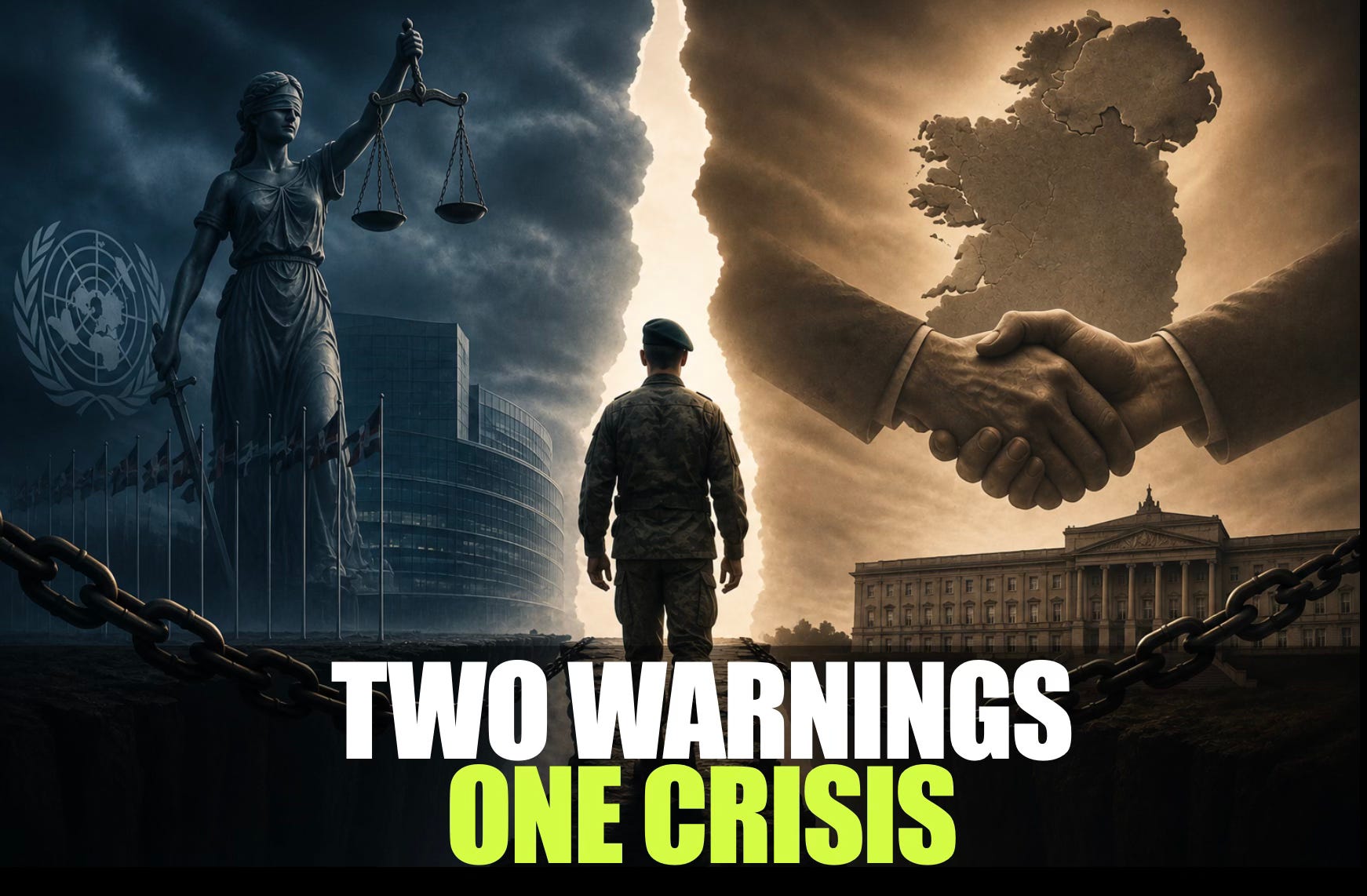
In the space of a few weeks, two significant pieces of writing have landed on the same problem from very different directions. One is a policy commentary published on 15 May 2026 by the Royal United Services Institute (RUSI), written by Sir Julian Brazier — a sober, analytical examination of the legal frameworks governing British forces overseas. The other, published earlier this month on JusticeforVeterans.uk, is a first-person essay by Dr Bob Parr MBE, a Royal Marine and UK Special Forces veteran and Oxford research fellow, titled The Longest Betrayal.
Neither piece is polemic for its own sake. Both are grounded in law, evidence, and the lived experience of those who served. And both arrive at the same uncomfortable conclusion: the British state has, over decades, constructed a legal environment that exposes its own servicemen and women to a standard it does not apply to their enemies — and shows little serious intention of changing that.
If you care about national defence, the rule of law, or the basic obligation a state owes to those it sends into harm’s way, both are worth your time. This post brings them together.
The Legal Tangle Overseas: What the RUSI Report Explains
Sir Julian Brazier’s RUSI commentary sets out a problem that has been quietly accumulating since 2011. For most of modern history, British forces operating abroad were governed by the Law of Armed Conflict (LOAC) — also known as International Humanitarian Law — rooted in the Geneva Conventions. These are rules designed specifically for the conditions of war: the chaos, speed, and moral weight of decisions made under fire.
That framework was disrupted by a European Court of Human Rights ruling in the Al-Skeini case, which extended the ECHR’s jurisdiction to cover the actions of the armed forces of signatory states, even when operating outside Europe. At a stroke, Human Rights Law (HRL) — a framework designed for peacetime policing, individual rights, and domestic governance — became a second set of rules that commanders and soldiers had to satisfy simultaneously.
The practical consequences were serious. By November 2021, civil payouts to individuals in Iraq and Afghanistan had reached £32 million. The UK saw a wave of lawfare — litigation, often funded and organised by firms like that of Phil Shiner, who was eventually struck off and given a suspended sentence for fraud in the pursuit of those very cases. Former Supreme Court Justice Lord Sumption described the ECHR as having “created havoc” by requiring compliance with regulations “designed for policemen turning in pickpockets at European police stations” in the context of handling captured Taliban fighters.
In November 2025, nine former four-star generals wrote to The Times warning that “every deployed member of the British Armed Forces must consider not only the enemy in front but the lawyer behind.” General David Petraeus, the former US commander in Iraq and Afghanistan, had said much the same in 2018: that Britain’s fighting capacity would be “greatly diminished” if it could not restore the primacy of the Law of Armed Conflict.
Parliament has attempted partial fixes. The 2021 Overseas Operations Act introduced a “triple lock”, making it harder (though not impossible) to prosecute veterans for historical overseas operations. But Brazier’s analysis shows why this falls short. Derogating from individual ECHR articles still leaves others — notably Article 2 (the right to life) and Article 7 (no punishment without law) — intact and justiciable before Strasbourg. The European Court, not British courts applying LOAC, remains the ultimate arbiter of whether a commander’s decision in a firefight was lawful.
His conclusion is stark: the only way to restore genuine confidence in the chain of command is a full withdrawal from the ECHR and the ICC’s jurisdiction over these matters, with them handled entirely within the British legal system under the Law of Armed Conflict.
The Betrayal at Home: What Dr Bob Parr’s Essay Adds
Where Brazier focuses on the overseas legal framework, Parr’s essay confronts what is happening on British sovereign territory — specifically, in Northern Ireland.
The Northern Ireland Troubles Bill currently before Parliament is presented as a vehicle for truth and reconciliation. Parr, who served in Northern Ireland for several years, argues it is neither. He describes a “ratchet” — each piece of legislation over three decades tightening the mechanism a notch further, each government assuring veterans that the settlement is fair, each settlement proving, in practice, to be a further accommodation of those who once tried to destroy the state those veterans defended.
The 2023 Legacy and Reconciliation Act had imposed real constraints: it barred conventional police investigations into Troubles-era incidents, channelling them instead through the ICRIR. The new Bill, Parr argues, repeals those constraints — reopening the door to criminal investigations of security force veterans through a new Legacy Commission whose independence has yet to be tested.
But the passage in Parr’s essay that deserves the widest possible audience concerns the Republic of Ireland’s statutory role in this process. Buried in Part 6 of the Bill, the Independent Commission on Information Retrieval (ICIR) is defined as a body established by an agreement between His Majesty’s Government and the Government of Ireland. Under the Bill, the ICIR must report annually to both governments simultaneously. The Secretary of State must consult the Government of Ireland before making regulations governing the destruction of ICIR records.
This is not a procedural footnote. It means a foreign sovereign government — one whose historical relationship with republican paramilitaries is documented in official inquiries, including the Barron Reports and the Arms Crisis of 1970 — holds a formal, co-equal statutory role in overseeing the accountability processes for British soldiers who served on British territory.
Parr’s point is not that this is the product of conscious malice. His argument is more damning than that: that successive governments, Conservative and Labour alike, made rational political calculations in which veterans’ legal exposure was an acceptable price to pay. Veterans, unlike paramilitaries, have no electoral bloc, no friendly neighbouring government, and no decades-long litigation infrastructure. They had no leverage. So they were traded.
The Connecting Thread
These two pieces address different theatres and legal mechanisms, but the underlying pattern is the same.
In both cases, British service personnel face legal accountability through frameworks they did not ask for, designed by bodies with no stake in the operational realities those personnel faced, operating under political conditions shaped by interests other than their own. In both cases, partial legislative fixes have been offered and found wanting. And in both cases, the warnings from senior figures — generals, judges, academics, veterans — have been noted and largely set aside.
Brazier ends his RUSI piece with a simple observation: “The UK owes a great deal to those it places in harm’s way. Protecting them from legal action by foreign bodies after they have served in war should surely be part of the repayment of that debt.”
Parr ends his with a prophecy: “A state that trades its soldiers is a state that has forgotten what soldiers are for. And a state that has forgotten what soldiers are for will, in due course, find itself without them.” He points to the current exodus of personnel from Special Forces as evidence that this is already happening.
Both pieces are worth reading in full.
Sir Julian Brazier’s RUSI commentary: Military Action Under Lawfare: Conflicting Codes Impede Decisions(15 May 2026)
Dr Bob Parr’s essay: The Longest Betrayal, Justice for Veterans (5 May 2026)
If you found this useful, please share it. These arguments deserve a wider hearing than they currently get.
What has happened to professional soldiers that took the Queens shilling and served with honour? From the outside looking in, it is a scandal. I see soldiers persecuted for their duty to the crown, however the politicians and law agencies also played there part in the operations and seem to be immune to similar prosecution. There is an hierarchy of decision making and it seems to me that the blame game goes to the bottom of the food chain, where it should be at the top. The difference is about responsibility which soldiers are trained to be responsible the rest just use obfuscation to avoid it. It’s not going to get those recruiting figures up. Or is this the plan to destroy the defence of armed forces and show the world how stupid we are. This I believe is political and no matter how much the PM says what we are doing, it’s all false. Enough of me this rant is over.
The motto of the ECHR should be, “Rubbish in, rubbish out.” In parallel, the idea that if you sat a chimpanzee at a piano for long enough, it would eventually become a star in Beethoven’s first Piano Concerto is preposterous. Anyway, if you have the stamina, Jonathan Sumption’s Spectator article, equating pickpockets and the Taliban, 'Judgment call: the case for leaving the ECHR', is on this link https://spectator.com/article/judgment-day-the-case-for-leaving-the-echr/ If you don’t want to read it, three extracts:
# “One point should be made at the outset and never overlooked: we do not need the European Convention on Human Rights in order to protect human rights. Many of the rights which the convention proclaims were part of British law long before the convention was conceived. There is nothing in it that we cannot enact by ordinary domestic legislation. We can have whatever rights we want if there is a sufficient democratic mandate for them. The real purpose of the convention is to make us accept rights which we may not want and for which there maybe no democratic mandate.”
# “the ECHR is the sole judge of its own jurisdiction. It can and does help itself to whatever additional powers and jurisdictions it likes.”
# “the court (Strasbourg) claimed jurisdiction over British military operations overseas in places such as Iraq and Afghanistan. At one point it created havoc by ruling that there was no right to detain captured Taliban fighters as prisoners of war without complying with regulations designed for policemen turning in pickpockets at European police stations.”
It has become a complete can of worms that lawyers, likely as not, can only make worse. an example is in the newsletter; "Under the Bill, the ICIR must report annually to both governments (London and Dublin) simultaneously. The Secretary of State must consult the Government of Ireland before making regulations governing the destruction of ICIR records."