


BY DR ROBERT PARR*
The Northern Ireland Troubles Bill currently before Parliament is presented as a mechanism for truth and reconciliation. It is neither. It is the latest manoeuvre in a thirty-year political retreat — one that reopens the door to criminal investigations of security forces veterans, and does so through a framework designed and operated in formal partnership with a foreign sovereign power that has a declared political interest in the outcome.
I am not speaking abstractly. I served in Northern Ireland for several years. The men I served with — some now in their sixties and seventies, some dead — operated under lawful command, within defined rules of engagement, in a theatre where the state’s enemies were actively trying to kill them. They served the Crown. The Crown has a duty to them in return.
What they have received instead is a ratchet — each legislative iteration tightening the mechanism a further notch, each government assuring veterans that this time the settlement is fair, each settlement proving, in practice, to be a further accommodation of those who once sought to destroy the very state these veterans defended.
The Architecture of Asymmetry
The 2023 Legacy and Reconciliation Act imposed meaningful constraints: it barred criminal investigations into Troubles-related incidents by any body other than the ICRIR, and placed broader restrictions on prosecutions, civil claims, and inquests. For veterans, the practical effect was significant — it removed the threat of conventional police investigation. The new Bill repeals those constraints.
Section 88 removes the restriction on police-conducted criminal investigations, substituting a new Legacy Commission — a body whose independence and insulation from political pressure has yet to be established, and whose operating environment was shaped by negotiations in which veterans had no seat at the table.
Republican paramilitaries enter this environment with advantages no veteran can match. They have Sinn Féin — a party of government in both jurisdictions — providing political direction. They have thirty years of aligned legal infrastructure: NGOs, case files, Strasbourg litigation, and a collective narrative tightly managed and politically protected.
Veterans have regimental associations, some underfunded charities, and a government that has demonstrated repeatedly it will trade their legal exposure for political expedience.
The asymmetry is not incidental to the Bill’s design. It is load-bearing.
Since When Did Dublin Get a Vote?
Here is the question nobody in Westminster appears willing to ask aloud: at what point did the Republic of Ireland acquire legitimate standing to influence the prosecution environment for soldiers of the British Crown?
The answer is buried in Part 6 of the Bill. The Independent Commission on Information Retrieval — the ICIR — is defined in Section 72 as a body established by an agreement between His Majesty’s Government and the Government of Ireland, concluded in Belfast on 15 October 2015. Under Section 83, the ICIR must report annually to both governments simultaneously. The Secretary of State must consult the Government of Ireland before making regulations governing the destruction of ICIR records.
Read that again. A foreign government has a formal, statutory, co-equal role in the oversight of a body that handles information about deaths caused — and suffered — by British security forces on British sovereign territory.
The Republic of Ireland is not a disinterested party. The Arms Crisis of 1970 established that elements of the Irish cabinet were involved in arms procurement for Northern nationalists. The Barron Reports documented Garda failures that materially benefited republican paramilitaries. For decades, Irish courts declined to extradite IRA suspects on political offence grounds, providing the sanctuary British justice could not reach. These are not allegations — they are findings of official inquiries and matters of public record.
A foreign government with that history now holds statutory co-equal oversight of accountability processes for British soldiers. That fact deserves to be stated plainly.
Those who served in South Armagh, Belfast, and Londonderry were deployed under Crown authority, answerable to British law, operating within a chain of command that ran to Westminster. Their legal accountability is a matter for British courts, British law, and British constitutional process. That a foreign government has been accorded statutory standing to shape the framework within which those personnel now face investigation is an affront to the most elementary principle of sovereignty.
What This Actually Is
Let me be precise, because precision matters here.
I am not alleging that this Labour government consciously set out to destroy the men who served it. Malice is too simple an explanation. What I am alleging is something more insidious: that successive governments — Conservative and Labour alike — have made a series of rational political calculations in which the legal exposure of veterans was an acceptable cost. Those calculations were made easier by the fact that veterans, unlike paramilitaries, have no electoral bloc, no friendly government in a neighbouring state, and no thirty-year litigation infrastructure to make the cost of betrayal prohibitive.
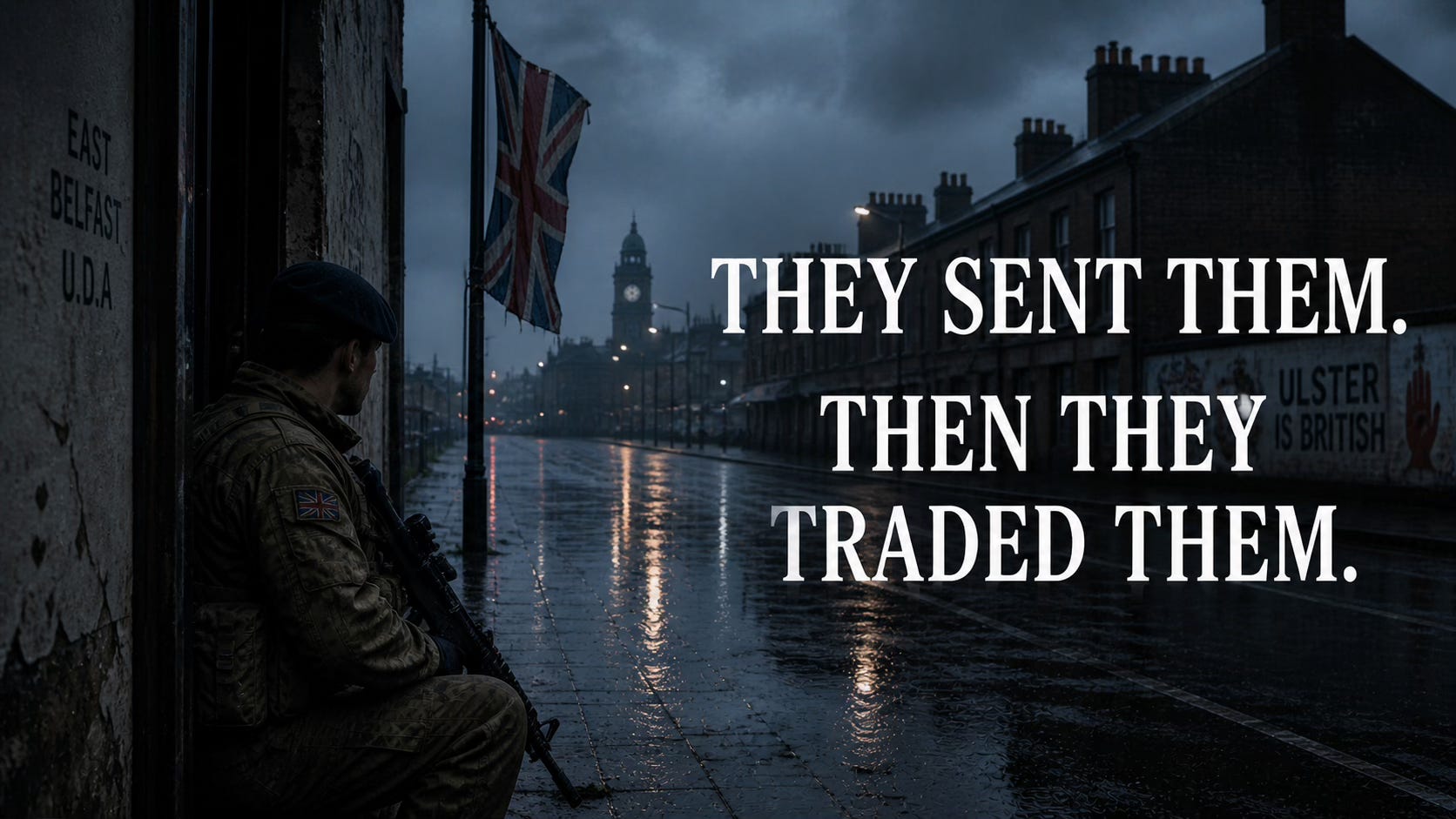
They were, in the cold language of political economy, without leverage. And so they were traded.
The Northern Ireland Troubles Bill is the most recent expression of that trade. It does not protect veterans. It processes them — contains their grievance within a structure designed to exhaust rather than resolve, while providing the government with the appearance of having acted.
The British Government deployed these men. The British Government directed them. The British Government prosecuted the conflict that soldiers fought on its behalf. The debt that was created does not expire. It does not become negotiable because the passage of time made honouring it inconvenient.
A state that trades its soldiers is a state that has forgotten what soldiers are for. And a state that has forgotten what soldiers are for will, in due course, find itself without them.
That is not a threat. It is a prophecy. And it is one we are already watching come true — not least in the current exodus of personnel from our Special Forces, a strategic haemorrhage that should alarm every defence planner and every parliamentarian who claims to take national security seriously.
* Dr Robert Parr MBE AKC is a Visiting Research Fellow at the Changing Character of War Centre, Pembroke College, University of Oxford. He served for 25 years in the Royal Marines, UK Special Forces, and National Intelligence. He can be found on LinkedIn.
This is an edited version of Dr Parr’s essay, The Long Betrayal. The full version can be downloaded here:

Yes, I agree with the thrust of the article, and I agree fully the comment by Dick Hallem. There is a further point. That is that each government in power differs from its preceding one in terms of perspectives and relationships with other nations. This current government is exactly the same in broad terms, but it has commenced its period in office determined to undo the legacy of its predecessor like no other - seeking vengeance, in other words. Coupled with Starmer’s vain-glorious attempt to be known as an internationalist, more likely a tool thereof, he has deliberately used his legalistic background to alter conventions that have been the cornerstone of the UK. There are many examples but one of these is the standing of HM Armed Forces in the face of so-called ‘Human Rights’ international law. To him, such laws trancends the practicalities of pursuing historic events. To him, there is no case for proportionality or what has been past convention. If there is a target to be held answerable because of written or imagery ‘evidence’, that target is to be pursued remorselessly. If there are no such records, then there is no target. And this is where the void between the forces of good and those of civic evil is the crux of justice and proportionality. Starmer is incapable of balanced judgement; he is incapable of understanding practicalities, he does not demonstrate the higher qualities of leadership,, he is nationally unpopular, he is doomed to failure.
The next government will need to rapidly undo the damage Starmer and his acolytes have wreaked upon those who did their duty to this Nation.
Betrayal of veterans is treason.