

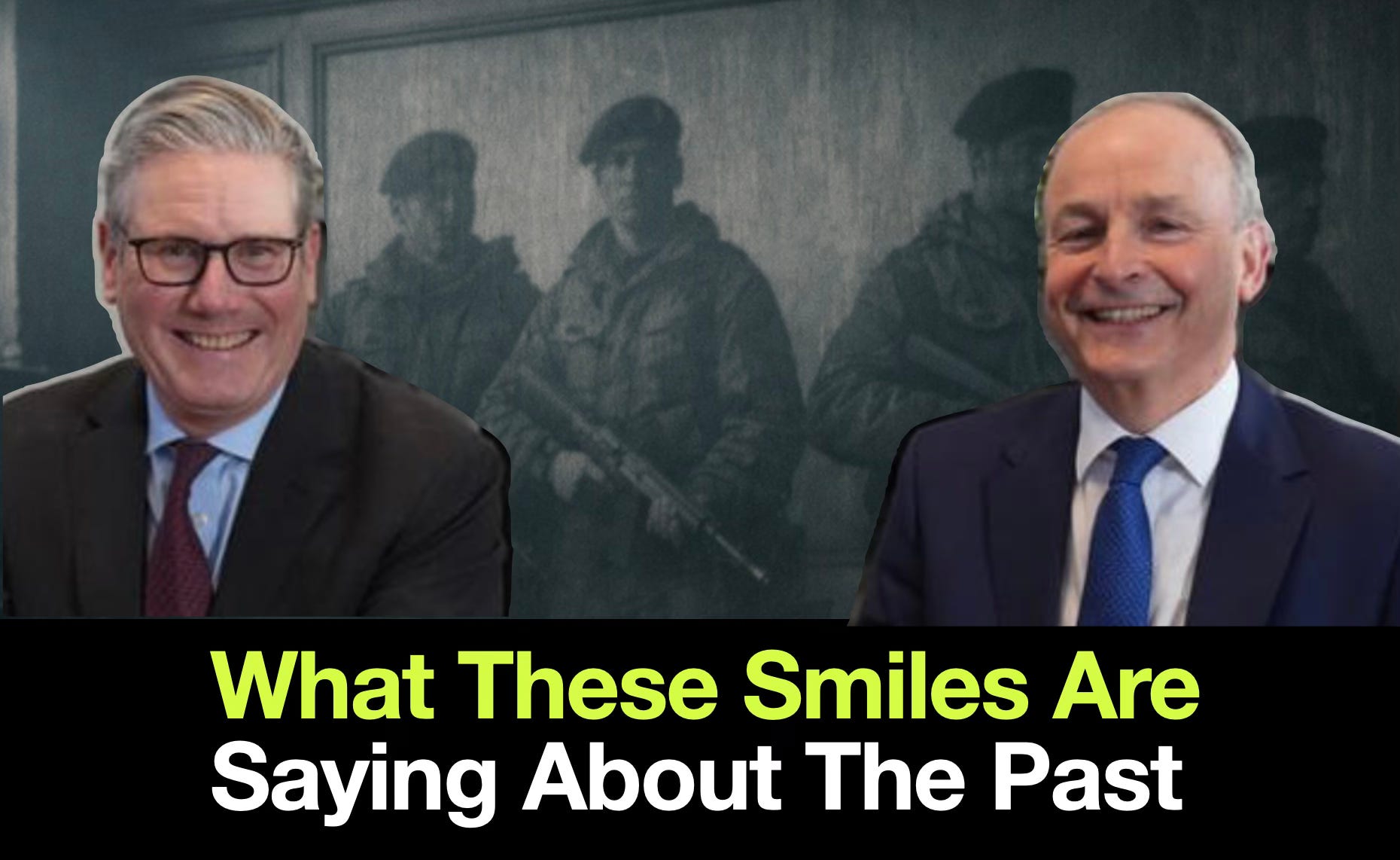
When Keir Starmer and Taoiseach Micheál Martin concluded their joint summit in Cork on 13 March, the communiqué they produced was given the kind of title governments reach for when they wish to suggest both sentiment and gravity: “Shared Prosperity, Shared Seas, Shared Ties.” The press dutifully ignored most of it, being more interested in the optics of two centre‑left leaders looking statesmanlike on the banks of the Lee. But buried in point five – under the heading “Shared Ties” – was a sentence that ought to concentrate the minds of every veteran of the Northern Ireland campaign, and every MP who claims to speak for them.
The two leaders declared that they “welcome the agreement reached since our last summit on a Joint Framework on Legacy marking essential and significant progress on this most difficult of issues,” and pledged to “continue implementation, including through legislation in both the UK and Ireland.” Strip away the diplomatic upholstery and the meaning is plain enough: the Troubles Bill is going ahead, Dublin has been given its assurances, and anyone who imagined that a change of government might mean a change of direction has been quietly disabused.
A framework built on whose priorities?
Ministers present the Joint Framework on Legacy as a humane and overdue reckoning with the past. What it actually represents is a bilateral legal architecture designed, in large measure, to satisfy Dublin, to placate the human‑rights lobby, and to provide the mechanisms by which former members of the security forces can be hauled before investigators decades after the events in question.
The 2023 Legacy Act – imperfect as it was, and it had genuine flaws – at least contained a conditional immunity scheme that offered some protection to those who cooperated with the truth‑recovery process. That immunity provision was the principal reason veterans’ groups gave the Act a cautious welcome. It was also, not coincidentally, the provision that most exercised Dublin, the Irish human‑rights bar, and the network of legacy lawyers whose livelihoods depend on the continued prosecution of historical cases. The new Framework scraps it. Immunity is repealed. Inquests that had been frozen are to resume under reworked rules. A new Legacy Commission – with expanded investigative powers – will take the field.assets.publishing.service.
The government presents the removal of immunity as a concession to victims. In practice, it is a concession to lawfare. One foreseeable beneficiary of a system with no immunity, expanded investigative reach, and cross‑border cooperation mechanisms is not the families of Troubles victims. It is the solicitor class that has turned historic allegations into a permanent industry.
What Dublin gets
It is instructive to consider what Ireland has secured from this arrangement, and what it has conceded.
Dublin gets: the repeal of the immunity provisions it most objected to; a reformed Legacy Commission with powers it can work with; UK legislation constructed to answer Irish and ECHR‑based human‑rights objections; and – perhaps most valuably – the political optics of being treated as an equal partner in the governance of Northern Ireland’s past. Micheál Martin’s description of the Framework as a “generational opportunity” was not being modest. He knows what has been agreed.
Ireland concedes: a dedicated Garda legacy unit, some ring‑fenced funding, and a commitment to legislate in its own jurisdiction to facilitate cross‑border cooperation. These are not trivial obligations, but they are hardly symmetrical with what the UK has given away. There will be a Legacy Commission with teeth for British soldiers and police; there will be no equivalent tribunal with the same statutory reach and focus for the Garda or Irish state actors. The Garda’s role in some of the darker episodes of the Troubles period – collusion allegations, the Dublin and Monaghan bombings, the handling of informants – is not the subject of any parallel investigative architecture.
The veterans of the Ulster Defence Regiment, the Royal Ulster Constabulary, the Parachute Regiment, and the dozens of other units who served in Northern Ireland will be investigated by a body whose creation was negotiated, in part, to satisfy the government of a country that has faced no equivalent scrutiny of its own conduct.assets.publishing.
Starmer’s calculation
Whatever the rhetoric about victims and reconciliation, Cork was never primarily about doing right by the families of the fallen. Starmer came to Cork because the summit served several overlapping political purposes simultaneously, and the Troubles Bill is only one of them.
The broader pattern of the summit – shared seas agreements, energy cooperation, the emphasis on deep bilateral frameworks – represents Starmer’s preferred method of conducting what is, in effect, a managed rapprochement with EU‑adjacent structures without ever having to use the word “Europe.” Ireland is an EU member. When the UK legislates in parallel with Ireland, aligns its investigative procedures with Irish requirements, and creates joint commissions whose operational standards are shaped by European human‑rights norms on the Dublin side, it draws itself incrementally back into a web of regulatory interdependence. Not formally. Not loudly. But structurally.
And as so often since Brexit, it is those who served who are being used as the currency of that quiet rapprochement. The legacy Framework is, in this sense, a prototype. It establishes the principle that UK domestic legislation in sensitive areas should be developed in consultation with Dublin, shaped by Irish requirements, and structured so that unilateral divergence is politically and legally costly. Once that principle is embedded in statute – and it will be, when the Troubles Bill passes – it becomes a precedent. Future governments that wish to diverge will find themselves doing so against a framework deliberately constructed to resist easy unilateral deviation.
If you look at the pattern of his decisions, one conclusion is hard to avoid. This is not an accidental by‑product of Starmer’s Northern Ireland policy. It is a feature of it.
The veterans in the room nobody mentions
Through all of this – the summits, the frameworks, the carefully worded joint statements – the people whose lives are most directly affected are receiving the least consideration.
A soldier who served in South Armagh in 1972 is now in his seventies. He served under the legal rules of engagement that existed at the time. He may have given evidence to previous inquiries. He may have cooperated in good faith with the existing processes. Under the new arrangements – no immunity, a reinvigorated commission, restored inquest powers, cross‑border mechanisms for gathering evidence – he faces the prospect of renewed investigation, potential prosecution, and the entire apparatus of lawfare being brought to bear on decisions made half a century ago in conditions that no Legacy Commission sitting in comfortable offices will ever fully comprehend.
Ministers will point to their much‑touted “protections” for veterans – higher thresholds for re‑investigation, remote testimony, advisory panels and the like. On paper, it sounds reassuring. In practice, it changes nothing about the core reality: a seventy‑year‑old veteran can still find himself dragged back into the dock for split‑second decisions taken half a century ago. Veterans have heard variations of the “rare prosecutions” argument before. They have also watched as a series of pledges to protect former service personnel were quietly abandoned when political inconvenience demanded it. There is no particular reason to believe that this time will be different, and rather a lot of reasons – structural, legal and political – to believe it will be worse.
What comes next
The next Commons stage of the Northern Ireland Troubles Bill is scheduled for 24 March and, on all current indications, will proceed. The government’s majority is sufficient. The Cork summit has made any significant reversal politically costly – to walk back now would mean renegotiating a framework to which both governments have publicly recommitted, and risking the kind of diplomatic rupture that Starmer’s entire Irish strategy is designed to avoid.
Those who wish to amend the Bill – to restore meaningful protections for veterans, to limit the commission’s prosecutorial reach, to ensure that genuine safeguards accompany any reinstatement of inquest powers – have a narrow window in which to press their case. After 24 March, it narrows further. Conservative and unionist MPs who claim to stand with veterans should prove it in the division lobbies, not in sympathetic tweets.
The veterans of the Troubles did not choose to serve in a dirty, complicated, morally ambiguous conflict in which the state’s enemies were frequently indistinguishable from the civilian population. They served because they were asked to. The least the state owes them is legislation that does not, half a century later, place them at the mercy of a legal process that has been designed, in large measure, to satisfy everyone except them.
Cork was a pleasant summit. The communiqué was elegantly worded. Point five, however, was a declaration of intent – and veterans should read it as such. If you served in Northern Ireland – or if someone you love did – this is the moment to tell your MP that “lawfare by another name” is not what you were promised.
I would never ever have believed that in my lifetime, which started as a British Army Brat and continues into my 83rd year a very angry British Army Veteran, that I’d read a headline such as this … "Labour's lawfare has broken British army morale".
It heads an article in the Spectator dated 14 March 2026. The author goes on to report..."In the fortnight since America and Israel launched their attack on Iran, much has been said and written about the respective merits of France’s and Britain’s military. A headline in this week’s Daily Telegraph ... asked: ‘Britain spends billions more than France on defence, so why is the French military superior?"
The answer it seems lies in the final two paragraphs of the story: "There have been allegations of civilian deaths levelled at French soldiers serving in Africa in the last decade, accusations that stemmed from war’s moral disorder. It was the word of insurgents against the word of French soldiers. In such cases France – to paraphrase Emmanuel Macron – always stands with its soldiers.
The French special forces soldier told me that ‘in a democracy such as France, soldiers accept to risk their lives’. In exchange, he said, the state has a moral obligation ‘to protect them in the event of accusations related to the performance of their duties. This moral contract is at the heart of military loyalty and discipline.’
Keir Starmer’s government has broken this contract, and in doing so it has broken the morale of the British military." ... 🤨
A weak man appeasing a deeply unpleasant government headed up by a deeply unpleasant premier with links to deeply unpleasant auxilliaries, namely the IRA and Sinn Fein, is nauseating.