

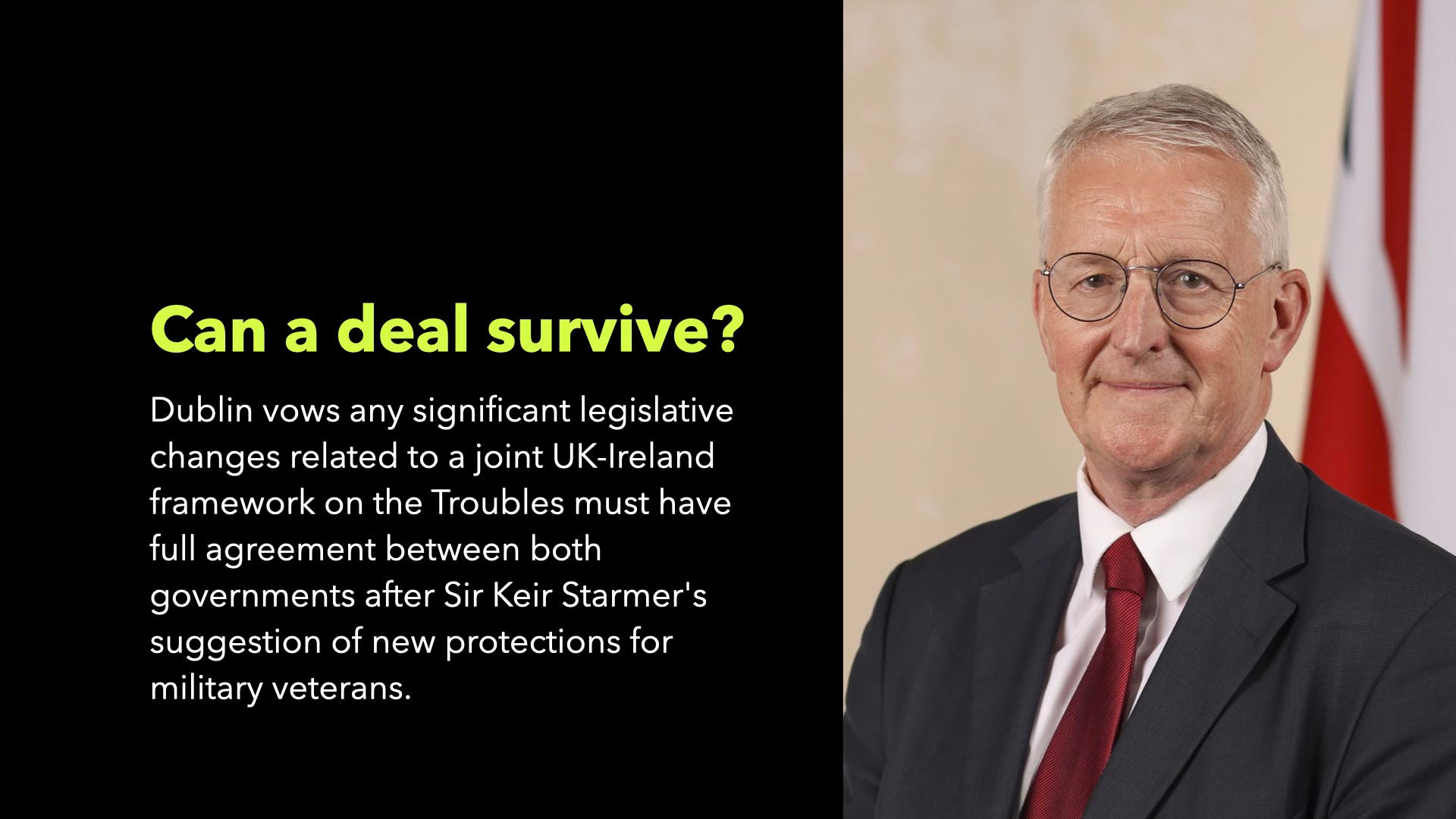
The Northern Ireland Secretary, Hilary Benn, will emphasise the “huge importance” of Ireland sharing information related to the Troubles legacy investigations during his visit to Dublin.
Benn is set to meet with Irish Foreign Minister Helen McEntee and Justice Minister Jim O’Callaghan today. In January, Minister McEntee stated that any significant legislative changes related to a joint UK-Ireland framework on the Troubles must have full agreement between both governments. This follows UK Prime Minister Sir Keir Starmer’s comments suggesting new protections for military veterans.
The joint framework on legacy, unveiled by London and Dublin last September, sets out measures to address historical cases from the Northern Ireland conflict. The framework includes commitments to overhaul the structures established by the previous Conservative government’s Legacy Act, notably removing a provision that offered conditional immunity to perpetrators of Troubles crimes.
The Irish government has pledged to offer the “fullest possible” cooperation with the new legacy commission and to establish a dedicated legacy unit within An Garda Siochána, the Irish police force.
However, Sir Declan Morgan, chief commissioner of the Independent Commission on Reconciliation and Information Recovery (ICRIR), which investigates Troubles crimes under the Labour government’s reformed Legacy Act, has stated that the ICRIR currently lacks formal information-sharing arrangements with Irish authorities.
Ahead of his Dublin visit, Benn said both governments are making significant progress in fulfilling their respective commitments. Benn added, “The sharing of information by the Irish authorities is vital for legacy investigations, including the Omagh bombing inquiry.”
Benn highlighted the strong relationship between the UK and Ireland, grounded in shared interests and values, and the mutual commitment to the Good Friday Agreement.
Veterans, however, have a different view of the Republic of Ireland’s covert role in sustaining the IRA during the Troubles, and highlighting how the border between Northern Ireland and the Republic functioned as a sanctuary for IRA operations.
A special report by veteransforjustice.uk details how the Republic’s early permissiveness, combined with limited cooperation between Irish and British security forces, enabled the IRA to regroup, plan, and execute attacks across the border.
Although Ireland’s stance shifted over time, the IRA had already gained a significant operational advantage, which continues to affect legacy debates and trust between veterans and the Irish state.
Well he can ask why did the garda allow PIRA terrorists through their borders where we could not go and arrest them. They did not even hand them back when on hot pursuit after them.
Capture of Ireland's political and cultural estates by terrorists significantly lengthened the war and increased the death toll.