

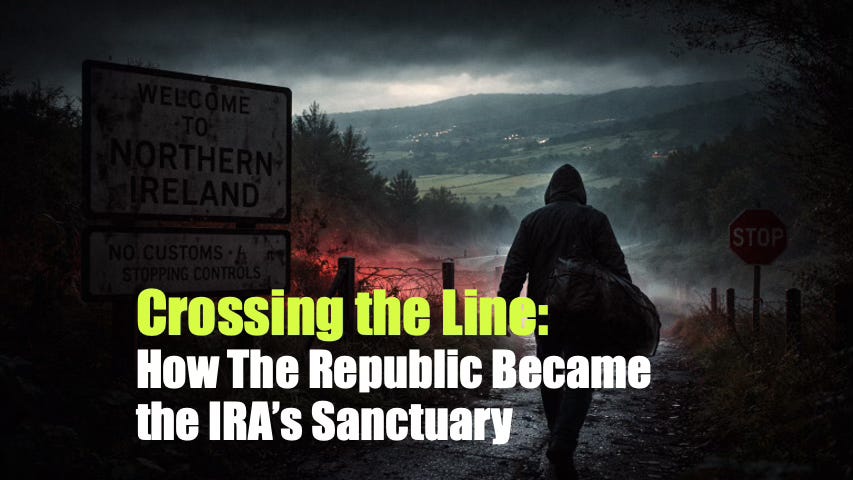
Much is now made of the “huge importance” of Ireland sharing information under the UK Government’s Troubles legislation by Hilary Benn, Secretary of State for Northern Ireland, and his counterparts in Dublin. In principle, cooperation is welcome. But any post-conflict framework that expects frank disclosure from former soldiers while remaining opaque about the Republic’s own role during the thirty-year insurrection risks lacking credibility from the outset. This is not an attempt to refight old battles. The stated purpose of the legacy process is reconciliation and stability for the future. Yet reconciliation rests on reciprocity. If one side of a divided history declines to account for its part, confidence in the process will inevitably be fragile.
For decades, the Provisional IRA had a strategic advantage that most insurgents could only dream of: a neighbouring state, officially neutral, that provided legal shelter, political cover, and a sanctuary for its operations. That state was the Republic of Ireland. While Dublin condemned violence in Northern Ireland, its policies often allowed the IRA to function with unprecedented freedom, providing a sanctuary that became crucial to the movement’s endurance.
The border between Northern Ireland and the Republic was not just a geographic line—it was the critical element that allowed the IRA to regroup, escape, and continue operations. This sanctuary was not a theoretical concept for those who served in Northern Ireland—it was a painful reality. Attacks could be planned in one jurisdiction, executed in another, and followed by a quick retreat into a territory beyond the reach of British law enforcement.
Dublin’s official stance, dating back to Taoiseach Jack Lynch, was to condemn violence in the North. However, this was complicated by actions such as Lynch’s 1969 announcement of “field hospitals” along the border, which, while not explicitly supporting the IRA, signalled sympathy for nationalist communities. The Extradition Act of 1965, which included a broad “political offence” exemption, allowed many IRA members to evade extradition to Britain, contributing to the perception of impunity felt by many who served.
On the ground, the border created a permissive environment for the IRA. In the early 1970s, checkpoints were sparse, and cooperation between the Garda Síochána and the Royal Ulster Constabulary was often slow and fraught with tension. IRA units could retreat into the Republic after an attack, beyond the reach of British law enforcement. Safe houses and logistics operations were set up in southern Ireland, where British forces had no jurisdiction. The result was a sanctuary that allowed the IRA to survive during some of its most difficult years.
For many veterans, this wasn’t just a matter of politics; it was about the reality of cross-border operations. IRA volunteers could retreat to the Republic, where political and legal constraints often rendered British forces impotent. This created a profound sense of asymmetry and frustration. While British soldiers and police were under intense scrutiny, those involved in IRA operations operated with relative safety, protected by a system that neither sought nor fully enforced accountability.
As the conflict progressed, Dublin’s approach began to shift. The Irish government came under increasing external pressure to do more to combat terrorism, while internal shock from bombings and attacks within the Republic itself led to a reassessment of the threat posed by the IRA. Changes to the legal framework, such as the narrowing of the “political offence” exemption in the Extradition Act and the Criminal Law (Jurisdiction) Act of 1976, sought to reduce IRA members’ ability to evade extradition. However, the impact of these measures was limited and rarely used.
While Dublin’s position appeared to soften over time, for example, with the 1985 Anglo-Irish Agreement, by then, the IRA had already taken full advantage of the Republic’s initial permissiveness. The earlier years of sanctuary had allowed the IRA to regenerate, plan, and regroup on southern soil, making later cooperation somewhat ineffective in reversing the operational advantage the IRA had gained.
The current political landscape often echoes the past. The UK government’s abandonment of the Legacy Bill, enabling inquests, and continued amnesty provisions for terrorists while soldiers face prosecution for split-second decisions are seen by veterans as signs of historical appeasement. They perceive these actions as continuing the same trend that allowed the IRA to thrive. The government’s failure to adequately address the unique role the Republic of Ireland played in sustaining the IRA’s operations is one of the most contentious issues in the debate over legacy and accountability.
While Dublin did not officially support the IRA, its policies and actions often provided the movement with the legal and operational sanctuary it needed. The IRA knew it could rely on the Republic as a rear base, where it could regroup, train, and continue its campaign with minimal interference. This was not passive support—it was a significant factor in the IRA’s ability to sustain its operations throughout the conflict.
In retrospect, the question is not whether the Republic of Ireland was complicit, but whether its policies allowed the IRA to survive and regenerate in ways that would have been impossible without such sanctuary. The issue of trust remains central to the debate, as many veterans continue to feel that Dublin’s actions during the conflict have never been fully acknowledged or addressed.
DOWNLOAD FULL SPECIAL REPORT HERE:

Hello again brothers and sisters in arms. What a load of malarkey! Yet again these idiots "The Government" and other politicians, can "Talk The Talk," but will not "Walk the Walk!" Benn using the Ploy of "sharing information with Eire on the Troubles?" The IRA and other terrorist sub-units are active and always will be for the foreseeable future! They're just not totally "operationally active" at this time. There will always be a requirement for a military presence in Northern Ireland, and people will die! Unfortunately, that's "the nature of the beast!" Soldiers being fired upon, will kill armed terrorists who don't surrender. That's common sense and self preservation! "We Serve, We Fight, and We Protect!" I say again to Starmer, his Cronies, and all the other Self-seeking Wolves, who are trying to "injure" our veterans and our Military Establishment. Leave your agendas and arrogance at home, and do what's respectful and right for us veterans and your fighting forces! BenN