

John Larke has spent a lifetime in public service. During his civilian career, John Larke spent 40 years working in government — nationally and locally. Alongside this, he served for 40 years in the Territorial Army, including 21 years with 21 SAS (Artists Rifles), later commissioning as an officer and reaching the rank of Lieutenant Colonel.
That combination gave him a rare perspective.
He understood government from inside the system, while also understanding the experience of those who have served. When concerns emerged within the veteran community about the Northern Ireland legacy legislation, he brought those experiences together.
His approach was simple:
Veterans should not assume that writing a letter is the only way to be heard.
They should engage directly with those who represent them.
Why meeting MPs matters
When legislation is debated in Westminster, MPs receive briefings, ministerial advice and party information.
Those things are part of the democratic process.
But they are not the same as hearing directly from people who have lived the consequences of the decisions being discussed.
John’s experience was that personal engagement could change understanding.
When veterans were encouraged to write to their local MPs, he suggested something different: that a small group should meet representatives face to face.
The purpose was not confrontation.
It was conversation.
A meeting allows veterans to explain not only what they believe, but why they believe it.
Preparation is vital
The Cornwall group did not simply arrange meetings and arrive with concerns.
They prepared.
They looked at the skills and experience within their group and brought together people who could explain different aspects of the issue. The eventual group, which became known as the “Fighting Patrol”, included veterans with operational experience, people able to discuss the effects of service on mental health, and individuals able to understand the legal issues involved.
John’s advice is straightforward:
Keep it focused.
Understand the issue.
Prepare what you want to say.
A meeting with an MP is not an opportunity to deliver a lecture. It is an opportunity to ensure that a representative understands the concerns of their constituents.
Persistence is part of the process
Veterans sometimes assume that if an MP does not respond immediately, engagement has failed.
John’s experience suggests otherwise.
Some MPs initially did not respond to requests for meetings. Rather than abandoning the effort, the group continued to make contact, explaining that local constituents wanted the opportunity to discuss their concerns directly.
Eventually, those efforts succeeded.
Democratic engagement requires persistence.
Respectful persistence.
But you may need to keep punching the bruise.
Local government: the bridge between communities and Westminster
One of the most important lessons from Cornwall was that Westminster is not the only place where citizens can make their voices heard.
Local government matters.
John Larke recognised that while the Northern Ireland legacy debate was ultimately a matter for Parliament, it was also an issue affecting communities across the country. He therefore looked beyond Westminster and engaged with the local democratic structures that already existed.
He approached the councillor responsible for veterans’ affairs, explained the concerns surrounding the legislation and helped provide the background information needed for the issue to be considered locally. The result was that Cornwall Council debated the matter and passed a motion expressing concern, with the council leader subsequently writing to the Secretary of State for Northern Ireland.
Read more about Cornwall Council:
Cornwall Council backs veterans’ call for action over Legacy Act repeal
Government Responds to Cornwall Council’s Veterans’ Legacy Concerns
This goes beyond the immediate issue.
The current political debate about decentralisation — including the commitment to move power away from Westminster and strengthen the role of regions and communities — raises an important question.
If communities are to have a greater voice through devolved decision-making, then local democracy must be more than the administration of services.
It must also provide a route through which citizens can raise concerns, influence debate and ensure that local experiences inform national decisions.
The legacy issue, therefore, provides a practical test of that ambition.
Can a veteran, or any citizen, raise a concern locally and see that concern travel through the democratic system?
The answer matters because local representatives are not separate from Westminster. Councillors engage with MPs, councils communicate with ministers, and local concerns can become national issues.
John Larke’s experience demonstrates how this process can work.
The lesson is not that councils should become political campaign organisations.
It is that effective decentralisation depends on active citizens and representatives who are prepared to listen.
Engagement is not activism
There is an important distinction.
A veteran who contacts an MP or councillor is not automatically becoming a political activist.
They are acting as a citizen.
They are explaining their experience, asking questions and ensuring that elected representatives understand the consequences of decisions.
John’s own approach reflects this. He describes himself as someone who wanted to influence outcomes rather than seek recognition. If something changed, the important thing was the result — not who received credit.
That principle is important.
The objective is not to create a veterans’ political movement.
It is to ensure that those who have served remain part of the democratic conversation.
What can veterans do?
John’s advice is practical.
First: Ppeak to others.
A small group with different experiences and skills can often achieve more than individuals acting alone.
Second: Engage locally.
Contact your councillor and your MP. Explain your concerns and ask them to listen.
Third: Prepare.
Understand the issue. Read the debates. Know what has been said. Be ready to explain your concerns clearly and calmly.
Democracy depends on participation
The lesson from Cornwall is not that every veteran must become a campaigner.
It is that democratic systems only work when citizens engage with them.
John’s experience challenges the idea that individual action is pointless. As he explained, while some may believe engagement will make no difference, his own experience showed that sustained, informed engagement can influence how representatives understand an issue.
Change rarely comes from one letter or one meeting.
It comes from people taking the time to explain, listen and persist.
Veterans do not need to become politicians.
They simply need to remain citizens.
ACE your engagement
Meeting an MP or councillor is not about delivering a political campaign script.
It is about explaining, clearly and respectfully, why an issue matters to you and why your elected representatives should understand it.
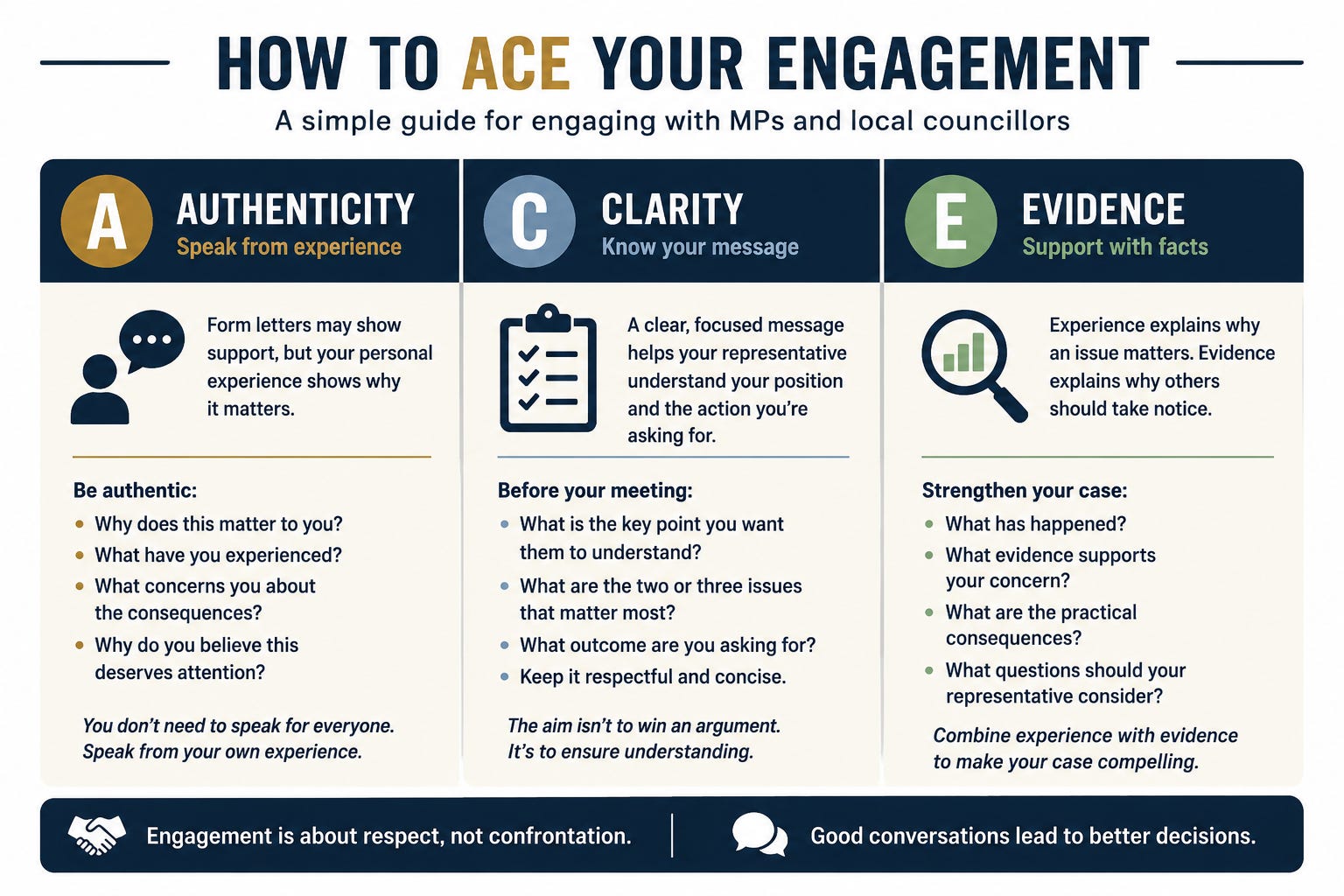
A useful way to think about engagement is ACE:
A — Authenticity: Speak from experience
The strongest voices are authentic ones.
A form letter may show that many people share a concern, but it rarely explains why the issue matters to an individual.
An elected representative will receive many standardised messages. What stands out is a constituent who can explain:
Why does this matter to me?
What have I experienced?
What concerns me about the consequences?
Why do I believe this deserves attention?
A veteran does not need to speak on behalf of everyone who has served.
They need to explain their own experience and why they believe it matters.
Personal testimony cannot be dismissed as simply another campaign message.
C — Clarity: Know what you want to say
A meeting with an elected representative is not the time to discover your argument.
Before attending, decide:
What is the key point I want them to understand?
What are the two or three issues that matter most?
What outcome am I asking for?
Keep the message focused.
Respectful disagreement is part of democracy. The aim is not to win an argument in the room; it is to ensure that the representative understands your position and the reasons behind it.
As John Larke found, preparation matters. The Cornwall group planned their presentation, considered the strengths within their team and ensured that each person contributed their own area of knowledge.
E — Evidence: Support your case with facts
Experience explains why an issue matters.
Evidence explains why others should take notice.
A strong engagement combines both.
Do not rely only on emotion or personal opinion. Be prepared to explain:
What has happened?
What evidence supports your concern?
What are the practical consequences?
What questions should your representative consider?
John’s own approach reflected this. He researched parliamentary debates and used relevant statements from Hansard to help MPs understand how the issue had been discussed within their own political context.
A good meeting is not a confrontation.
It is a conversation based on experience, clarity and evidence.
That is how citizens make themselves heard.
Download Salus Archive Briefing Book
Looking for more guidance?
The Salus Archive Briefing Book contains information on the Salus Archive in PDF format.
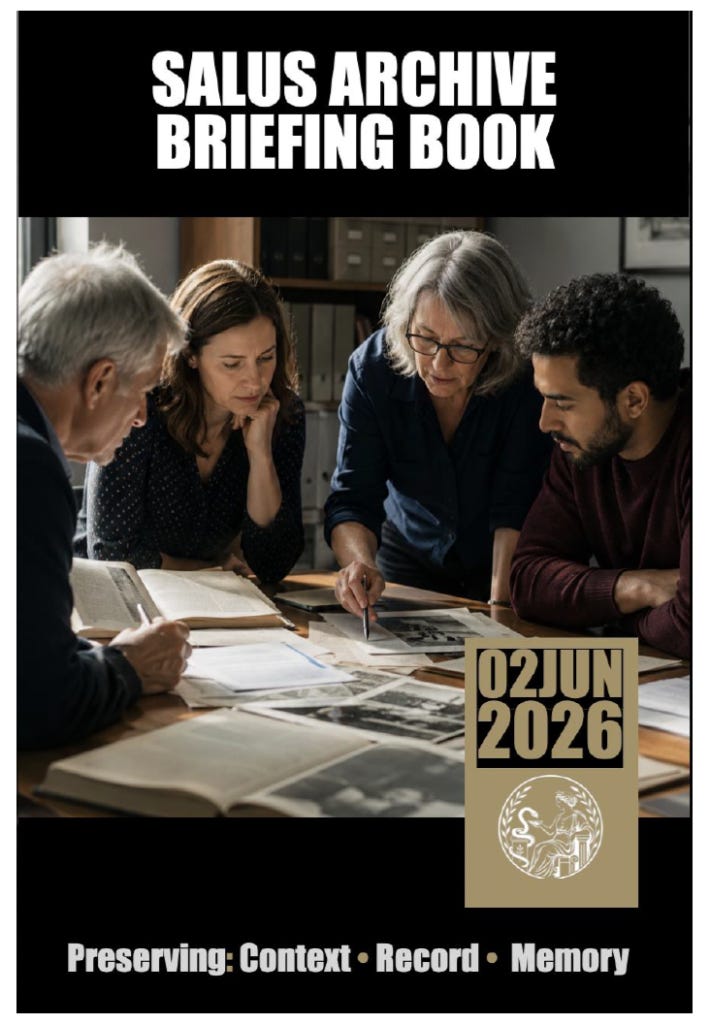
This is version 02JUN2026. The Briefing Book will be updated when needed.
Download: Salus Achive Briefing Book 02JUN2026
If your MP does not want to engage, he or she won't. I have personal experience of that, and have given up, so everything goes directly to Holyrood as I am in Scotland. The Stormont MLAs refuse to engage at all. That is why the Northern Ireland Office is under investigation for the removal of a British citizen from Northern Ireland.
728895
Thank you John great advice FH. Shiny C