

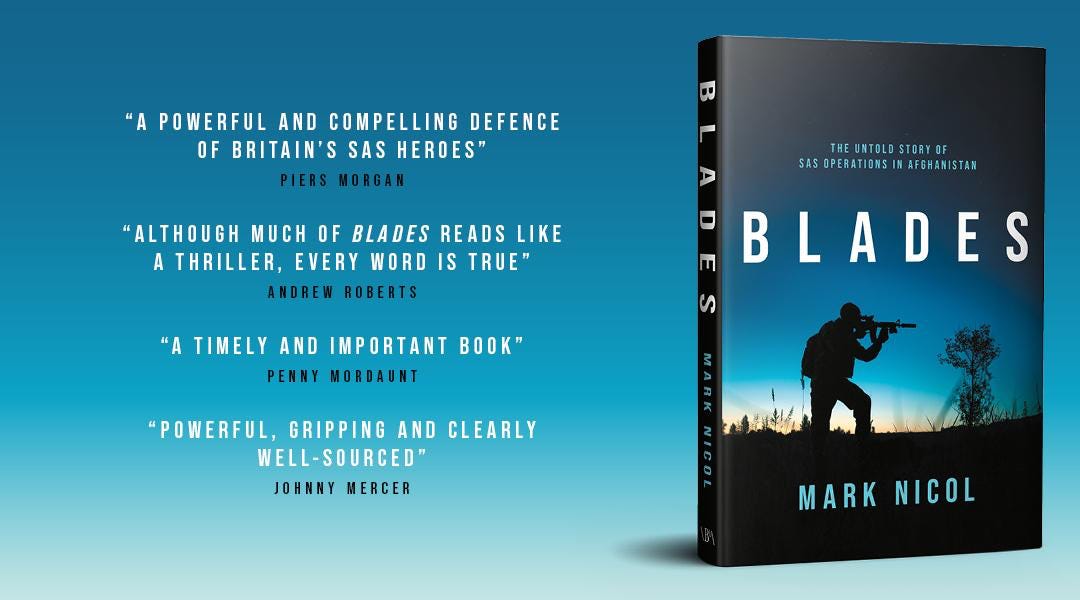
The launch of Mark Nicol’s Blades at the Royal Regiment of Fusiliers’ headquarters brought together people with a longstanding interest in the SAS, military operations, and national security.
Beyond the customary acknowledgements and lighter moments of a book launch, however, a serious argument emerged about the relationship between the British state and those it sends into harm’s way.
Introducing Nicol, Richard Williams highlighted the pressures facing serving personnel and veterans. He described the dangerous, necessary work still undertaken by members of the Regiment and their successors, while reminding the audience of former soldiers, some now in their seventies and eighties, who still face the consequences of their service in Northern Ireland.
Williams, in a measured introduction to a subject on which opinions are often firmly divided, encouraged readers to consider Nicol’s account alongside other perspectives and reach their own conclusions.
Nicol’s central argument is that the controversies surrounding SAS operations in Afghanistan cannot be understood solely by examining the actions of individual soldiers. They must also be considered in the context of the political decisions, operational instructions and legal arrangements under which those soldiers were required to operate.
Taken together, the two speakers raised a question that extends well beyond Afghanistan: what happens when the consequences of state decisions fall on individuals long after those responsible have moved on?
The problem did not begin at the compound door
Nicol argues that the SAS was tasked with dismantling Taliban improvised explosive device networks through repeated detention operations, but without the detention arrangements necessary to make those operations effective.
In his account, suspects could not be held for longer than 96 hours under the applicable arrangements. Soldiers were consequently sent repeatedly against individuals suspected of involvement in attacks on British forces, without a sustainable means of removing them from the battlefield.
The implications were considerable. British personnel were being killed and injured by improvised explosive devices, while the forces tasked with disrupting the networks responsible faced restrictions that Nicol believes undermined their ability to accomplish the mission.
He directs his criticism particularly at decisions made in London: “The easiest thing for the state is to blame individuals at the sharp end and not to recognise that the whole policy picture is decided at a much higher level, much, much higher level.”
Nicol is not simply challenging particular allegations or defending individual soldiers. He is questioning whether institutions responsible for directing military operations can adequately discharge their responsibilities by concentrating subsequent scrutiny on the actions of those carrying out their instructions.
He went further: “If you create cases against those individuals, no one looks at how they’ve been let down by a chain of command and how they’ve been let down by ministers back in London.”
Those at the sharp end make decisions for which they may properly be held accountable. But those decisions do not occur in isolation. Military operations result from policies, instructions, resources, intelligence, legal advice, and command decisions made at multiple levels.
Investigating what happened during an operation is essential. Establishing why it was conducted under particular conditions is equally important.
Context, conduct and accountability
Nicol was particularly critical of the prevailing narrative surrounding allegations of SAS misconduct in Afghanistan, including the BBC Panorama investigations.
He argued that the reporting had failed to give adequate weight to operational circumstances, particularly the restrictions on detention and the difficulties of conducting counter-terrorist operations against insurgents who understood those restrictions.
Nicol’s assessment is contested. Allegations of unlawful killings are exceptionally serious and must be independently examined. Operational frustration, however acute, cannot justify unlawful conduct.
But acknowledging that principle does not dispose of the institutional questions.
An investigation may establish what particular individuals did. A fuller examination must also consider the circumstances in which they acted, the instructions they received and the extent to which those circumstances resulted from decisions taken elsewhere.
Nicol challenged how the Afghanistan Inquiry discussed moral courage. He contrasted courtroom judgements with decisions made during military operations, arguing that the circumstances could not simply be equated.
He also directed the question of moral courage towards those responsible for the policy framework: “It is a degradation of moral courage by those in Whitehall and the Mandarins who sent the SAS in to fight with one arm tied behind their back.”
For Nicol, the government’s failure was not simply that mistakes had been made. The state failed to resolve operational contradictions before requiring soldiers to confront their potentially fatal consequences.
The distinction between individual and institutional responsibility is fundamental. Soldiers’ actions remain open to scrutiny, but that scrutiny should not replace an examination of the decisions of those who authorised, directed, and supervised their operations.
What would you have done?
The final line of Nicol’s book is also the question he put to the audience: “What would you have done?”
It invites readers to consider the choices confronting soldiers conducting operations against individuals suspected of making bombs that were killing and maiming British personnel.
It is a powerful question, although it cannot, by itself, settle arguments about the legality of particular actions.
Understanding the circumstances in which a decision was made is not the same as determining whether that decision was lawful. Nevertheless, any serious examination of conduct must take account of the conditions prevailing at the time.
Another question receives less attention.
What obligations does the state owe to those it placed in those circumstances, particularly when the consequences follow them for years or decades after their service has ended?
A question beyond Afghanistan
The experiences of SAS personnel who served in Afghanistan and veterans who served in Northern Ireland are not identical. The conflicts, tempo, operational environments, legal frameworks and allegations differ, sometimes substantially.
Nevertheless, they raise a common question about the continuing relationship between the state and the individuals who served it.
The state exercises extraordinary authority over military personnel. It determines their deployments, sets their missions, defines their operational constraints and requires them to accept risks most citizens will never encounter.
That relationship cannot reasonably be regarded as ending when the uniform comes off.
Nor should the legitimacy of investigating alleged wrongdoing obscure the responsibilities of those who authorised, directed and supervised the operations concerned.
In Northern Ireland, there is an additional human dimension. Many former soldiers are now elderly. The consequences of continuing investigations, inquests and civil proceedings may extend well beyond the individuals directly involved, affecting spouses, families, health and wellbeing.
These consequences deserve consideration in their own right.
An important distinction exists between investigating credible allegations of criminal conduct and subjecting individuals in their later years to repeated or prolonged legal processes without adequate consideration of their fairness, necessity, or human consequences.
The argument is not that military service confers immunity from criminal investigation or that the suffering of veterans should outweigh the rights of victims and their families.
It is that the treatment of veterans, including the processes they undergo, remains a legitimate matter of public concern.
Today’s soldiers, tomorrow’s veterans
Nicol’s argument deserves attention from those currently serving.
Operation Banner veterans' experiences may offer a glimpse of the future awaiting some who served in Afghanistan, Iraq, and other operations.
Men and women who served in Northern Ireland during the 1970s and 1980s could scarcely have imagined that, half a century later, some would still face investigations, inquests, and civil proceedings arising from events that took place when they were young.
Many are now in their seventies and eighties. Political circumstances, institutions, and public understanding of the conflict have changed.
Yet the consequences of their service remain part of their daily lives.
Some have spent decades living with the possibility of further proceedings. Others have faced renewed scrutiny long after memories have faded, witnesses have died, and the circumstances that led to the decisions have receded into history.
Those currently serving, or who served in Afghanistan and Iraq, might reasonably ask whether a similar future and retirement awaits them.
What assurance can the state give those serving today that, should their actions come under scrutiny decades from now, ministers’, officials’, and commanders’ decisions will be examined with the same rigour as their own conduct?
And what responsibility will the state accept for their welfare when that happens?
These are not unreasonable questions.
Nor are they demands to place military personnel beyond the reach of the law.
They concern the obligations of an institution towards individuals who acted under its authority, often in circumstances that the institution itself determined.
A fundamental question also concerns institutional memory.
By the time today’s operations become tomorrow’s historical controversies, the ministers who authorised them may be dead. Senior officials and commanders may have retired. Departments may have been reorganised, policies replaced and records lost or dispersed.
Yet the individual soldier remains identifiable.
The state is an enduring institution.
Those who serve it are not.
This creates an uncomfortable possibility: the burden of explaining decisions the state makes collectively may eventually fall disproportionately on the individuals required to implement them.
The state possesses continuity of authority without necessarily preserving continuity of personal accountability. Governments change, ministers depart, and senior officials move on, but the institutions they represent retain the power to investigate events from decades earlier.
The individual has no comparable institutional continuity. Memories fade, health deteriorates, and the capacity to respond to allegations or participate in lengthy proceedings may diminish with age.
None of this prevents legitimate historical scrutiny. But it should shape how that scrutiny is conducted, how long proceedings can continue without resolution, and what obligations the state recognises towards those affected.
For those serving today, the treatment of Operation Banner veterans is therefore more than a historical controversy. It is a question of their own future, and whether the state's obligations endure for as long as the consequences of military service.
Today's young soldier is tomorrow's elderly veteran.
How the state treats one generation tells the next what its promises of duty, care and responsibility may ultimately be worth.
Responsibility cannot stop at the sharp end
Towards the end of his remarks, Nicol called for renewed recognition of the SAS’s importance to national security and for the government to ensure special forces are not again placed in similarly compromising operational circumstances.
He argued that workable detention arrangements would have prevented the contentious shootings now under examination.
That is a substantial claim requiring scrutiny. One cannot simply assume that different arrangements would have prevented particular incidents.
But the underlying institutional question remains.
If operational constraints were known to be undermining the mission, who was responsible for addressing them? What warnings were given? What alternatives were considered? Who decided to continue operations under the existing arrangements?
These are matters of institutional accountability, not merely retrospective sympathy for soldiers.
Public debate tends to treat the state as a single, almost abstract entity while treating the individual soldier as a readily identifiable bearer of responsibility.
Yet the state acts through people. Policies are proposed, approved and implemented by identifiable officeholders. Orders are given through chains of command. Decisions have authors, and failures have histories.
If accountability is to mean anything, it must trace those decisions upward and examine the actions that followed.
Nicol’s Blades presents one account of events in Afghanistan. Read it critically, consider it alongside competing evidence, and judge it on its merits.
But the questions raised at its launch extend considerably beyond the book, the SAS or Afghanistan.
They concern the relationship between the British state and successive generations of those who have served it.
When the state sends people into danger on its behalf, how far does its responsibility extend — and who holds it to account when the consequences return home with those who served?
Yes, I recently read the book, Blades. Apart from descriptions of epic special forces ops, I found it very depressing:
1. The long-running acrimony between the SAS and SBS is awful and greatly exceeds straightforward rivalry exacerbating some of the problems discussed. It needs to be dealt with.
2. It is now much clearer that lawfare has been allowed to drag on unchallenged for far too long. It is chronic and has been out of control for decades. The only good thing to come out of the egregious but symbolic Troubles Bill is that it has provided a much-needed catalyst.
What really bothers me, and this is a personal axe-grind, is that THE STATE DOESN'T CARE about the concerns articulated in the very good article above. What is going on in Westminster is being done ON PURPOSE. Bear in mind that the vote FOR the Bill was DOUBLE that of the vote AGAINST the Bill. There is no way that that represents the public/electorate at large.
We are heading for a situation where the armed forces will be subordinated to a political appointee, such as the Attorney General. In regimes of a past era, that was known as a Commissar. And we know what that means.
Well said in a lot of aspects!