

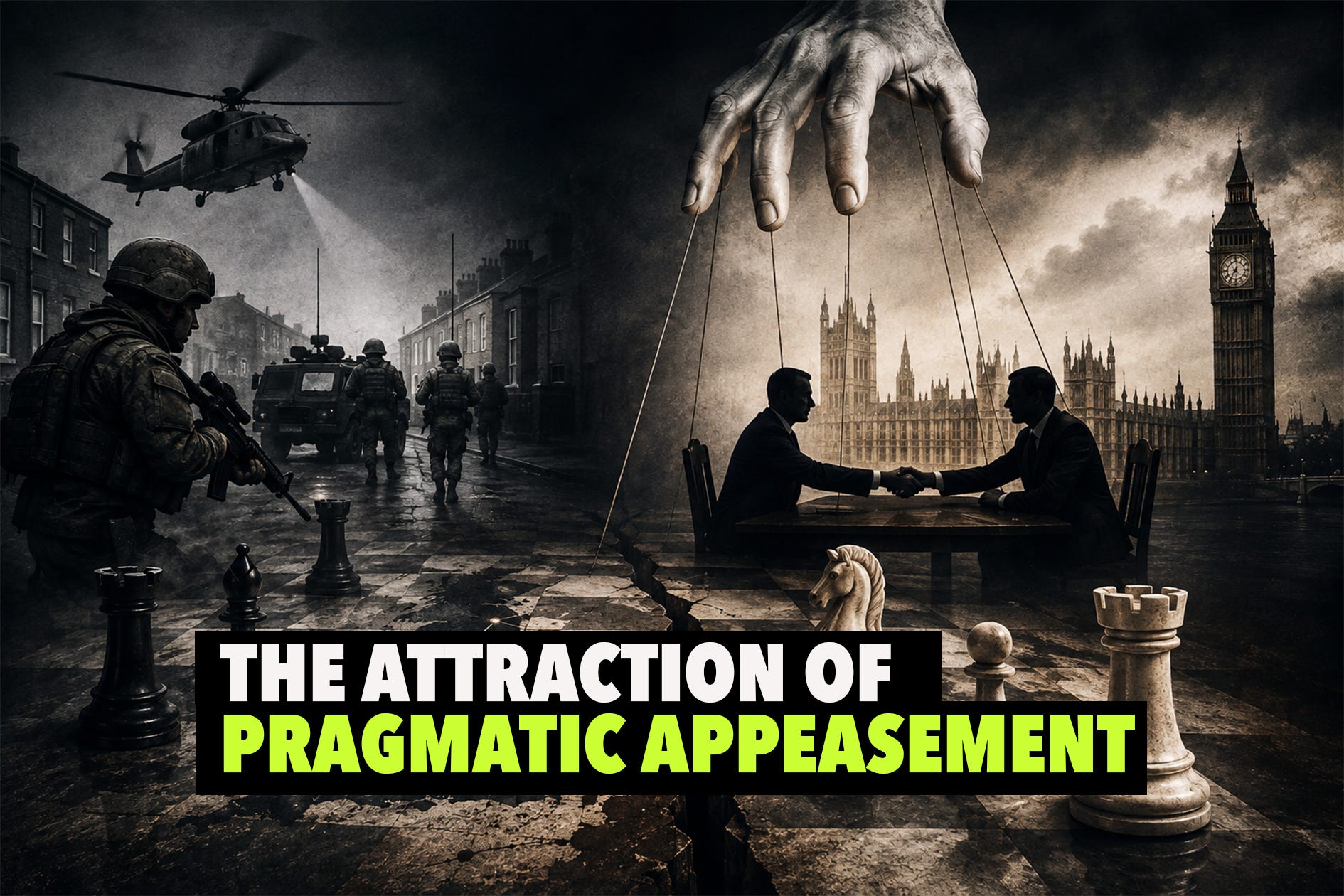
There are two distinct dynamics in British security operations: the strategic and the operational. Understanding why they so consistently work against each other requires honesty about what actually happened during the Troubles — not simply the version that has prevailed since 1998.
The Intelligence War on the Ground
During the Northern Ireland operation, those running close-target work attended a weekly operational conference with the Commander Land Forces (CLF). Its purpose could best be described as quality management — ensuring Army and RUC relationships were functioning as designed. Intelligence services attended too, sitting quietly behind the CLF.
Each group — COP, FRU, Det — briefed and left before the next entered. Operational units were always last to speak. Nothing sensitive was disclosed to the CLF.
This was not a rejection of the military chain of command, which those involved respected professionally. It was a deliberate decision to prevent the intelligence services from gleaning information and interfering in operations that were, at that point, producing results.
The reason was straightforward: there was no way of knowing, and no basis for trusting, what the intelligence services were prepared to share with their IRA contacts. Special Branch colleagues — with direct visibility of what was happening at NIO and HMG level — were explicit: disclose current intelligence upwards and it could destroy the joint operation that had taken years to build.
That distrust did not emerge in a vacuum.
By the mid-1980s, the operational picture was of an IRA campaign under serious pressure. Its networks were compromised, its freedom of operation was being constrained, and the organisation knew it.
Yet another dynamic was operating at the strategic level.
Back-channel relationships maintained the possibility of political accommodation. Whatever the intentions behind them, the effect was to preserve hope at precisely the point when operational pressure was intended to extinguish it.
That distinction matters.
Pragmatic Appeasement and What It Produces
What occurred during this period, and what has recurred since, can be understood as a form of pragmatic appeasement.
Not the ideological appeasement of the 1930s, born of sympathy for an aggressor’s position, but something more mundane: appeasement as administrative convenience.
The path of least institutional resistance dressed as statesmanship.
The mechanism is not difficult to understand. An intractable threat generates pressure on the political and administrative class. Full-spectrum counter-measures are available but carry costs — political, diplomatic, legal and reputational.
Managed engagement, by contrast, can be presented as sophistication.
It distributes the costs invisibly across time and across the people least able to resist them, while concentrating the appearance of resolution at the centre. It also insulates those responsible from accountability because the consequences of managed engagement frequently arrive long after the decisions that produced them.
This need not be incompetence or naïveté. It can be a perfectly rational institutional response to badly designed incentives.
The question is what it ultimately costs.
The GFA Narrative and What It Conceals
The dominant account of the Good Friday Agreement holds that the IRA fought the British state to something approaching strategic stalemate, making negotiation the rational means of ending an otherwise irresolvable conflict.
That account is, at best, seriously incomplete.
The operational picture through the late 1980s and into the 1990s tells a different story.
The IRA’s position was deteriorating. Intelligence penetration of the organisation was extensive. The political space for republican violence was narrowing, particularly after 1991. A movement that retained considerable capacity for tactical violence was nevertheless running out of strategic road.
Those are not contradictory propositions.
An organisation can retain the ability to kill without retaining a credible path to victory.
Yet the eventual settlement granted republicanism political opportunities and legitimacy that its armed campaign had failed to secure.
That does not make negotiation inherently wrong. Nor does it mean that every element of the Good Friday Agreement was mistaken.
It does mean that the conventional story of how and why the settlement became necessary deserves considerably more scrutiny than it usually receives — including scrutiny of the decisions made by Tony Blair, Jonathan Powell (current National Security Advisor) and others who shaped the process.
The settlement ended one phase of the conflict. It did not resolve every question beneath it. The relationship between violence and political legitimacy, sovereignty and consent, and the consequences of rewarding those capable of sustaining disorder remain part of Northern Ireland’s political landscape.
That matters because the Northern Ireland model did not remain in Northern Ireland.
The Recurring Pattern
What the Northern Ireland experience reveals is not simply a collection of mistakes. Mistakes in complex counter-insurgency environments are inevitable, possibly even forgivable.
It reveals an institutional disposition — a preference, particularly at the strategic level, for outcomes that can be described as resolution over the harder task of establishing what resolution actually requires.
The vocabulary is diagnostic.
Operational thinking is concerned with defeating a threat.
Strategic thinking, in the British state at least, has increasingly preferred to manage it.
These are not synonyms.
A threat that is managed without a defined end-state does not necessarily diminish. It can accumulate. The costs are deferred, the problem compounds, and the conditions for genuine resolution become progressively harder to create.
The habits developed during the Troubles — back-channel engagement with violent movements, political legitimacy used as an incentive rather than a reward, and the suppression or dilution of operational ground truth when it complicates strategic policy — did not necessarily disappear with the peace process.
That is why the Northern Ireland experience matters now.
An “Islamic Sinn Féin”?
In a recent Spectator article on MI6 involvement in back-channel diplomacy, Dean Godson cites a senior official describing covert outreach to the current generation of home-grown Islamists as an attempt to conjure into being an “Islamic Sinn Féin”.
The comparison is revealing.
As far as it goes, it identifies a structural parallel between insurgent political movements operating within a democratic state. But it also risks importing the assumptions of the Northern Ireland framework — including the assumption that accommodation can transform a security problem into a manageable political one.
Before adopting that lesson, we should be certain that it is actually the lesson Northern Ireland teaches.
The question is not whether the state should engage with domestic threats. Some form of engagement is frequently necessary.
The question is what that engagement is designed to achieve, and what it is structurally permitted to concede.
During the most effective phases of the Northern Ireland operation, that distinction was clear: engagement served intelligence collection. It was a means of understanding and defeating the threat, not accommodating it.
Once political accommodation becomes the objective, the purpose changes.
Pragmatic appeasement has surface appeal precisely because it looks like sophistication. It borrows the language of realism — complexity, nuance, the long game — while avoiding the hard question that realism actually demands:
Where does the present trajectory lead?
Before Britain attempts to create an “Islamic Sinn Féin”, it might therefore be worth looking again at what actually happened when it created the original model.
A state that cannot define the end-state of engagement — or has decided that the end-state does not matter — is not managing a threat.
It is funding one.
We'll folks another interesting 'Tale Of Three Cities.' London, Belfast and Dublin? People talk about 'Managing Threats?' Well of course, but also, it depends on the type of threat your trying to manage, and what the agenda is behind it? An organisation like the IRA has turned the theory around, and is now managing the Stormont, Dublin and Westminster! Clever eh! When Special forces and intelligence units like 14 Intelligence Company. 'The Det' work together as they did/do in Northern Ireland. Great progress in weakening the capabilities of the IRA were significantly reduced, and that's a fact! Unfortunately, the momentum was stopped, thus preventing on going operations against the IRA that would undoubtedly have cleared out the top leadership and degraded their armament and bomb making sustainability. So, do we trust politicians that send our soldiers to fight in conflict zones ?? A government that suppressess its backing and support for veterans who returned home after fighting the good fight! A government that uses 'smoke and mirrors' to avoid commitment in keeping 'lawfare and the Human Rights Commission from pursuing men and women who put their lives on the line, in defence of The Realm! These are the questions that matter! Or do you the Government of the Day, prefer to see terrorism, anarchy and total disorder roaming our green and pleasant land? Or indeed in those far off places where Great Britain's other interests lay? Stop hounding us veterans! Start to 'reel in' the bad people for a change. You are failing the very people that protect you!
One has to wonder why, as all the IRA leadership and most dangerous members of the IRA, were known to the British government and security forces the decision to eliminate them all was not made.
After all, the IRA specifically targeted civilians, killing men, women and children; they used fear to continue their fight by murdering or maiming those Irish that didn't believe the same as the IRA. They said it was a war but their tactics were not seen as warfare but terrorism.
If you chop off the head of a snake another doesn't necessarily grow back.