

There is a pattern in how this debate is conducted.
One side speaks in the language of rights, victims, and accountability. The other responds with process, fairness, and the lived reality of those being pursued decades later.
Both are speaking past each other.
What is missing is not more heat, but three things without which any argument for reform will continue to fail on its own terms — and opponents will fill the silence.
1. Acknowledge legitimate victim interests — genuinely and first
The families of those killed during the Troubles — civilian families above all, but also the families of combatants — have a lawful and legitimate interest in understanding what happened to their relatives. That interest is not a debating inconvenience. It is the foundation of the State’s obligations under Article 2 of the European Convention on Human Rights.
Any argument for reform that does not begin by saying this clearly will be read, correctly, as an argument against scrutiny altogether. It is not. But the failure to state it prominently hands opponents the most powerful card in the deck.
The case for reform is not that investigation is wrong. It is that a system which subjects elderly veterans with severe PTSD to years of adversarial process — without producing reliable findings, and without any mechanism to hold those who directed terrorist violence to equivalent account — is not discharging its investigative duty. It is performing it.
The evidence submitted to the Joint Committee on Human Rights illustrates what this looks like in practice: a veteran with severe psychiatric illness ordered to give evidence under threat of contempt, then pursued through the Scottish courts for a £5,000 fine; a soldier shouted at by a coroner during a panic attack; a witness with catastrophic brain injury subjected to MRI and CAT scans to verify that he could not remember events he had not directly witnessed. These are not the outcomes of a rigorous system. They are the outcomes of a system that has lost its proportionality.
Acknowledging victim interests does not require accepting that every process, however prolonged or degraded by time, remains equally valid. It requires saying, plainly, that those interests are real — and that the current system is failing to serve them well either.
2. Explain why safeguards are not impunity — and show the precedents
This is where the argument is currently weakest, and where opponents are most effective.
Proposals such as requiring new evidence before reopening an investigation, limiting repeated examinations of the same facts, or accepting medical certificates confirming a witness is unfit to give oral evidence are routinely characterised as efforts to “close cases down” or to place soldiers above the law.
That framing is allowed to stand too often. It should not be.
Each of these measures has direct equivalents in ordinary legal systems that no one considers protective of wrongdoing:
When Parliament created a mechanism to reopen concluded criminal cases — the Criminal Justice Act 2003, permitting re-prosecution after acquittal where new evidence is compelling and re-prosecution is in the public interest — it set a high evidential threshold as the condition of doing so. The “New Evidence Certificate” requirement applies the same principle to the investigative context: finality is the default; departing from it requires a defined evidential gate. The legacy framework is not being asked to accept a novel restriction. It is being asked to apply a standard Parliament has already endorsed in a more serious context.
Medical evidence accepted as determinative of a witness’s fitness to give evidence is standard practice in civil and criminal proceedings throughout England, Wales, and Scotland. The coroner who dismissed consultant psychiatric evidence from Professor Seena Fazel in favour of a report from a less-qualified practitioner who had never met the veteran was not applying a rigorous standard. He was departing from one.
Presumptions in favour of remote testimony now exist in many jurisdictions following COVID-era reforms, and are applied to vulnerable witnesses as a matter of course. Veterans in their seventies and eighties, many suffering service-related trauma, meet any reasonable definition of vulnerable witness.
Statutory time-bar provisions — or, where no bar exists, judicial discretion to stay proceedings as an abuse of process — operate precisely to prevent the courts from becoming instruments of oppression rather than justice. No equivalent protection currently exists in the Northern Ireland legacy framework.
The point is not that veterans deserve special treatment. It is that the current framework denies them treatment that any other witness category would receive as a matter of course. A system that requires that gap to be closed is not granting impunity. It is restoring baseline proportionality.
This argument must be made with evidence, not assertion. Opponents will deny it. The response needs to be specific: here is the English law equivalent, here is the Scottish procedure, here is how every other mature system handles this. That is a rule-of-law argument, not a special pleading argument, and it is much harder to dismiss.
3. Confront the assumption that public interest is constant over time
There is a premise at the centre of the opposition’s case that is rarely named and almost never challenged: that the public interest in investigating past events remains the same whether the investigation takes place ten years or forty years after the events in question.
It does not. And the failure to say so clearly is a significant strategic error.
As time passes:
Evidence degrades or is lost
Witnesses age, die, or lose reliable recall
Context is flattened or distorted by subsequent events and narratives
The capacity of any process to produce findings capable of withstanding scrutiny diminishes
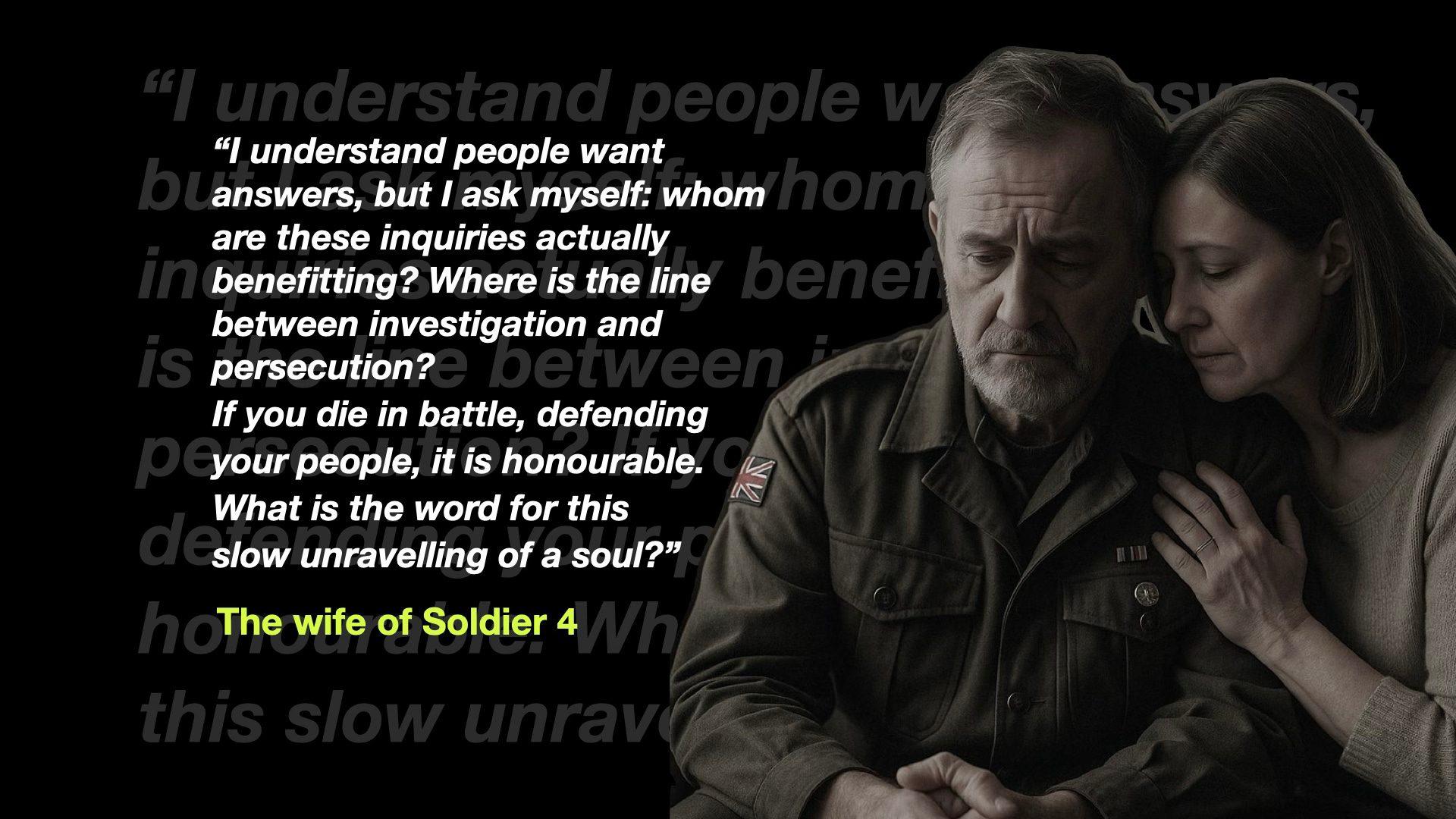
At the same time — and this is the part that tends to be overlooked — the human cost of requiring participation increases, not decreases. The veteran, who was 30 at the time of the events, is now in their 70s. The PTSD that was manageable with support is now, forty years on, something else entirely. The wife of the soldier referred to in the evidence as Soldier 4 put it plainly:
“I understand people want answers, but I ask myself: whom are these inquiries actually benefitting? Where is the line between investigation and persecution? If you die in battle, defending your people, it is honourable. What is the word for this slow unravelling of a soul?”
This is not sentiment. It is a description of what happens when a process designed for a purpose loses sight of whether it can still achieve it.
An investigation so degraded by time that it cannot produce reliable findings is not discharging the State’s Article 2 obligation. It is performing the appearance of discharging it, at serious human cost, while yielding nothing that serves the interests of families seeking truth.
The argument is not against investigation. It is that the threshold for continuing must rise as the evidential basis weakens and the human cost grows. This is not a concession to those who wish to evade accountability. It is a condition of a system that takes accountability seriously.
The emotional architecture of the debate must shift
There is a fourth element that the argument has not yet addressed, and it may yet be the most consequential.
The opponent’s human stories lead every media presentation of this issue. The families of those killed are the first voice heard. The veterans’ case is presented as institutional, legalistic, procedural.
The evidence submitted to the Joint Committee on Human Rights contains material that should reverse this. The account above of Soldier 4’s wife is one example. The description of a decorated veteran who cannot leave his home, cannot use public transport, and spent the years of legal process sitting in his front room waiting to be attacked, is another. These are not footnotes to an amendment schedule. They are the reason the amendment schedule exists.
The argument for reform needs to lead with what the current system is doing to people before explaining the statutory protections it proposes. The case for change is not primarily a legal argument. It is a description of a system that has become, in the words of one submission, “punitive in its own right” — and the legal argument is how the situation gets fixed.
Until that order is reversed — until the human cost is placed at the centre and the procedural remedy follows from it — opponents will continue to own the emotional register of this debate, and the argument will remain, structurally, defensive.
The issue is not whether the past can be examined
It is whether a system can do so without becoming, in effect, a form of punishment in its own right.
The argument for reform has the stronger case on the merits. But it is not yet making that case in the way that wins.
Four things are needed: a genuine acknowledgement of victim interests stated prominently and without qualification; a concrete, evidence-based demonstration that the proposed safeguards are standard legal norms rather than special privileges; an explicit argument that investigative legitimacy is time-sensitive and must be proportionate to what a process can actually achieve; and a reordering of the argument so that the human cost leads and the procedural remedy follows.
Without all four, the gaps will be filled by those with every incentive to do so.
—
This post draws on written evidence submitted to the Joint Committee on Human Rights by the Special Air Service Regimental Association, the Special Boat Service Association, and the Special Reconnaissance Regimental Association (NITB0019), April 2026.
What Is Missing From The Debate On Legacy Investigations? A very good question with a very simple answer? Because on the Government's side there's nobody capable or intelligent enough to understand in what they're doing, is first of all it's ILLEGAL! And that the damage to our Military Establishment irreparable, and also the bond of TRUST.Has been broken! "Get A Grip You Bastards!"