

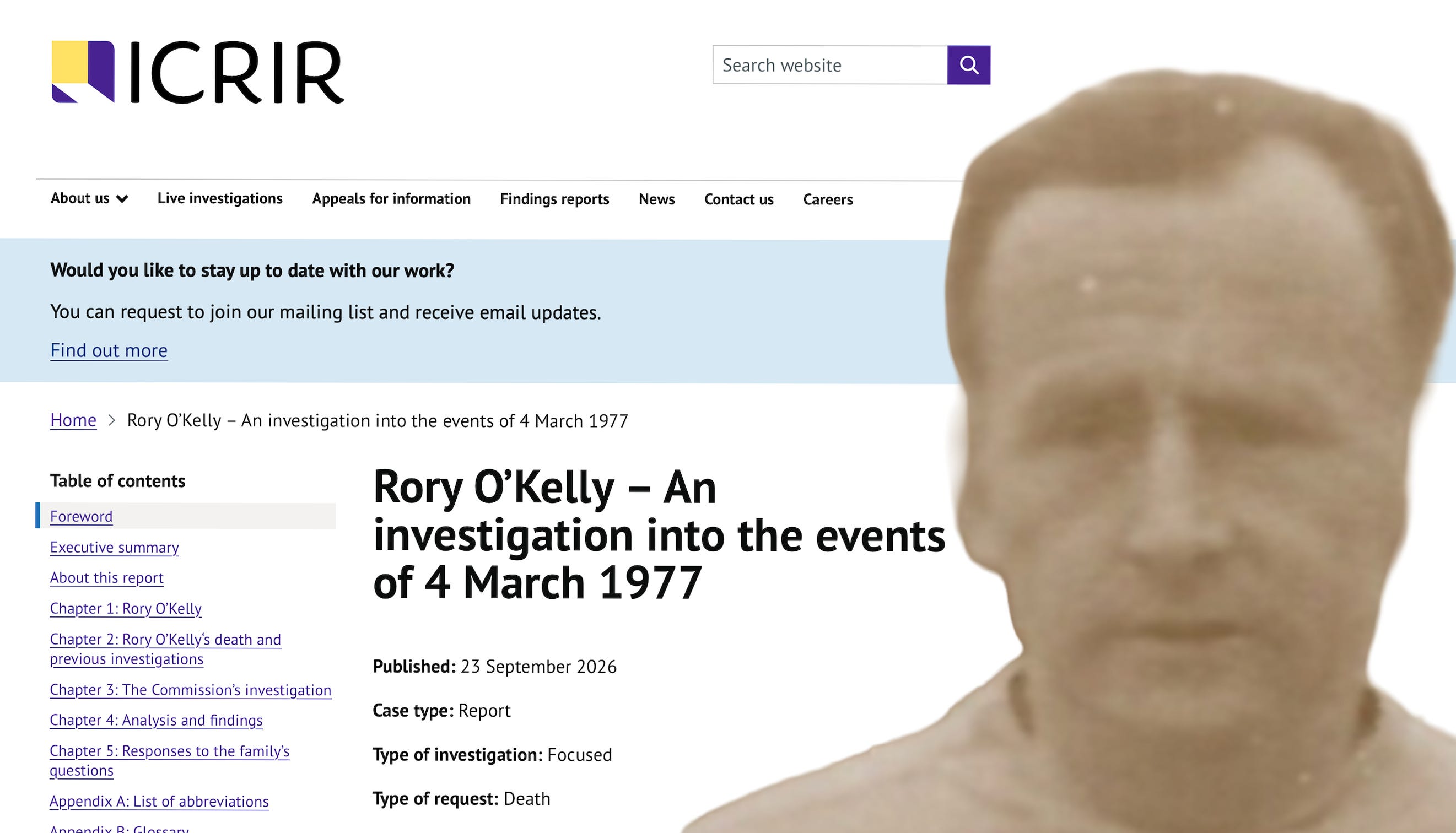
The Independent Commission for Reconciliation and Information Recovery (ICRIR) has published its investigation into the murder of Rory O’Kelly, a solicitor and Assistant Director of Public Prosecutions, who was shot dead in Coalisland in 1977.
The report provides a detailed reconstruction of his final days and concludes that Rory was deliberately targeted because of his role in administering justice. It finds that his murder was part of a wider Provisional IRA campaign against those involved in Northern Ireland’s judicial and administrative systems.
For his family, the report provides important recognition.
They received an official account of what happened. They received confirmation that Rory was not the victim of a random act of violence, but a targeted attack because of the work he carried out.
But the central questions remain unanswered.
After a lengthy investigation:
· No suspect has been identified
· No prosecution has followed
· No individual has been held accountable
· No definitive answer has been provided as to who carried out the murder
The ICRIR concluded that the killing involved planning.
The attack required a decision to target Rory, intelligence about his movements, logistical arrangements, a weapon and support from others.
Yet the people who planned, supported or carried out the murder have not been identified.
That raises a fundamental question about the legacy process.
The issue is not whether Rory O’Kelly deserved a thorough investigation. Every victim and every family deserves the truth about what happened to their loved one.
The question is how public policy should measure the value of a legacy investigation when the principal outcome is improved historical understanding rather than justice or accountability.
The report demonstrates that information can still be recovered nearly half a century later. But it also highlights a difficult reality: people who knew about the planning, the operation and those involved may still be alive.
The challenge is whether the mechanisms now available can recover that knowledge.
A wider question is consistency.
The ICRIR has powers to require information from individuals and organisations.
However, recovering the truth ultimately depends on cooperation from those who possess relevant knowledge. Where individuals or organisations choose not to engage, the ability to establish responsibility is severely limited.
At the same time, former members of the armed forces remain subject to compulsory engagement with legal processes.
A legacy system must command confidence among victims, survivors and the wider public. That requires transparency about what it can achieve, what it cannot achieve, and whether the outcomes delivered are proportionate to the resources committed.
To be sure, families deserve answers.
But the public also deserves an honest assessment of what the legacy process is delivering — and for whom.