

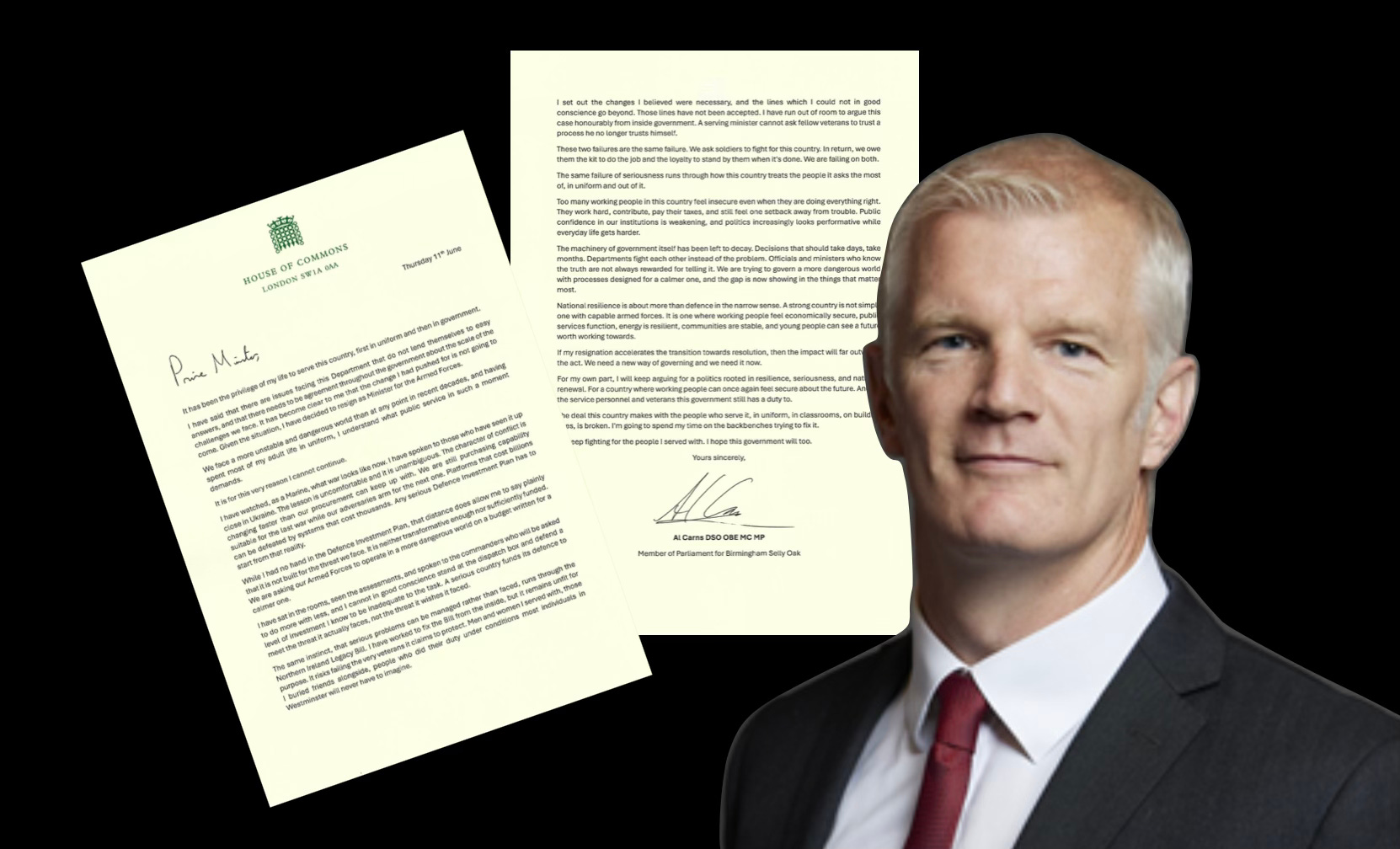
From a veteran’s perspective, Al Carns’ resignation letter is remarkable not for what it reveals, but for what it states publicly.
Ministers resign for many reasons. Most resignation letters are carefully drafted, focused on policy disagreements, and written in a way that leaves room for future reconciliation.
Carns’ letter is different. It is unusually direct, deeply personal, and framed around questions of duty, trust, and obligation.
The most significant aspect of the letter is that Carns links two issues that are usually discussed separately: defence preparedness and the Northern Ireland Legacy Bill.
He writes: “These two failures are the same failure.”
That sentence sits at the heart of the letter.
Carns argues that Britain is asking its Armed Forces to operate in a more dangerous world while failing to provide the resources required to meet that challenge.
He then applies the same criticism to the Northern Ireland Legacy Bill, which he says remains “unfit for purpose” despite his efforts to improve it from within government.
Whether one agrees with that assessment or not, it is a notable argument.
Carns is not presenting defence policy and legacy policy as unrelated debates. He is presenting them as symptoms of a broader problem in how the government approaches responsibility, risk, and public service.
For veterans, the most important passage may be his discussion of the Legacy Bill: “I have worked to fix the Bill from the inside, but it remains unfit for purpose.”
That statement matters because it comes from the Minister for the Armed Forces himself.
Carns does not claim the legislation merely needs refinement or better implementation. He states plainly that he believes it remains fundamentally flawed despite attempts to improve it.
He then goes further: “A serving minister cannot ask fellow veterans to trust a process he no longer trusts himself.”
This is perhaps the most striking sentence in the entire letter.
It is important to be precise about what it means.
It is not proof that the process is objectively compromised, nor does it reveal undisclosed information. What it does reveal is Carns’ own judgment after serving inside government and engaging directly with the issue.
For many veterans, that judgment will carry weight regardless of whether they ultimately agree with it.
The language of duty runs throughout the letter.
Carns repeatedly returns to the relationship between the nation and those who serve it.
“We ask soldiers to fight for this country. In return, we owe them the kit to do the job and the loyalty to stand by them when it’s done,” he writes.
Later adding: “The deal this country makes with the people who serve it... is broken.”
This is not the language of administrative disagreement. It is the language of obligation, trust and responsibility.
Veterans have long framed debates around Operation Banner and legacy investigations in similar terms.
For many, the central issue has never been solely legal. It has been whether the state honours its obligations to those it asked to serve in difficult and dangerous circumstances.
Carns’ letter does not settle that debate. What it does show is that the same concerns are now being expressed publicly by a minister who held responsibility for representing service personnel within government.
The broader political significance of the resignation lies not in speculation about private conversations but in the public record.
Carns has stated that:
The Defence Investment Plan is inadequate to meet the threat environment.
The Northern Ireland Legacy Bill remains unfit for purpose.
His efforts to improve it from inside government were unsuccessful.
He can no longer ask veterans to trust a process he no longer trusts.
Those are serious statements from any politician.
They are especially significant coming from the Minister for the Armed Forces.
The importance of this letter lies not in any claims to reveal what the government is hiding.
It is that a serving Armed Forces Minister concluded that he could no longer defend either the defence settlement or the legacy process and chose to resign rather than do so.
Standing with veterans
There is also a separate question of Carns’ standing with veterans.
For some, this resignation will help.
It gives him an honourable explanation: he stayed inside government because he was trying to change the Bill, and he left when he concluded that he no longer could.
But one letter will not be enough to settle the matter.
Some veterans will ask why he did not resign sooner.
Others will want to see whether his words are followed by sustained action: opposing the Bill where necessary, supporting serious amendments, meeting veterans directly, and continuing to press the case from the backbenches.
This resignation buys him a hearing.
It does not automatically buy him forgiveness.
Having left ministerial office, Carns is no longer bound by collective responsibility. Whether he chooses to use that freedom to challenge the Bill will likely shape how many veterans judge this resignation.
If Carns chooses to support those affected by legacy lawfare, his reputation with veterans may recover.
If the letter is not followed by action, however, it will be remembered as a moment rather than a turning point.
Either way, his letter will remain part of the debate long after the immediate political fallout has passed.
Big words from Carns, but is it true - did he really try and effect change from within the Government? I suspect not! I believe he is weak, devoid of robust character to do what is truly needed to protect the UK and veterans from this Government.
If he was the man the letter purports to be, he would have resigned as an MP or at least walked across the floor! This government is hell bent on the continued destruction of the country; how can a 'hero' of the nation continue to support that?!?!
He continues to take his salary, his expenses and the £3000 bung (for increased cost of living expenses) the government gave to every MP.. sickening when veterans and the serving see increases in their cost of just living!
Al Carns hmmm yes what can we say here? Well, he served in the Marines, did the Afghanistan gig, won a couple of gongs! So what! He doesn't carry the blood of a true warrior in his body! He's had countless opportunities to stand tall for veterans but has failed at every twist and turn. I believe his letter of resignation is a 'get out I'm clean' move to try and exonerate himself from his failed tenure as a government minister!