

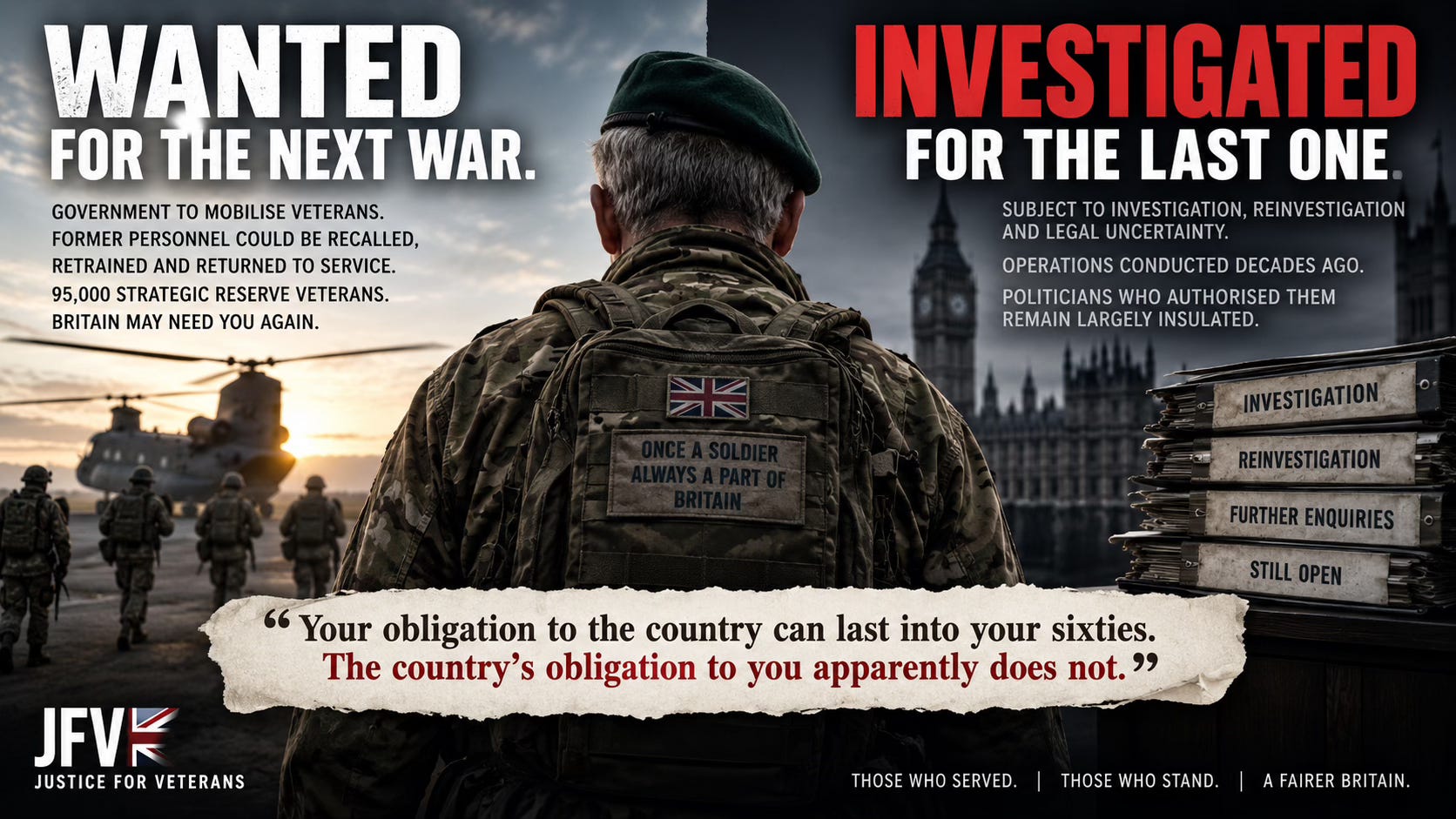
When veterans started seeing posts about the Government preparing to mobilise them as part of Britain’s preparations for a future war, they thought it was a joke.
But, folks, that’s the plan.
Louise Sandher-Jones, the Armed Forces minister, a staunch supporter of Labour’s Troubles Bill and who called veterans opposing it naïve and refused to say if IRA terrorists will join Labour’s Troubles commission, revealed Britain is planning a major drill to mobilise its army of veterans as it prepares for war.
Former servicemen and women could be recalled, retrained and returned to military service. The Strategic Reserve — some 95,000 former personnel — is increasingly being regarded as an essential part of Britain’s ability to fight.
There is something obscene about the contradiction.
At the same time as the state is looking to veterans because it may need them to fight again, it is paving the way for military veterans to remain exposed to investigation and repeated reinvestigation over operations conducted decades ago.
The message appears to be:
Your obligation to the country can last into your sixties. The country’s obligation to you apparently does not.
Justice for Veterans does not argue that soldiers should be above the law. Where credible evidence of wrongdoing exists, it should be investigated.
But neither should those who served be subjected to an endless cycle of investigation, reinvestigation and legal uncertainty while the politicians who authorised military operations remain largely insulated from responsibility for the consequences.
If Britain expects former servicemen and women to answer the call again, it has a corresponding duty to stand behind those it sent into harm’s way before.
The Government cannot demand lifelong military obligation from veterans while offering them no corresponding certainty that the state will honour its obligations to them.
Louise...... Who nobody has heard of before Guitar Andy the Etsey Noel Galagher got into power. Who the flying fire truck does the scumbag think she is calling Veterans naive for opposing this traitorous bunch of cretins witch hunt.
She would not have the bottle to even stand guard duty on a main gate to a park let alone what our Armed Forces do. She would def not say that to Veterans face.
I'd love to be recalled to the Navy and point blank refuse to even unpack the uniform.
I would abolsolutely p**s myself with glee if all our SF suddenly said poke it were going private sector! Who'd serve these traitors nowadays
This shower of Shit of a government must think Veterans came down "with the last shower!" No chance you naive Woke Chancers! The Veterans hold the line for one another and those that support us! 💪💪👊👊👈