

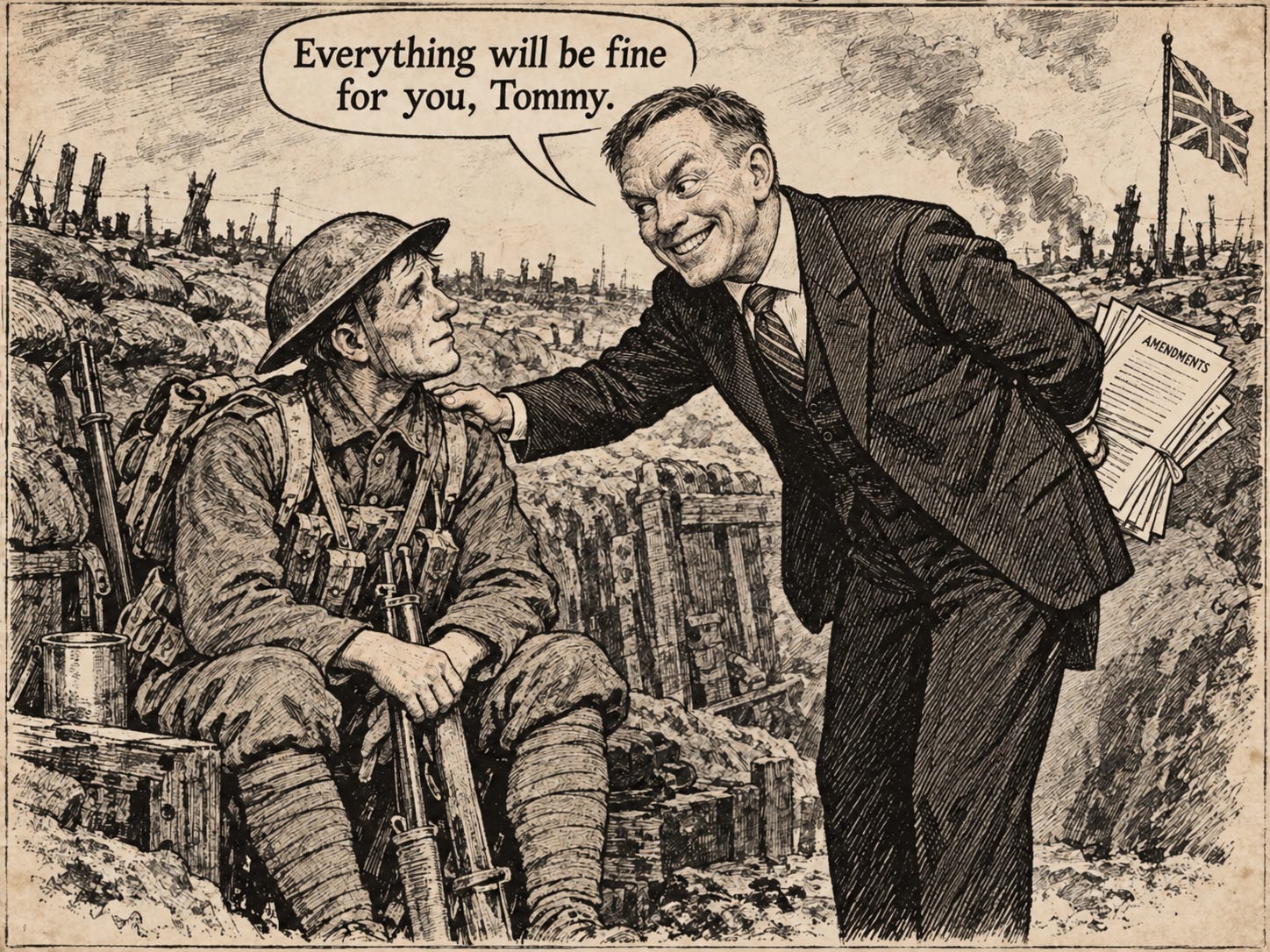
In an interview with The Independent on Thursday, Northern Ireland Secretary Chris Bryant promised a substantial package of amendments to the Northern Ireland Troubles Bill, to be tabled on Monday 12 October.
He has made significant assurances about protecting veterans, preventing repeated investigations and recognising the operational circumstances in which soldiers served.
Fine words. But words in a newspaper interview are not the law.
The Government has already updated the parliamentary amendment paper for Monday 12 October. Yet Bryant’s promised package of government amendments does not appear in the published document.
That leaves MPs potentially just seven days before the Commons debate on 19 October to examine the Government’s proposals, consult legal experts and establish whether the promised protections are worth the paper they are written on.
Veterans have waited decades for justice. Parliament should not be expected to scrutinise their future in seven days.
HOLD YOUR FIRE
Veterans and their representatives understandably feel pressure to respond immediately to every new statement, assurance, and supposed concession.
That is precisely the trap to avoid.
Whether deliberate or otherwise, the piecemeal release of information gives the Government the opportunity to control the news agenda, set the terms of debate and respond selectively to criticism.
Worse, premature commentary and well-intentioned suggestions can be taken out of context, presented as agreement or used to suggest that veterans’ concerns have been addressed.
As the familiar warning goes: Anything you say can and will be used against you.
The appropriate response, for now, is straightforward: “We will comment once we have received and thoroughly assessed the Government’s amendments.”
That is not surrender. Nor is it an instruction to remain silent. It is a refusal to be manoeuvred into taking positions before the facts are available.
DIFFERENT VOICES. DIFFERENT POINTS OF FIRE.
The veterans’ community is not a single organisation, and it should not pretend to be one.
Regimental associations, individual veterans, campaign organisations, former commanders and legal representatives have different interests, responsibilities and concerns.
That diversity is a strength.
There is no need for a single spokesman, a common statement or a grand coalition attempting to speak for everyone.
Indeed, different groups should maintain their own points of fire, raise their own concerns and speak in their own voices.
But independent voices need not become instruments of the Government’s communications strategy.
There is a world of difference between maintaining separate lines of argument and allowing those arguments to be drawn out, one by one, in response to selective ministerial announcements.
Independence requires discipline, not uniformity.
THE GAME IS ABOUT TO CHANGE
The Troubles Bill is approaching the next stage of its parliamentary journey. Assuming it completes the Commons, it will move to the House of Lords.
And that changes the game.
Think of the difference between Rugby League and Rugby Union. The ball looks much the same. So do the players. But the rules, tactics and methods of gaining ground are different.
A team that tries to play Rugby League under Rugby Union rules will find itself in serious trouble.
The same applies to Parliament.
The Commons is dominated by party numbers, government business and political confrontation. The Lords operates differently. Detailed scrutiny, specialist knowledge, cross-party engagement, and carefully constructed amendments matter more.
The Government will still have considerable influence, but it cannot simply assume that the Commons approach will work unchanged in the Lords.
That means the present argument is not confined to what happens on 19 October.
The questions asked now, the weaknesses exposed, the assurances recorded, and the legal issues left unresolved will all form part of the material available for scrutiny in the Lords.
There is no prize for firing every round before the next phase begins.
SET THE AGENDA. DON’T FOLLOW THE GOVERNMENT’S.
The Government controls when it releases its amendments.
It does not control when, how, or on what terms veterans respond.
The immediate task is to obtain the complete amendments, examine their legal effect, identify the gaps between ministerial promises and statutory protections, and establish what remains unresolved.
Different organisations can then challenge different aspects of the Bill, using their own expertise, evidence and authority.
The objective is not to generate another few days of angry headlines. It is to ensure Parliament confronts the legislation's real consequences.
Bryant has made his promises. Now he must produce the wording.
Until then, veterans gain nothing by negotiating against themselves, offering premature concessions, or allowing the Government to claim support it has not earned.
Hold your fire. Keep your powder dry. Preserve the different points of fire.
And remember: 19 October is not necessarily the end of the battle. It will simply be the end of the first half.
As the Labour Party has 233 members in the Lords and the Conservatives have 247, surely the balance has shifted. The Greens (2 members) have voted with Labour (in the HoCs), and the Unionists (9 members) with the Tories. Surely the associations should seek to influence the Lib Dems (80 members) and non-affiliated members (43 members), along with the Bishops (23 members)?