

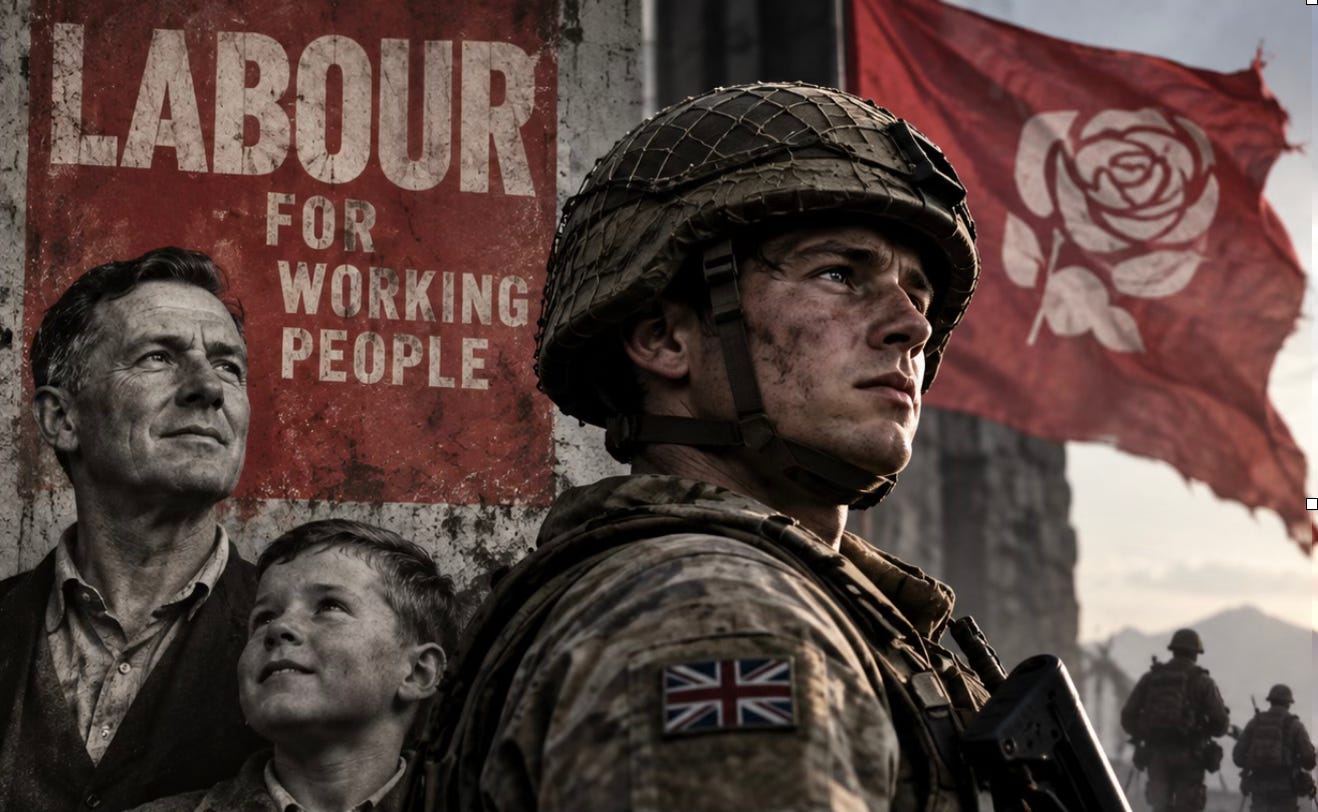
Responsibility for the use of military force is a bipartisan issue.
Governments of both parties have sent British servicemen into danger, and governments of both parties carry responsibilities towards those they sent.
But there is a particular point that Labour should reflect upon.
For generations, the British Armed Forces have drawn heavily from working-class communities. Many servicemen came from families where supporting Labour was not simply a choice made at each election. It was part of the family’s political identity, passed from one generation to the next.
And when Labour governments sent them to fight, they went.
Attlee committed British forces to the counter-insurgency campaign in Malaya. Attlee also decided to commit British forces in support of the US-led UN effort in the Korean War.
Wilson sent the Army onto the streets of Northern Ireland.
Blair sent British forces into Kosovo, Sierra Leone, Afghanistan and Iraq.
These were very different conflicts, fought for very different reasons. Some were justified. Others remain deeply controversial.
That isn’t the point.
The point is that the men sent to fight trusted the government that sent them.
The young soldier did not formulate British foreign policy.
He did not decide whether troops should patrol Belfast, enter Basra or deploy to Helmand.
Those decisions were made by ministers.
The serviceman accepted that an elected government had the authority to make them. Then he did what his country asked of him.
That relationship involves obligations in both directions.
Government can ask a young man to go somewhere he may be killed and, if necessary, to use lethal force against another human being.
In return, government assumes a responsibility towards those it sends.
That does not mean excusing criminal behaviour. A uniform cannot place anyone above the law.
But neither can government ask servicemen to carry the physical and moral burden of its decisions and then, decades later, allow political responsibility to disappear while the actions of individual veterans are examined again and again.
And that presents today’s Labour Party with a problem that goes considerably beyond veterans policy.
Many of the veterans affected come from Labour families.
Their fathers voted Labour. Their grandfathers voted Labour. In some cases they have voted Labour throughout their own lives.
Now some find themselves questioning an allegiance they once took for granted.
Not because they suddenly changed their values.
Because they are asking whether the party they trusted still feels the same obligation towards them.
That should concern Labour.
These men trusted Labour governments when those governments sent them into danger. They accepted the authority of the state, served where they were ordered to serve and lived with the consequences.
Some never came home.
Those who did are entitled to expect that the trust runs both ways.
If the state asks a man to risk his life in its service, the state acquires a duty towards him that does not expire when the operation ends.
And when a political party loses the trust of people whose families have supported it for generations, it should ask itself why.
UK citizens (including soldiers) trust neither Labour nor the Tories nowadays.
The Torries or Liebour and most definitely the waste of fresh sire Lib Dems haven't given a toss sbout the British people in decades. They'd rather cosy up to the Muslim, br used by them then when the rime is right be dumped by them. Muslim Brotherhood puppets!
They're all part of the Fabians and are now living out that dangerous orgs 140 plan
People should listen to Colin Brazier on the Triggernometry podcast and ex Army Officer on the Dozen podcast.
It's all a plan! And we do not feature in it. Except our hard work paying taxes for their welfare bill