

Three separate events this week have collided, exposing the real fault line in the Troubles legacy debate.
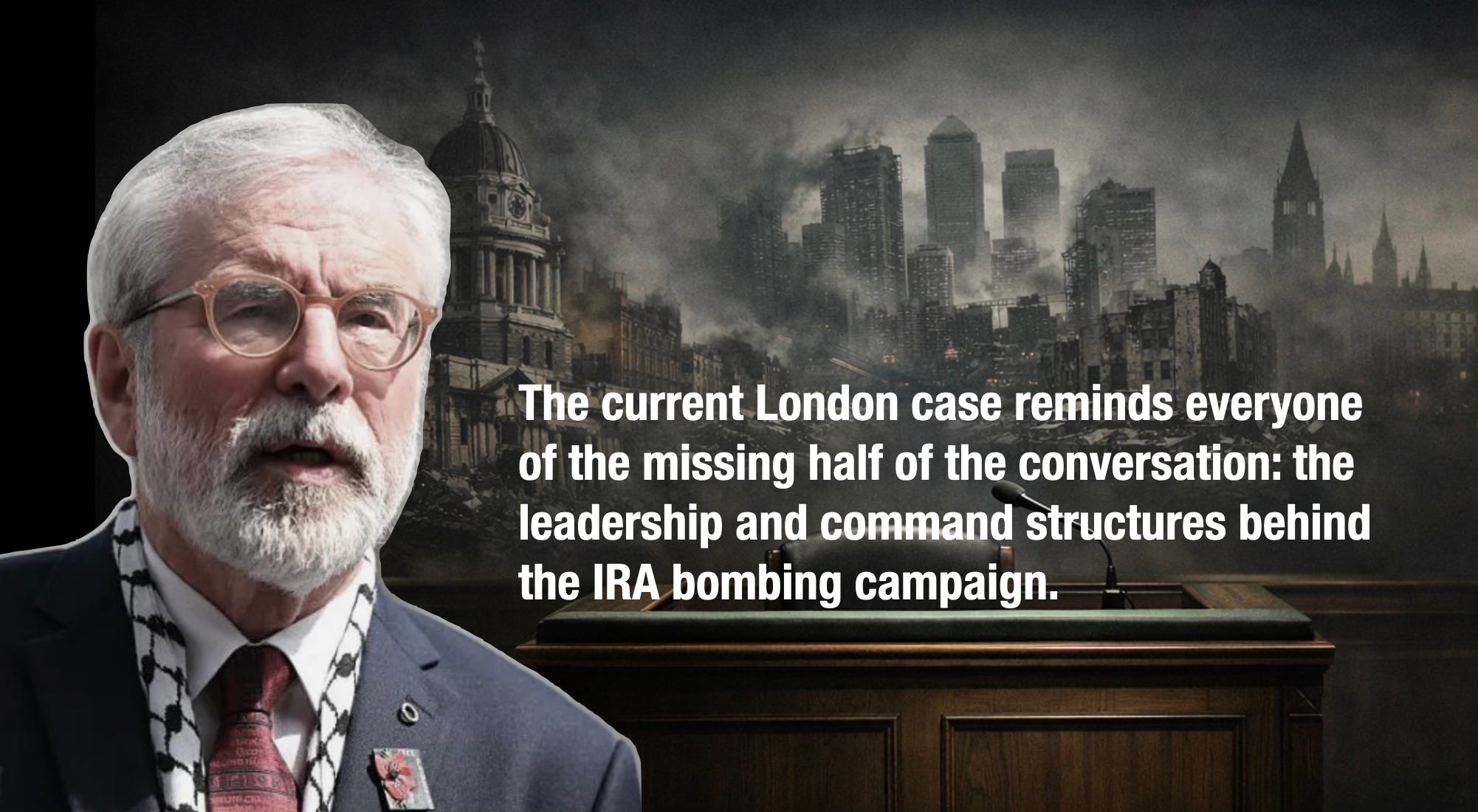
In London, Gerry Adams is facing a civil case in the High Court brought by victims of IRA bombings in the 1970s and 1990s. The claimants are not seeking compensation in any meaningful sense. They are seeking a finding of responsibility — even if only on the civil standard of probability — and symbolic damages of £1.
At the same time, veterans are briefing members of the House of Lords on the government’s attempt to repair the legal framework governing legacy investigations.
And within days, the British and Irish governments are meeting in Cork, where legacy cooperation and information-sharing form part of the wider political conversation.
Each event might normally pass as part of the slow churn of post-conflict politics. Together, they reveal something more important: the legacy question remains fundamentally unresolved.
For more than two decades, the dominant narrative around the Troubles has increasingly centred on the conduct of the British state. Soldiers and police have been examined, reinvestigated, and, in some cases, prosecuted for events dating back half a century.
That scrutiny is not illegitimate. States must answer for their actions.
But what the Adams case highlights is the extraordinary asymmetry that has developed.
The republican movement has long demanded the opening of every British archive, every military file and every intelligence record relating to the conflict.
Yet there has never been a comparable demand for disclosure from those who organised and directed the IRA campaign.
Where are the operational records?
Where are the command structures?
Where are the documents explaining how bombings were authorised, planned and executed?
The civil case now before the court revolves around three attacks on the British mainland — the Old Bailey bombing of 1973 and the Docklands and Manchester bombings of 1996. The victims are ordinary people whose lives were shattered by explosions in the heart of British cities.
They are not seeking vengeance. They are seeking acknowledgement.
That simple fact cuts through decades of political choreography.
Because the central question of the legacy debate has never really been answered: can a historical reckoning be credible if it operates overwhelmingly in one direction?
This question now hangs over Westminster.
The House of Lords debate will focus on how the government proposes to reshape the legal architecture for Troubles investigations. Peers will argue about amendments, legal standards and institutional structures.
But the Adams case reminds everyone of the deeper issue. A system that subjects soldiers and police officers to repeated scrutiny while paramilitary leadership remains largely untouched will never command broad public confidence.
The Anglo-Irish dimension adds another layer.
London and Dublin have been developing joint approaches to legacy matters, emphasising cooperation and information-sharing. That principle is sound. The conflict was never neatly confined within a single jurisdiction.
Yet cooperation must mean something more than procedural alignment. It must also involve honesty about the past on all sides.
If one side insists on exhaustive disclosure while the other offers only silence or selective memory, the resulting process will struggle to command legitimacy.
The truth is that the legacy question has been frozen for years because political convenience has been allowed to override historical balance.
This week’s convergence of events briefly disrupts that equilibrium.
A courtroom examining evidence from the past.
A parliament reconsidering how the past should be investigated.
Two governments discussing how the past should be managed.
For veterans, victims and anyone concerned with historical integrity, the lesson is simple.
The legacy debate is not settled. It is merely paused between moments when reality forces it back into view.
This week is one of those moments.
As an Irish patriot myself, it is totally disgusting that both Sinn Fein and the IRA constantly pretend that they speak for the Irish people, but the reality is that they simply don’t and in our times, their true colours have been fully revealed - the fact that British veterans are being dragged through the courts decades later for historical offences (and even their families if their loved ones have died in this horrific conflict in Northern Ireland) is beyond evil and yet traitor IRA and traitor Sinn Fein also bombed targets in Dublin and Monaghan in the Republic is proof of this, at the same time as they carried out attacks here in the U.K. and in Gibraltar, supported by Gadaffi’s regime in Libya - they are deeply hypocritical to have the sheer arrogance to claim they speak for the Irish people, how dare they attempt to do so - I was only a child in the Republic when Lord Mountbatten was murdered by the IRA in Co. Sligo and I remember the fallout from this horrific attack, yet I was so proud that the late Queen Elizabeth II got to visit my native Ireland many decades later 🇮🇪☘️🇬🇧🥰
My grandparents lived in northern Ireland when I was little the north south border was just down the road from their house. I'm not sure most people have a clue what it was like even when it was quiet. I've watched idiots lob grenades over police station walls and hotels blow up and that was just one summer in Enniskillen. The army had to come and get us out one summer when I visited with my uncle who was a serving British police officer and someone found out, he couldn't visit again after that. I've never understood why the army gets blamed for it all but the IRA were the hard done by angels 🤬, angels don't dissappear people for questioning what was happening.