

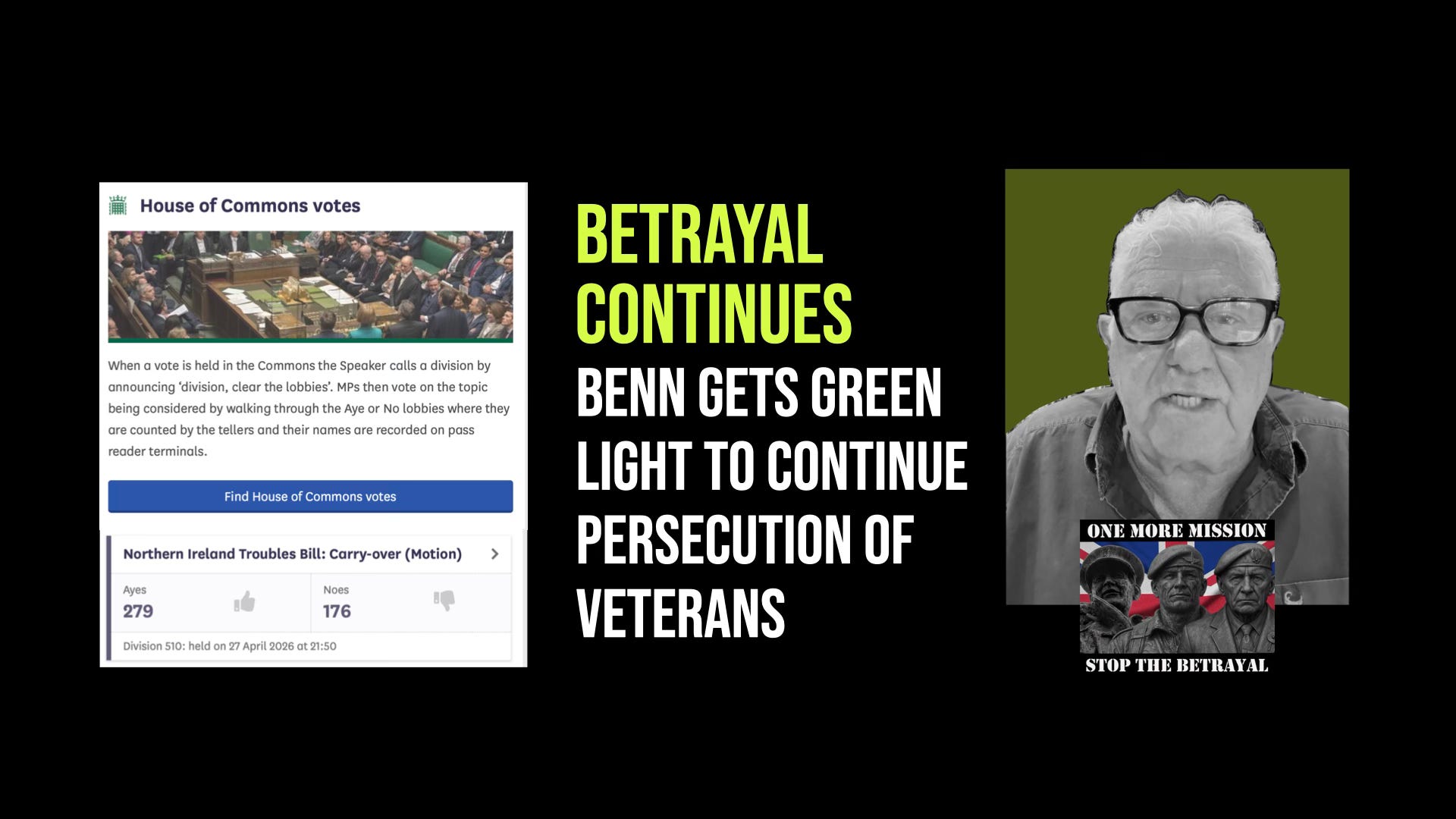
There are moments in politics when a result looks decisive on paper but unsettled in reality. The passage of the Troubles Bill is one of them.
On this episode of One More Mission, former Parachute Regiment officer Lt Col Simon Barry sets out a clear view: the vote went through, but the ground beneath it is moving.
The Government’s majority held — but not as comfortably as before. Absences mattered. The margin narrowed. And beyond Westminster, something more significant is taking shape.
Veterans are no longer waiting to be spoken for. They are writing to MPs, meeting them, and turning what was once treated as a distant, technical issue into a constituency problem. That changes the calculation. MPs can absorb criticism from a niche group. They struggle when that criticism spreads across families, communities, and voting blocs.
Barry’s point is blunt: the Government may have misread the country.
The figure often cited — around 300,000 who served in Northern Ireland — only scratches the surface. Each of those individuals sits within a wider network: families, friends, communities. Many of those communities are the same working-class base that historically supplied the ranks of the Armed Forces. Ignoring them is not just careless. It is politically short-sighted.
That shift is becoming something more powerful than a campaign — it is a growing movement. Reports from the doorstep during local election campaigning suggest increasing awareness — and simmering anger — about what is being done to veterans, not for them.
This is where the argument moves beyond numbers in a division lobby. It becomes about legitimacy.
The Government continues to frame the Bill as a necessary correction to a failed settlement. Barry does not dispute that the previous arrangements satisfied few and resolved little. But replacing one flawed structure with another that produces the same practical imbalance is not progress. It is repetition, presented more carefully.
The deeper concern is motive.
If this were simply about fixing defects in earlier legislation, it could have been done quickly and directly. Instead, the previous framework was discarded and replaced wholesale. That raises a harder question: what is driving this?
Barry points to a convergence of political and strategic considerations—relations with the Republic of Ireland, alignment with wider European priorities, and the persistent pressure of legacy narratives shaped beyond the UK’s control.
In that context, the risk is clear. History becomes negotiable. Responsibility becomes blurred. And those who carried out lawful orders on behalf of the state find themselves exposed to processes that show little regard for time, evidence, or proportionality.
This is where the language of “law” and “justice” begins to diverge.
The episode returns repeatedly to that distinction. Law, as it is currently applied, is seen by many veterans as a tool — something used, managed, and at times exploited. Justice, by contrast, is what is missing. The absence is not abstract. It is felt in the imbalance between those pursued decades after the fact and those whose actions have never been meaningfully examined.
That perception — right or wrong — now has political weight.
It also shapes how recent events are interpreted. Incidents of renewed violence in Northern Ireland are not seen in isolation, but through the lens of history: pressure applied at moments of political decision, followed by concessions. Whether one accepts that reading or not, it is part of how veterans and many in their communities understand the present moment.
Against that backdrop, engagement with government continues.
A meeting at Number 10 with representatives from regimental associations is pending. Barry is clear-eyed about it. Dialogue matters. But timing matters too. A meeting after a vote raises obvious questions about intent. Without substance — without commitments written into law — process alone carries little weight.
That is a recurring theme: if protections are not explicit, they do not exist.
The same applies to the Government’s proposed amendments. There is much talk of changes to come, of safeguards to be introduced. Yet little has been set out in terms that would materially alter the position of those affected. Meanwhile, key external actors have already signalled limits on what they will accept.
That leaves a simple, uncomfortable equation. If the Bill depends on external alignment, and that alignment rejects meaningful protections, then those protections are unlikely to appear.
Someone absorbs the cost.
Barry’s conclusion is not rhetorical. It is practical. The momentum is shifting, but it is not yet decisive.
The “Green Army” — the wider network of regimental associations and veterans’ groups — remains fragmented. That is changing. Conversations are taking place across units and associations that rarely act in concert. A broader coalition is beginning to form.
For the first time in years, there is a sense that voices are being heard — not centrally directed, but locally amplified.
That matters more than headlines.
The next phase will not be decided in Westminster alone. It will be shaped by constituencies, local media, and direct engagement between veterans and those elected to represent them.
The vote has happened. The argument is still very much alive.
Listen to the full podcast here:


