

There is a political technique so effective, so quietly devastating to principled opposition, that it has become the instrument of choice for governments wishing to do difficult things to the law. It does not require argument. It does not require evidence. It requires only a victim — real, sympathetic, and strategically placed.
We have seen it twice in recent months, in two bills that appear, on the surface, to have nothing to do with one another.
The first is the Courts and Tribunals Bill, which proposes to end jury trials in thousands of cases. The second is the Northern Ireland Troubles Bill, currently at committee stage, which repeals the immunity provisions of the Legacy Act and reopens the door to prosecution, civil action, and resumed inquests for events that took place half a century ago.
Different subjects, different ministries, different political pressures. But the same rhetorical architecture. And in both cases, the same question goes unanswered: when the government says it is acting for victims, who precisely bears the cost?
The jury trial revolt
When 3,200 lawyers wrote to the Prime Minister to protest the Courts and Tribunals Bill, and seven senior former judges signed a letter to The Times calling the changes unworkable, they were met not with counterargument but with counterpositioning.
Justice Secretary David Lammy placed victims at the centre of his defence — people waiting years for their day in court, trapped in a Crown Court backlog that has more than doubled since 2019 and now stands at nearly 80,000 cases. Critics were accused of “weaponising” victims. The irony appears to have gone unnoticed in government.
The backlog is real. The suffering of those who wait is real. But the Institute for Government has estimated that judge-only trials would reduce court time by around two per cent, even on optimistic assumptions. The victims are genuine; the causal chain between this specific remedy and relief for them is far weaker than the rhetoric implies.
What is being sold as a practical response to a crisis is, in constitutional terms, the removal of a right that has stood for centuries — the right to be judged by one’s peers. Opposition to that removal is reframed, through the victim prism, as indifference to those who suffer.
The Troubles Bill and the other victims
The same prism is at work in the Northern Ireland Troubles Bill, with higher personal stakes and older men in the dock.
The government’s stated reason for repealing the Legacy Act’s immunity provisions is unanswerable in its surface presentation: that immunity would have shielded terrorists — men who planted bombs, who shot civilians, who committed atrocities the full horror of which families have carried for decades. To oppose the repeal of immunity, on this framing, is to stand between grieving families and justice. It is to defend the indefensible.
What the framing occludes is who else falls within the bill’s reach.
Veterans now in their seventies and eighties. Most were young lads. They all served in units operating under rules of engagement that the state itself authorised. All acted in circumstances of operational complexity that no ministerial briefing note can now fully reconstruct.
They face reinvestigation, resumed inquest, and civil action.
Under the Legacy Act, more than 1,000 investigations were shut down — among them 225 into the deaths of soldiers and veterans. None of that is foreclosed any longer.
The pipeline of legal exposure, briefly sealed, has been unsealed.
The asymmetry is not merely prospective. It is already written into the history of the peace process itself. Paramilitary prisoners were released under the Good Friday Agreement after serving, in many cases, a fraction of their sentences.
More than four hundred so-called “comfort letters” — Letters of Facilitation issued under the On-The-Runs scheme — were sent to republican suspects between 2000 and 2014, effectively guaranteeing that named individuals would not be arrested if they returned to the United Kingdom.
The scheme was eventually ruled unlawful, but the political reality it created was not undone. Men who planted bombs, who murdered soldiers and civilians, who directed campaigns of terror, walked free or were never pursued. The state, in the interests of a peace it needed, made its accommodations.
That is a defensible political choice. What is not defensible is to make that choice on one side of the ledger and then present the other side as equally open for legal business, with the language of victim justice providing the cover.
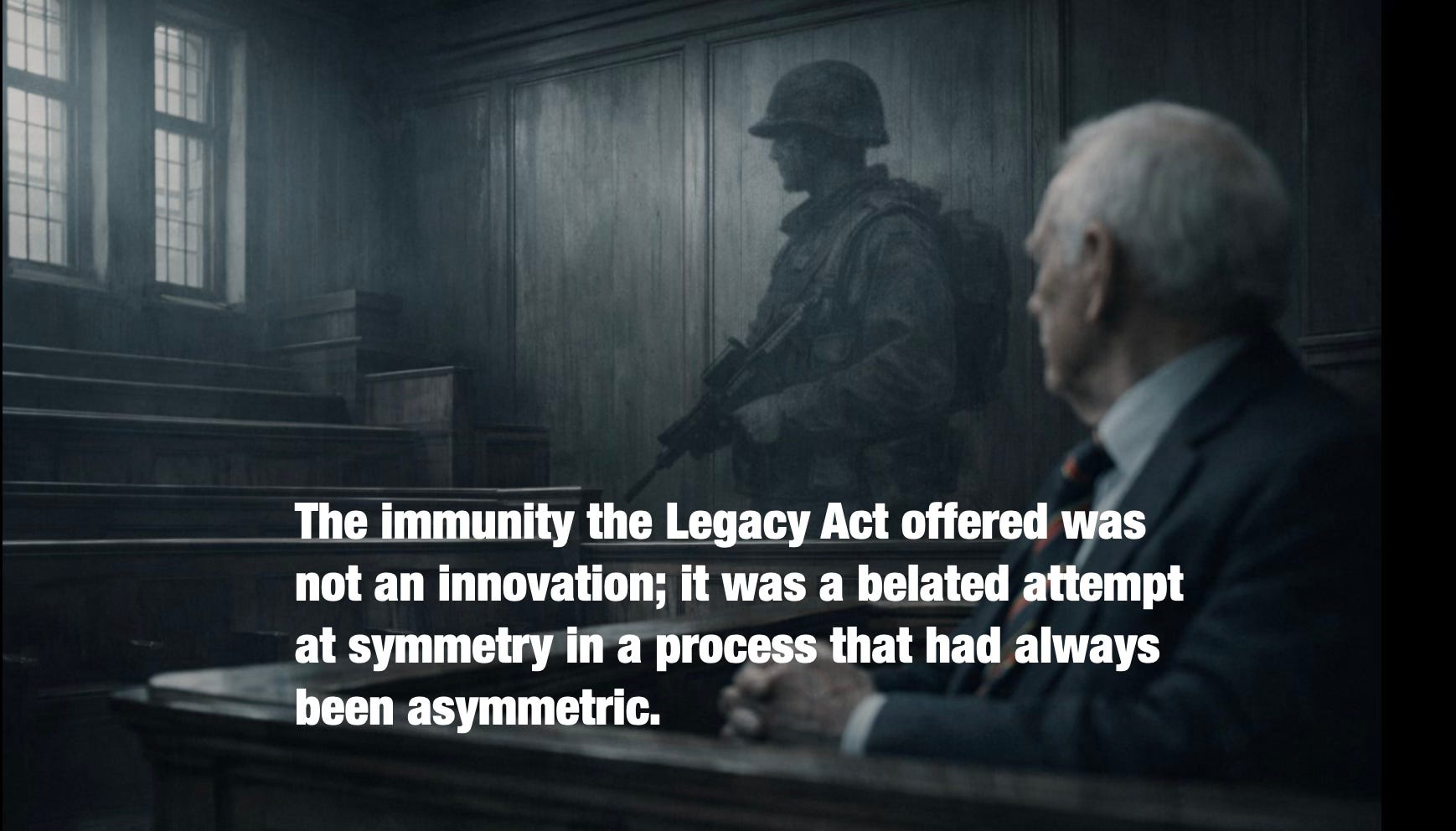
The immunity the Legacy Act offered was not an innovation; it was a belated attempt at symmetry in a process that had always been asymmetric. Repealing it does not restore balance. It removes the only formal protection extended to those who were never informally accommodated.
The government’s answer to veterans’ concerns is reassurance dressed as statistics. Just one soldier has been convicted since the Good Friday Agreement. The majority of live prosecutions concern paramilitaries. Veterans, the implication runs, should not worry.
But a single prosecution that ends without conviction does not establish that no wrong was done by pursuing it. It may establish precisely the opposite — that a case was brought, or sustained, not because the evidence warranted it but because the legal system had been made available as an instrument of pressure. The phenomenon has a name in contemporary strategic analysis: lawfare. The systematic use of legal process as a weapon — to exhaust, to stigmatise, to deter — is increasingly recognised as a component of grey-zone warfare, the space between open conflict and formal peace in which adversaries pursue political objectives through means that are technically lawful.
Northern Ireland did not end in 1998. The political contest over its narrative continues, and the legal arena has become one of its principal theatres. When veterans’ organisations speak of being subjected to vexatious claims, when solicitors operating in a specialised and ideologically coherent ecosystem pursue cases through every available avenue of domestic and international law, the question is not only whether a particular prosecution succeeds. It is whether the cumulative effect of legal exposure — the investigations, the lawyers’ letters, the resumed inquests, the civil claims, the years of uncertainty — constitutes, in aggregate, a form of warfare conducted by other means against men who are no longer young enough to bear it.
The government’s one-conviction statistic answers the narrowest possible version of this concern. It does not answer the broader one.
The question the government has not answered
Leading lawyers call the jury trial changes an "irremediable error". Nine retired four-star generals have warned that the human rights frameworks embedded in the Troubles Bill represent an existential threat to military morale and operational effectiveness. These are not fringe voices. They are not indifferent to victims. They are raising questions about what fairness under the law actually means when applied with consistency — not only to those who have waited decades for answers, but to those who may now, in the final chapter of their lives, be required to answer for actions taken in the service of a state that has since moved on.
The full picture is this: paramilitaries were released early, comfort letters were issued, political accommodations were made, and the law was then bent to accommodate. Veterans received none of those accommodations. They received, instead, decades of exposure to a legal environment shaped, in part, by those with strong political interests in a particular version of the Troubles narrative — and now, with the repeal of the Legacy Act’s immunity provisions, that exposure has been formally extended.
Consider the veteran who served in Londonderry in 1972 — a city whose very name remains, fifty years on, a contested political marker, with those who reject the constitutional designation preferring Derry as a signal of where their sympathies lie.
He is in his late seventies. In most cases, he has never been charged with anything. He served under orders in a conflict that has since been anatomised, memorialised, and politically settled in ways that bear little resemblance to what he experienced on the ground. Whether the law should reach him now is a serious question. Whether deploying the suffering of victims is a substitute for answering it seriously is, or ought to be, a settled one.
It is not enough to say that justice has been too long delayed. Justice delayed for one person is not automatically served by justice displaced onto another. And when the state that asks him to answer has already quietly made its peace with those who were shooting at him, the least it owes him is an honest account of what it is doing, and why.
This is a helpful article that throws light on the political contortions that have lead to the Jury trial and Legacy Act debates.
I agree with all you say in this article except for the sentence about "some young conscripts". In 1969 when British troops were first deployed in the Province, conscription had been ended nine years earlier, and any National Service conscripts had long since left the Armed Forces.