

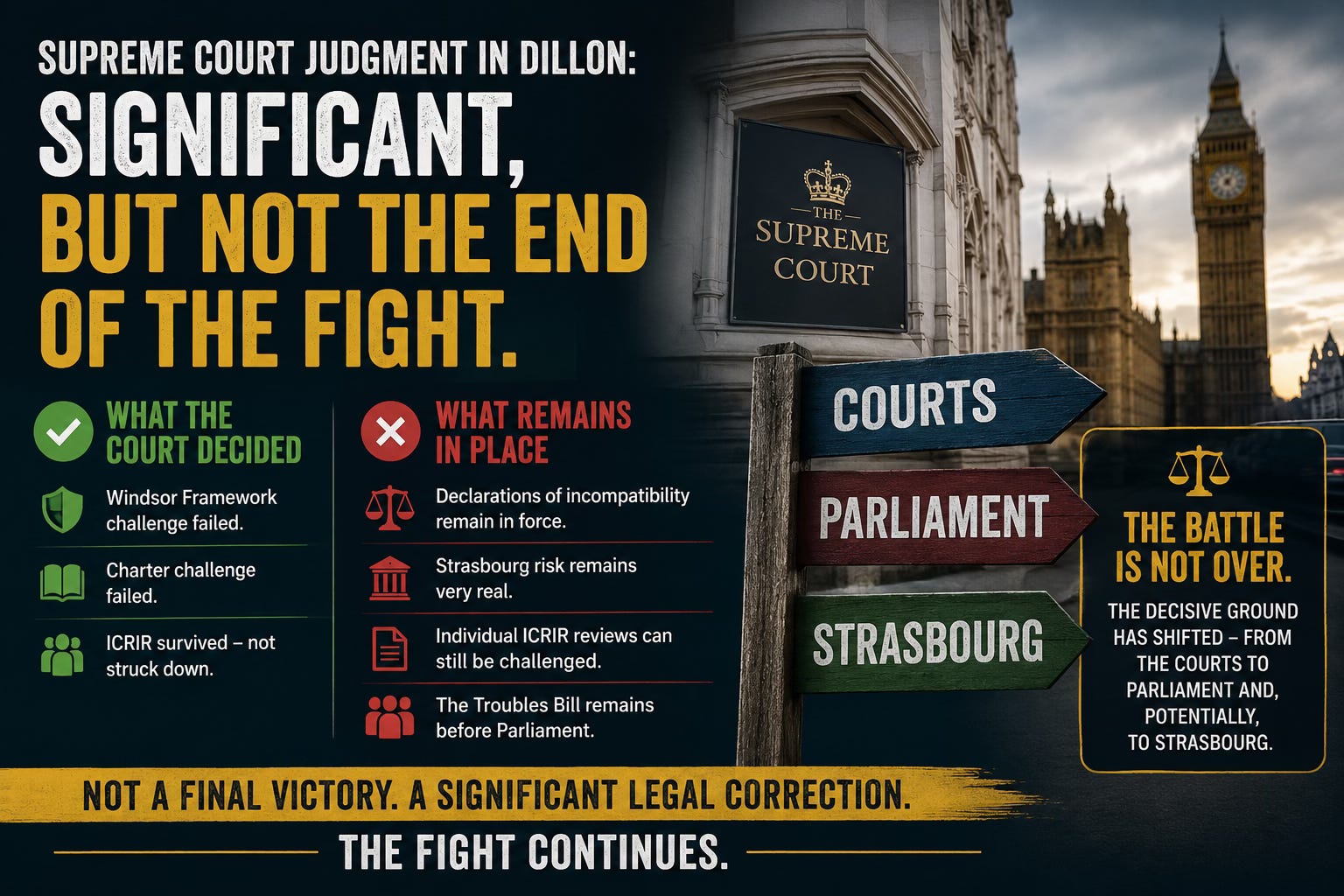
The Supreme Court judgment in Dillon is significant. But nobody should mistake it for the end of the legacy battle — and nobody should misread what the Court actually decided.
The judgment removes two major legal routes that had been used against the Legacy Act.
The Windsor Framework argument failed. The Charter argument failed. The ICRIR was not struck down — and the Court went further than merely preserving it in principle.
It actively accepted that the inquisitorial model was capable, in principle, of satisfying the state’s investigative obligations under Articles 2 and 3 of the Convention, finding that the Court of Appeal had been wrong to assess the ICRIR against the standards of the adversarial legacy inquest system.
That matters. But the judgment does not declare the entire framework settled or beyond challenge.
What Remains in Place Against the Government
Declarations of incompatibility under the Human Rights Act remain in force because the Government abandoned that appeal — a decision taken after the change of government following the July 2024 general election.
Those declarations cover:
The immunity provisions as incompatible with Articles 2 and 3 of the Convention
The civil claims bar under Section 43 as incompatible with Article 6
Section 8 on evidence admissibility as incompatible with Articles 2, 3 and 6
The Supreme Court confirmed that those declarations stand. It had no power to disturb them, and no appetite to do so.
Strasbourg risk remains real. The Court’s obiter treatment of the Veterans Movement’s reconciliation exception argument is instructive here. The Court found that the Strasbourg court has not established a reconciliation exception to the general rule that breaches of Articles 2 and 3 must be punished, though it has not ruled one out.
Under the domestic “mirror principle”, UK courts generally follow Strasbourg rather than anticipating new Convention principles before Strasbourg itself establishes them. The immunity provisions, therefore, remain exposed at Strasbourg, and the route there remains open.
The Troubles Bill also remains before Parliament and, if enacted, would significantly alter the legislative landscape — replacing the ICRIR, repealing the immunity scheme, allowing part-heard inquests to resume, and introducing legal representation for next of kin.
What the Judgment Does Not Close Off
The legal battlefield has narrowed, but it has not been vacated. Three fronts remain active.
First, Strasbourg proceedings are a realistic prospect. The declarations of incompatibility on Articles 2 and 3 provide a direct foundation for applications to the European Court of Human Rights. The reconciliation exception argument, while receiving no domestic endorsement, was explicitly preserved as a question Strasbourg has yet to resolve.
Second, individual ICRIR review challenges remain possible. The Court’s dismissal of the ab antechallenge — on the demanding standard that a breach must be shown in all or almost all cases — does not foreclose challenges to specific reviews once they are actually conducted. The Court was explicit that the effectiveness of an investigation can rarely be assessed until it is complete. Case-by-case challenges remain available.
Third, the Troubles Bill itself will generate contested terrain. Its provisions may give rise to fresh legal challenges from multiple directions.
The Supreme Court has removed the strongest arguments that the framework was legally unsustainable in its entirety. Any decision to repeal or substantially replace it now rests far more heavily on political judgment than legal necessity.
The Government can still say there are continuing legal drivers for change:
· Declarations of incompatibility remain formally in force
· Articles 2 and 3 exposure remains live at Strasbourg
· The Court did not endorse immunity as Convention-compliant
· The Court explicitly rejected, at least domestically, the reconciliation-exception argument
· Future ICRIR investigations can still be challenged individually
What Has Actually Shifted
The danger now is misreading the result in either direction.
For those who opposed the Legacy Act, the temptation will be to treat this as a decisive defeat. It is not. The declarations stand. Strasbourg exposure stands. The political battle over the Troubles Bill is live.
For those who supported the Act or who broadly welcome today’s outcome, the temptation will be to be complacent. That would be a serious mistake. The immunity provisions remain formally declared incompatible with the Convention. The Government that abandoned the appeal on that point has committed to repeal and replace the Act. The ICRIR’s legal viability has been confirmed, but its future remains uncertain pending the Troubles Bill.
The central issue has now shifted from whether the courts can collapse the framework to whether Parliament will dismantle or replace it by political choice. That is now the decisive ground.
For veterans, families, and all those with a stake in how this is resolved, the position is this: the Supreme Court has narrowed the legal argument and moved the decisive ground back to Westminster and, potentially, to Strasbourg. It has not delivered a final answer for either side.
This was not a final victory. It was a significant legal correction that changes the shape of the fight — without ending it.
Lawyers and Barristers will be only ones benefitting from this legal maze
Yet another load of "wrangling bollocks" that still offers no firm protection for veterans, or, fighting soldiers for doing their job on "The Battlefield!" This policy is clearly an appeasement to terrorist, thugs and criminals to use the law for their own benefit. Crafted and Choreographed by a toxic, fascist government and the so called "law practicing community."