

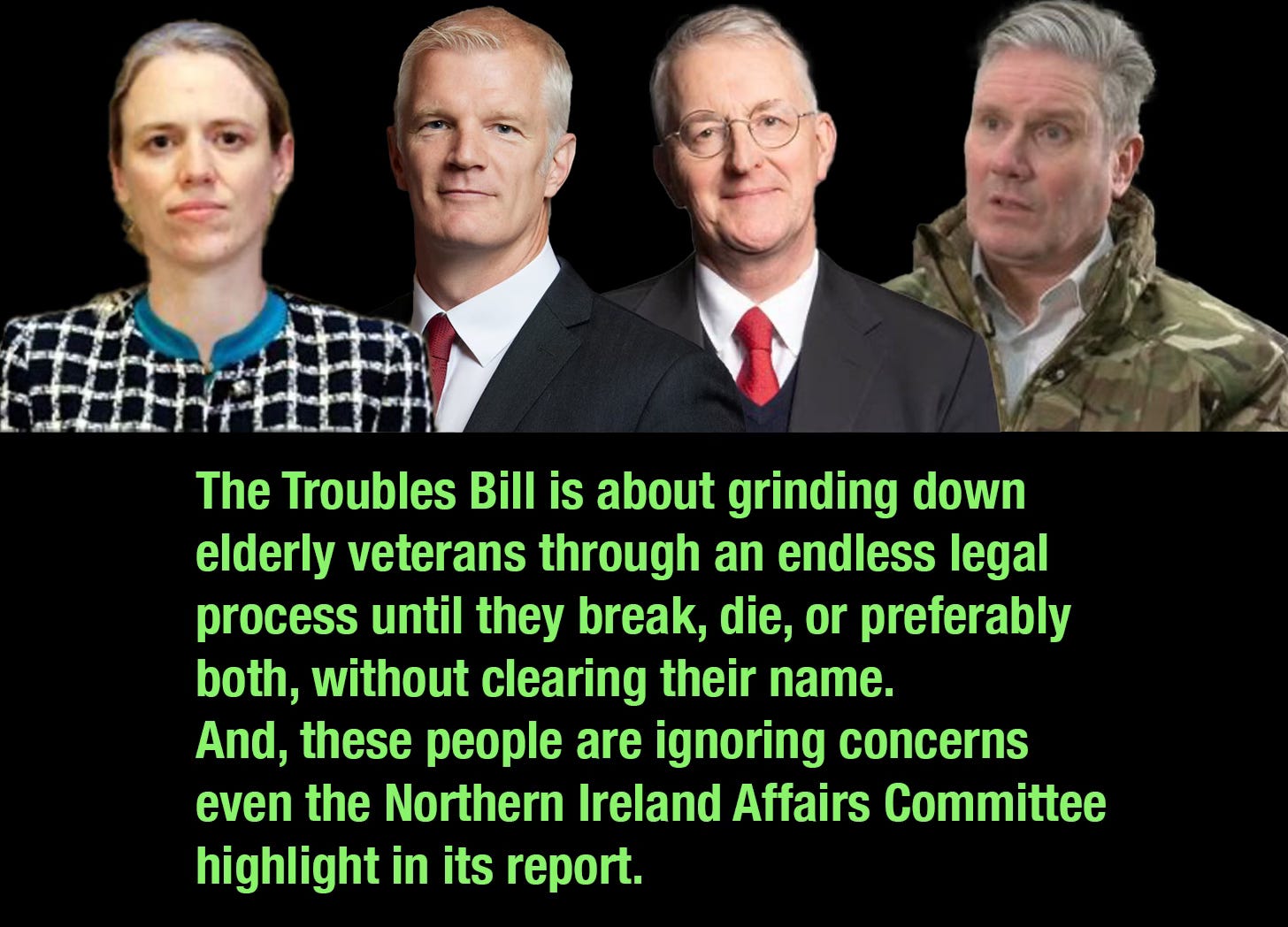
The Northern Ireland Affairs Committee (NIAC) just released its report on the Government’s legacy approach. For anyone worried about lawfare against Operation Banner veterans, it’s chilling reading.
NIAC is a Commons Select Committee that examines the expenditure, administration, and policy of the Northern Ireland Office and its public bodies. Its findings make clear, even to a casual reader, that this Bill is a complete betrayal.
Dismantling the 2023 Legacy Act
The 2023 Legacy Act, though flawed, tried to draw a line under the past. The Troubles Bill undoes every protection it offered.
· Immunity provisions removed—here’s the kicker: courts found these incompatible with the ECHR. The Government dropped the appeal before higher courts could rule. We’ll never know if that finding would have stood.
· Prohibition on new investigations removed — cases thought closed are being reopened.
· 38 legacy inquests shut down in May 2024 are being resurrected
· Five-year limitation period restarted from scratch — veterans who thought they had certainty now face indefinite jeopardy
· The time bar on prosecutions is effectively gone.
This isn’t reform. It’s demolition.
The “Six Protections” Lie
The Government trumpeted six new “protections” for veterans. The Committee’s report exposes this as a cynical rebranding exercise.
The Veterans Commissioner himself states: “..these are not veterans’ protections, in any way, shape or form. They are witness protections of which veterans can avail themselves.”
And it gets worse: “…these are not guarantees… things may happen. Some of it is in the gift of the coroner”
Critically, these “protections” do not apply to criminal proceedings—only to inquests and the Legacy Commission.
The Malone House Group, a Belfast-based non-governmental organisation (NGO), dismisses them as “mostly minimal administrative changes” with only one of any substance.
In effect, the Government is packaging basic witness safeguards as “veterans’ protections” while knowing full well they offer no real security against prosecution or the grinding trauma of repeated investigations and inquests. This highlights a troubling disconnect between what is promised and what is delivered.
“Trial by Media” Returns
Veterans opposed the Legacy Act’s closure of inquests not from fear of justice, but because of the fundamental unfairness of the coronial system.
The Committee heard that inquests have become “trial by media” with findings that “distort the rule of law of the time”.
The NI Veterans Commissioner states bluntly: “The vast majority of veterans in Northern Ireland would be totally opposed to the reintroduction of inquests.”
Yet the Bill restores them anyway. Why? Because, as the report makes clear, political optics trump fairness for those who served.
Reopening “Defective” Investigations = Infinite Jeopardy
Here’s a provision that should terrify every veteran: previous investigations can now be reopened if deemed “defective” or where there’s “new evidence.”
Ask yourself:
· Who decides what “defective” means?
· By what standard — 1970s or 2025?
· What constitutes “new evidence” — a witness suddenly “remembering” something 50 years later?
· Is there any limit to how many times an investigation can be reopened?
The answer is that there is no clear definition and no meaningful limits, only Indefinite jeopardy.
A veteran who thought his case was closed in 2015 could face reinvestigation in 2026. And again in 2030. And again in 2035. For split-second actions taken in 1972.
The Lawfare Infrastructure
The Bill doesn’t just remove protections — it actively constructs a prosecution machine:
Enhanced Powers:
· Legacy Commission gets “powers equivalent to those of a police service”
· Can initiate investigations without any referral or request
· Multiple bodies can refer cases (PSNI, Police Ombudsman, DPP, etc.)
Multiple Parallel Processes Veterans can face:
1. Legacy Commission criminal investigation
2. If insufficient evidence → Enhanced Inquisitorial Mechanism (a process judging on ‘balance of probabilities’—meaning cases are decided on whether something is more likely than not)
3. Coroner’s inquest
4. Police Ombudsman investigation
5. Civil proceedings
All of these can run simultaneously or sequentially, pursuing the same veteran for the same incident. The cumulative effect of these processes is deeply concerning for those involved.
Resource Imbalance:
· £250 million allocated to legacy mechanisms
· Irish Government adds €25 million for “participation and representation of victims”
· NGOs like CAJ, Pat Finucane Centre, with decades of experience
· Well-funded legal teams pursuing veterans
Meanwhile, veterans get minimal support and face these processes essentially alone.
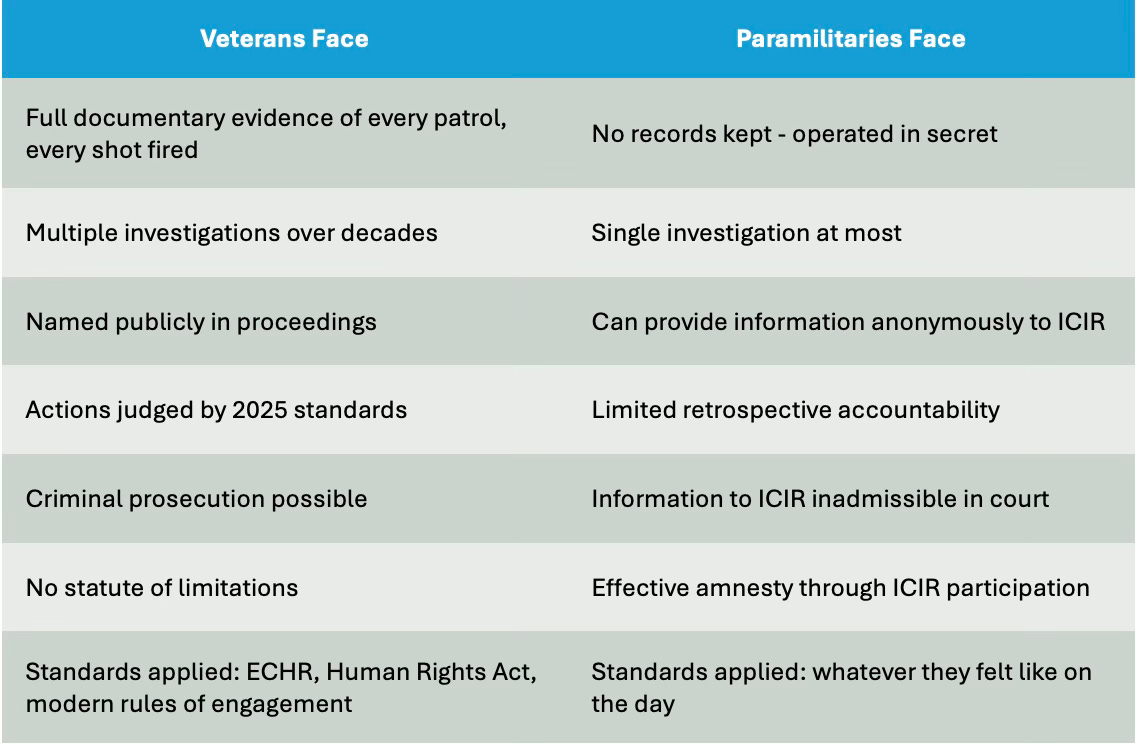
One side kept records. One side didn’t. Guess which side faces decades of legal pursuit?
The Veterans Commissioner asks the key question about Irish Government cooperation: “Who is scrutinising the Irish Government? Who is going to ensure that they provide all the information that they have?”
Answer: Nobody. The asymmetry is baked into the system.
Cross-Border Cooperation is a One-Way Street
The Irish dimension adds insult to injury:
· Extensive cooperation requirements for the UK authorities
· Irish Government commits to a “dedicated unit within An Garda Síochána” — but provides no Legacy Commission equivalent.
· No independent oversight of Irish investigations
· Irish Government contributing €25 million — for victim representation (i.e., prosecuting veterans)
· Veterans who operated along the border face Irish investigations with no equivalent accountability for Irish state failures.
The report notes that ICRIR has “still not met formally with the Commission at a strategic or operational level” despite the Joint Framework.
So much for equal partnership.
More Cases Than the Met
Buried in the report is this startling fact:
ICRIR has “more live murder investigations than the Met” with “102 investigations ongoing involving 182 deaths”
Think about that: a body investigating events from 30-60 years ago now has more active murder investigations than Britain’s largest police force does today, which deals with current crime.
This isn’t about justice. It’s about expanding a legacy industrial complex.
“Perception” - But Only When It Suits
The report repeatedly acknowledges that “perception matters in Northern Ireland” — but applies this principle with breathtaking hypocrisy.
Against veterans and former police:
· Senior PSNI/RUC personnel removed from commission leadership due to “perception” issues.
· Despite acknowledged integrity and professionalism
· Because nationalist community “perception” matters
For veterans:
· Concerns about inquest unfairness dismissed as “perception” problems.
· Fundamental unfairness of the system was waved away.
· “Perception” of veterans doesn’t matter.
The message is that some perceptions matter. Veterans don’t.
What “Reconciliation” Really Means
The report demolishes the reconciliation fig leaf:
· Secretary of State admits using the word in ICRIR’s title was “not fantastically helpful”
· 63% of Northern Ireland respondents believe reconciliation through these mechanisms is unlikely
· Yet investigatory and prosecution powers are being enhanced under this banner.
Reconciliation in practice means:
· Veterans face a lifetime of investigation.
· Paramilitaries can share information anonymously through ICIR with no risk of prosecution.
· “Truth” means documentary evidence against those who kept records.
· “Justice” means pursuing those who served under the Crown.
The Committee’s Own Witnesses Expose the Problem
Even witnesses sympathetic to the Bill’s aims revealed its flaws:
Sir Iain Livingstone(Operation Kenova lead officer): “My own view, and I say this as a suggestion, is that there might be a distinction to be drawn between those in the position of commissioner and those in the position of investigator... Having served in policing [in Northern Ireland], they can go and serve in the Commission, but perhaps not in the leadership or assessment of it.”
PSNI Chief Constable Jon Boutcher(former Kenova lead) agreed: “…to have people in senior levels is probably a bridge too far. That is probably a challenge, but it should not undermine the credibility, character, honesty and integrity of those people, because they are excellent people. I have complete trust and confidence in them, but it is about the perception of families.”
In effect, while these individuals are acknowledged as honest and competent, they are still being removed because of how it looks. Perception over justice prevails.
Timeline of Trauma
For a veteran, the Bill creates this nightmarish conveyor belt:
Year 1: Investigation opened by Legacy Commission (enhanced police powers)
Year 2-3: Investigation continues — your health deteriorates, legal costs mount
Year 4: Insufficient evidence for prosecution BUT...
Year 5: Case referred to Enhanced Inquisitorial Mechanism
Year 6: Public hearing — you give sworn testimony, media coverage, “balance of probabilities” findings published naming you
Year 7: Your reputation destroyed, but no criminal conviction... YET
Year 10: “New evidence” emerges (someone suddenly remembers something new)
Year 11: Investigation reopened as the previous one was deemed “defective” by current standards
Repeat indefinitely.
At no point is there finality. At no point can you move on. The process itself is the punishment.
Why This Matters Beyond Veterans
If you think this only affects veterans, think again. This Bill establishes several dangerous precedents:
1. Retrospective application of modern standards to historical actions taken under different legal frameworks.
2. No statute of limitations for state actors (while terrorists face no equivalent pursuit).
3. “Defective” investigations can be reopened indefinitely— chilling for any profession where standards evolve.
4. Multiple parallel proceedings for the same incident — double/triple/quadruple jeopardy in practice if not law.
5. Political considerations override legal fairness— “perception” justifies removing procedural protections.
6. Process as punishment— even without conviction, decade-long investigations destroy lives.
If they can do this to veterans who served under explicit state authority, they can do it to anyone.
The Committee’s Feeble Response
After documenting all these problems, what does the Committee conclude?
Despite acknowledging these issues, the report’s conclusion merely states safeguards should ensure investigations aren’t ‘punitive in nature’ — precisely what veterans argue the process has become, regardless of prosecution outcomes.
That’s it.
They identify the problem, hear the evidence, acknowledge the concerns... then conclude with meaningless platitudes about investigations not being “punitive.”
The entire process described IS punitive— that’s the point veterans keep making.
What This Really Represents
Let’s be clear about what’s happening here:
The 2023 Legacy Act, flawed as it was, represented an attempt to say: “The Troubles are over. We need to move forward.”
The Troubles Bill represents the opposite: They will pursue state actors indefinitely, through multiple mechanisms, with ever-evolving standards, until... well, there is no ‘until.’ This never ends.”
It’s lawfare by design:
· Remove immunity (and don’t appeal the court judgment that struck it down).
· Restore inquests (despite their documented unfairness).
· Create multiple parallel processes (Commission + Inquisitorial Mechanism + inquests + Ombudsman).
· Remove time limitations (restarting five-year clock, allowing “defective” investigation reopenings)
· Enhance investigatory powers (police-equivalent powers for the Commission).
· Enable indefinite jeopardy (”new evidence” can trigger reinvestigation forever).
· Package it as “protections” (that protect nothing).
This is definitely not about truth and reconciliation. It’s about grinding down elderly veterans through an endless legal process until they break, die, or preferably both, without clearing their name.
The Unasked Questions
The Committee’s report reveals questions they should have pressed harder:
1. Why drop the Supreme Court appeal on immunity provisions? Afraid higher courts might rule differently?
2. Why no statute of limitations when every civilised legal system recognises the need for finality?
3. Why multiple parallel processes for the same incident? How is that not oppressive?
4. Why apply 2025 standards to 1970s actions when even criminal law recognises you judge actions by the law at the time?
5. Why the asymmetry? If this is about “truth,” why does one side have records to examine and the other doesn’t?
6. Why call them “protections”when your own witnesses say they’re just basic witness safeguards?
7. What’s the endgame? When does this end? What does “success” look like?
They didn’t ask because they don’t want the answers.
A Betrayal Documented
This Committee report, intended to support the Government’s approach, actually documents a comprehensive betrayal:
✗ Protections from the 2023 Act systematically removed
✗ “Protections” for veterans exposed as meaningless rebranding
✗ Inquest system restored despite documented unfairness
✗ Indefinite jeopardy established through “defective” investigation provisions
✗ Multiple parallel processes created to pursue the same individuals
✗ No time limitations on investigations or prosecutions
✗ Fundamental asymmetry is baked into every mechanism
✗ Irish cooperation is a one-way street with no equivalent accountability
✗ £275 million funding infrastructure designed to pursue state actors
✗ “Reconciliation” rhetoric concealing prosecution focus
For every Operation Banner veteran, the message is clear:
You thought you could move on. You can’t. You thought investigations would end. They won’t. You thought 50 years was long enough. It isn’t. You thought serving your country meant something. It doesn’t.
This Bill doesn’t close the past. It weaponises it.
And the Committee, despite documenting every problem, waves it through with empty words about proceedings not being “punitive in nature.”
The process described IS the punishment. That’s the entire point.
For veterans reading this: The Committee heard you. They documented your concerns. They acknowledged the problems. Then they recommended that the Bill proceed anyway.
That tells you everything you need to know about how much your service is valued.
So much for the Military Covenant; this Government of left wing lawyers is despicable. Why anyone would join-up now is beyond me.
The insidious political self interest of the day in all spheres is adversely affecting the lives of many. The self serving ideological political class is no longer concerned with constituent representation and deserves no respect whatsoever.
Let us hope their demise is both swift and permanent.