

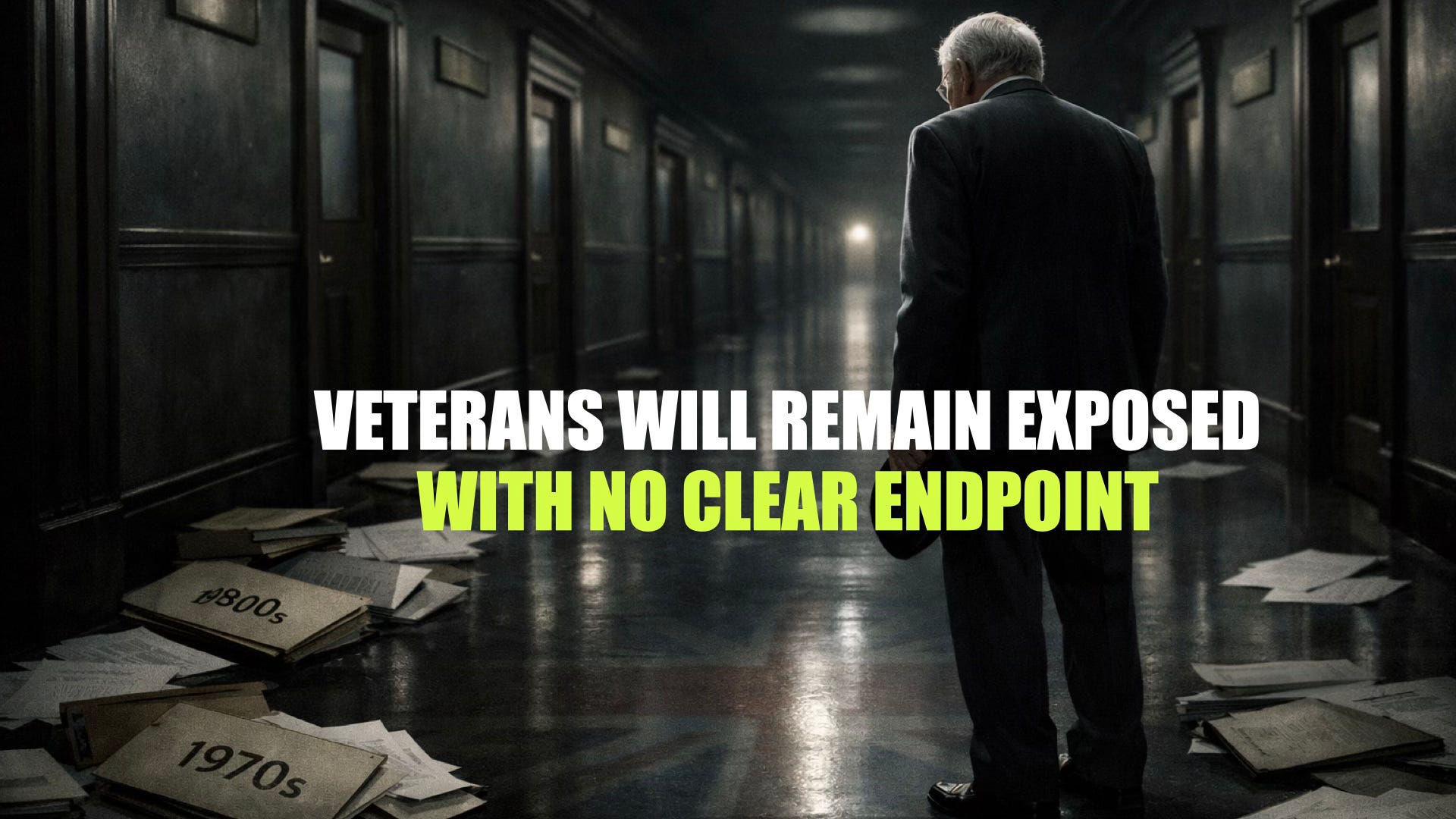
The Government insists it is refining the Legacy framework. Amendments are coming. Assurances are being offered. Language is being carefully adjusted. Yet for all the movement, the central question remains stubbornly unanswered: when does it end?
That is not a rhetorical flourish. It is the point on which the entire debate turns. For many veterans, the issue is not whether scrutiny should exist, but whether it should be able to continue indefinitely. On that, the current proposals offer little comfort.
Take the much-trailed attempt to address “equivalence”. Ministers are wary of placing any blunt statement in statute that distinguishes between lawful military action and terrorist violence. Instead, they lean on context — explanatory notes, statements in the House, and guidance to whatever body ultimately oversees the process. This is politics doing what politics does: softening language to hold together a fragile consensus.
But law does not operate on hints. It operates on what is written down plainly. If the distinction is not anchored in statute, it is open to reinterpretation — by courts, by future governments, and by the evolving machinery of human rights law. Veterans are right to treat such assurances with caution. They have seen where ambiguity leads.
The same pattern repeats with “protections”. There is talk of codifying existing practices — how evidence is taken, how individuals are approached, how the process is managed. All sensible, as far as it goes. But it does not go very far. Making a process more humane does not answer the deeper question of why the process exists In its current form at all.
For those caught up in it, the experience is not abstract. It is years of uncertainty. It is the knowledge that a case thought closed can be reopened. It is the slow grind of legal exposure without a clear endpoint. One veteran, involved in an ongoing inquest appeal, has spent three years wondering whether he will ultimately face a murder charge. That is not an outlier; it is increasingly seen as typical.
This is why the focus on procedural refinement misses the mark. The objection is not to how the system operates, but to what it permits. A process that can be revisited, appealed, and extended over decades becomes, in effect, a form of punishment in its own right — regardless of outcome.
Nowhere is this more evident than in the question of inquests. These remain the most potent mechanisms for reopening cases. They are open-ended, subject to appeal, and capable of running for years at considerable public expense. The Government proposes a new Legacy Commission, ostensibly designed as a more coherent and “fit for purpose” body. Yet inquests are allowed to continue alongside it, creating a parallel track that undermines any claim to finality.
It is difficult to avoid the conclusion that this is a political compromise rather than a legal necessity. Some cases proceed through one route, others through another. The result is not clarity, but duplication — and the near certainty of prolonged litigation.
Ministers will point, not unreasonably, to the fact that engagement is ongoing. Meetings are being held. Veteran representatives are being consulted. Draft amendments, we are told, are being shared in advance.
But consultation is not measured by the number of meetings held. It is measured by the changes that result from them.
On that test, the picture is less reassuring. The same core concerns are raised—about equivalence, about repeated legal exposure, about the absence of any meaningful finality — and yet the structure of the Bill remains largely intact.
Language is adjusted, processes are refined, but the underlying problem remains.
It is difficult to avoid the impression that engagement has become procedural rather than substantive: something that must be done, and seen to be done, rather than something that alters outcomes.
Officials can accurately say that they have consulted veterans.
Veterans, with equal accuracy, can say that they have not been heard.
That gap matters.
Not simply as a matter of tone, but of legitimacy. Legislation of this kind cannot rely on technical compliance alone. It depends on the confidence of those most directly affected. If that confidence is absent, no amount of careful drafting will compensate.
Ministers argue that improvements to the investigative and prosecutorial system will strengthen confidence. Better information sharing, more robust decisions, fewer weak cases brought forward. All of this sounds reasonable. Yet it sidesteps the underlying issue: confidence is not simply a matter of process, but of trust. And trust, once lost, is not easily restored by administrative reform.
Among veterans, the perception has taken hold that the system is not neutral.
That perception — fair or otherwise — is now a political fact.
Repeated investigations, collapsed trials, and cases that run for years before failing to meet the evidential threshold have all contributed to it. One need not accept every claim of “vexatious prosecution” to recognise that something in the system is not working as intended.
What, then, would address the concern?
The answer, often stated but rarely embraced, is straightforward: a clear legal threshold.
If a soldier acted under lawful orders and within the Rules of Engagement, there should be a presumption against prosecution unless compelling new evidence demonstrates otherwise. Without such a provision, the possibility of re-litigation remains open—and with it, the sense of living under permanent legal jeopardy.
This is where the Government hesitates.
To draw that line explicitly risks conflict with its interpretation of human rights obligations, particularly under Article 2 of the European Convention. However, avoiding drawing it leaves the system fundamentally unchanged. The result is a Bill that seeks to reconcile incompatible aims: legal compliance, political acceptability, and reassurance to those most affected. It succeeds fully in none of them.
There is also a question of timing.
The push to move to Committee stage quickly, with limited opportunity for consultation, has not gone unnoticed. Veteran groups, including some of the most senior and credible voices, are already expressing concern.
With Veterans Commissioners being brushed aside, the damage will not be easily repaired. Legislation of this kind depends not only on legal coherence but on moral authority. Lose the latter, and the former will not carry the day.
None of this is to deny the complexity of the issue.
The legacy of the Troubles is not easily resolved. Competing claims, contested histories, and the demands of law all press in different directions. But complexity is not an excuse for evasion. At some point, a decision must be made about what the system is for.
Is it to establish facts and draw a line under the past? Or is it to preserve the ability to revisit that past indefinitely, in the hope that justice, however defined, might eventually be satisfied?
At present, the answer appears to be both. That is precisely the problem.
The Government can still secure the Bill’s passage. It may even claim progress. But unless it addresses the question of finality—clearly, explicitly, and in law—the underlying issue will remain. The process will continue. Cases will be reopened. And those who once served will find that, decades on, they are still not quite finished with the past.
For them, the ‘Troubles’ ended long ago.
The legal aftermath has not.
Whether it ever will, remains to be seen.
The State's refusal to accept findings at various historical court hearings can only be a "best of three" attempts to ensure that those who waged a war of Terror within the YK and NI are found to be the great liberators rather than the terrorist aggressors they once were and probably still are. This State, our HMG taking up this support of terror against those who legally defended the UK and NI, can only be seen as complicit in all those terrorist activities that cost so many lives over many years. If any UK laws were broken or abused then the forensic trail leads back to HMG.
Scrap the Fkn Bill once and for all. Jail Adams and company. Along with Starmer and those lawyers and "what nots" who are all making money from this ludicrous affair! Then we'll have a nice clean start point! On Our Terms!