

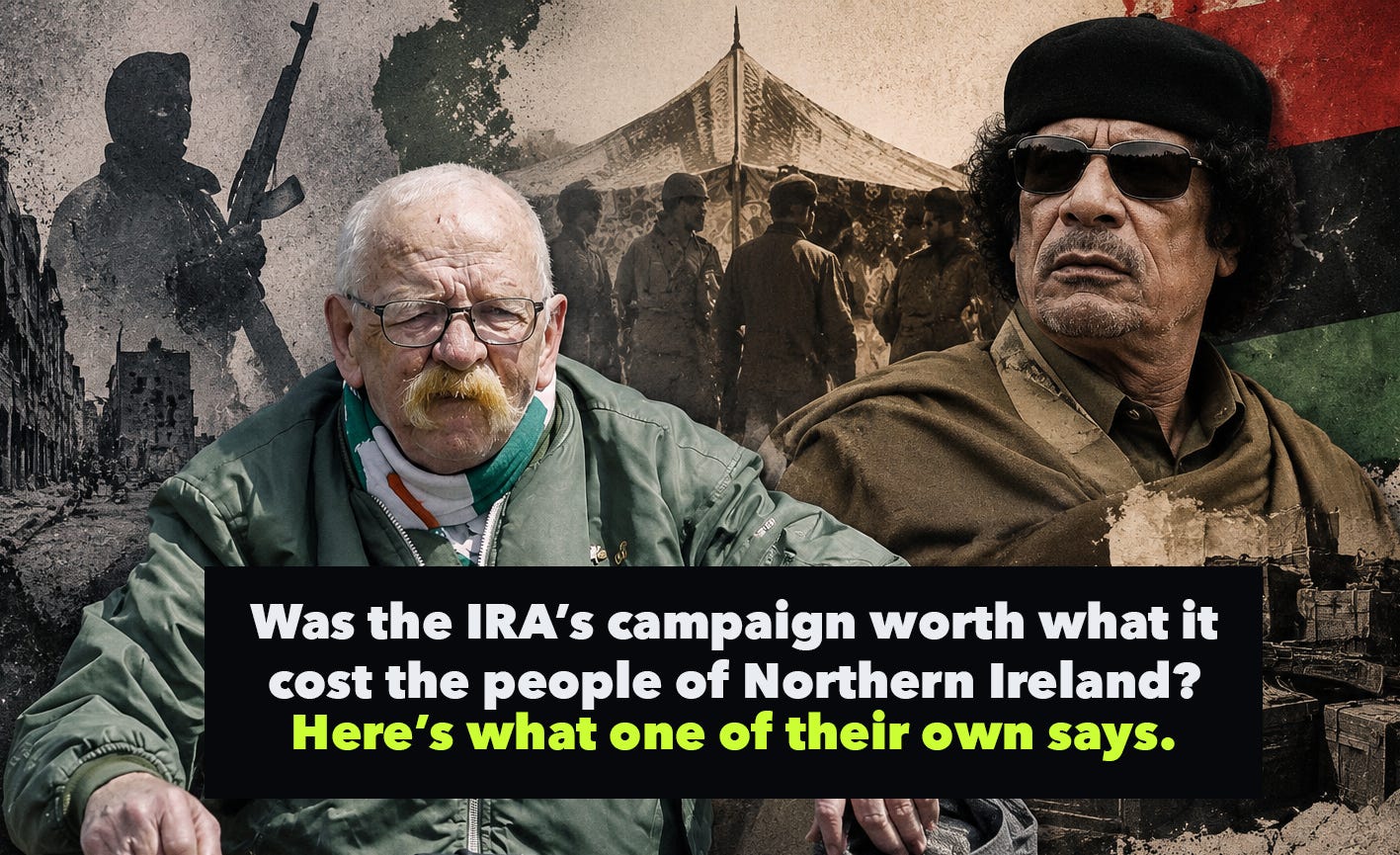
What did the IRA’s armed campaign actually achieve?
It is a question worth asking because one of the men who fought that campaign has given a remarkable answer.
Billy “Blue” Kelly was no armchair republican. He was an IRA gunman and sniper who admitted killing British soldiers. He went to prison. In 1972, he was part of the IRA delegation that travelled to Libya and persuaded Colonel Gaddafi to supply the organisation with weapons and explosives.
Before his death, Kelly recorded an interview that he insisted should not be published until he was gone.
His conclusion was stark:
“The IRA campaign wasn’t worth the loss of a single life, never mind nearly 4,000.”
And then he addressed the central question:
“The IRA gained nothing from this war. Any changes came about as a result of civil rights and changes in employment and equality law. We fought to get the Brits out of Ireland, but we failed.”
That raises a question which deserves serious examination.
What did the IRA’s armed campaign achieve that could not reasonably have been achieved through civil-rights agitation, democratic politics and constitutional reform?
And were any additional gains proportionate to the human, social, political and economic costs of the campaign?
The IRA’s objective was not better employment law or improved civil rights. It was to end British rule in Northern Ireland and achieve a united Ireland.
It did not achieve that objective.
Meanwhile, thousands died. Many more were injured. Communities lived with bombing, shooting, intimidation and fear. Vast resources were consumed by terrorism, counter-terrorism and repairing the physical and social damage of the conflict.
A counterfactual is also rarely confronted.
What might Northern Ireland have become had those decades instead been spent pursuing reform through civil-rights campaigning, democratic politics and constitutional negotiation?
We cannot know. But the existence of reforms at the end of the Troubles cannot simply be offered as proof that three decades of violence were necessary to obtain them.
That causal link has to be demonstrated.
Kelly’s testimony is important because it comes from inside the movement. Stripped to its essentials, his argument is:
We had an objective.
We used violence to obtain it.
We did not obtain it.
And the genuine improvements that did occur came through another mechanism.
Kelly went further. He said he had wanted to say this for a long time, but believed that if he had spoken while alive he would have been “castigated and pressurised into retracting it”.
Perhaps that is the question his final interview leaves behind.
Not who won the Troubles.
Not whose mythology should prevail.
But something considerably more difficult:
Was the IRA’s campaign worth what it cost the people of Northern Ireland?
Fear of speaking out
There is another question raised by Kelly’s interview, and perhaps an even more disturbing one, especially at a time when elderly veterans continue to face the possibility of their conduct being examined and re-examined through legacy investigations, inquests and other legal processes.
Why did an IRA veteran believe he could only tell his version of the truth after he was dead?
Kelly told the journalist that publishing his views while he was alive would get him “in big trouble”. He said that if he had spoken previously, he would have been “castigated and pressurised into retracting it”.
Consider the contrast.
The state continues to build elaborate legal mechanisms to examine events from half a century ago. The present Government says its legislation will prevent unnecessary repeated investigations of veterans, while still allowing some legacy cases to proceed. The very existence of those proposed safeguards acknowledges the problem created by repeatedly examining the same historic events.
Yet here was a man who had actually been an IRA gunman, admitted killing British soldiers and helped secure weapons from Gaddafi, saying that he dared not publicly challenge the republican account of the conflict until he was beyond the reach of those he feared.
That deserves attention too.
How many former participants privately question the stories they are expected to repeat publicly?
How many people who lived in communities dominated by paramilitary organisations have different accounts of what happened, what was done in their name and whether it achieved anything?
And how complete can our understanding of the Troubles ever be if some of those voices still believe silence is safer than speaking?
Truth cannot mean endlessly examining one set of people while others remain afraid to tell their own stories.
Nearly three decades after the Belfast Agreement, nobody should have to wait until death to say what they believe happened.
Hi brave warrior veterans and folks that support us. A book by an IRA gunman thug, speaking from his grave? This has absolutely no bearing on the Veterans' story! Our fight our plight for fairness, and above all; JUSTICE. Comes from the mouths of those who wore the uniform in the field of combat, to take down an enemy intent on destroying, disrupting, and killing the citizens and soldiers of Northern Ireland and the United Kingdom! The book maybe a fascinating read for the "Political Plebs" in Westminster and even for some Wokes that sit in Whitehall! Where are the eyes of this disgraceful government focused! Certainly not where the Veterans' Story is! Also we're playing into the hands of Sinn Fein and the IRA (same thing!):by encouraging a short crow on some IRA arse wipes book. Leave it where it belongs, in the ground!