

There is a point at which a debate stops being about tone and becomes about terms.
That point has now been reached.
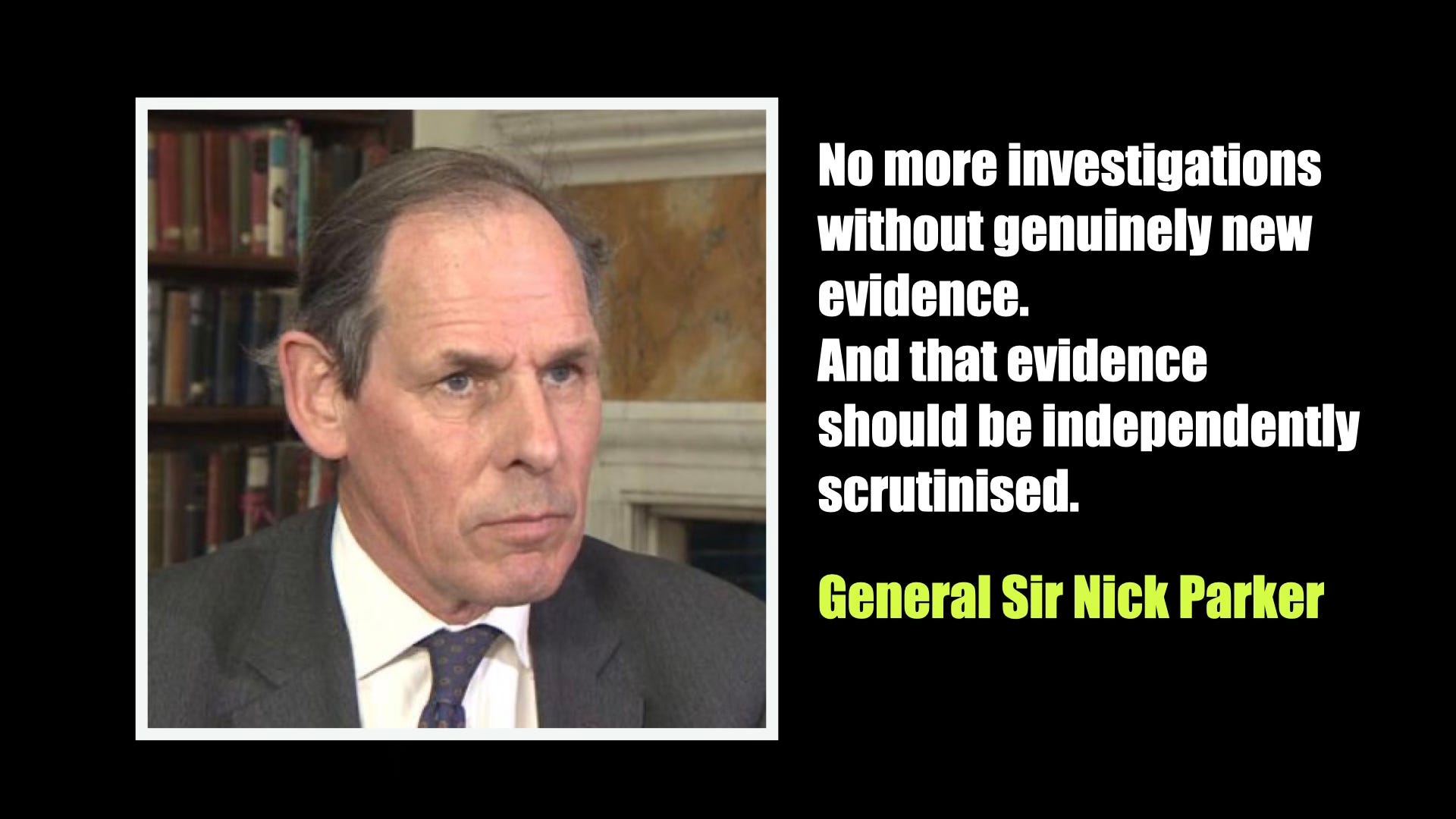
In his recent interventions — on Cool FM, in his Belfast Telegraph interview, and in The Spectator, where he argues the bill must be stopped — General Sir Nick Parker, who served as the last operational General Officer Commanding in Northern Ireland, has done something that has been largely missing from this discussion.
He has set out a clear threshold.
No more investigations without genuinely new evidence.
And that evidence should be independently scrutinised — in his words, by a Supreme Court judge.
That is not rhetoric. It is a line.
It matters because it cuts through the central evasion that has defined the debate for years. The issue has never been whether serious wrongdoing should be investigated. Parker is explicit: where there is compelling new evidence, investigation must follow.
What he rejects is something different — and far more corrosive.
The recycling of cases.
The steady lowering of the bar.
The assumption that process itself is a substitute for justice.
This is where his argument now carries weight beyond the veterans’ community. It is no longer framed as grievance. It is framed as proportion.
a threshold that means something
a process that leads somewhere
a system that knows when to stop
Without that, there is no resolution. Only continuation.
Parker also introduces a point that has been largely avoided in public discussion.
Accountability must follow responsibility.
In the Belfast Telegraph interview, he states plainly that those in the chain of command — those who gave the orders — should be held to account, not simply the man on the ground. At the same time, he makes clear that the orders issued during his own service were lawful, understood, and operated under the accepted rules of the time.
That is not a contradiction. It is a correction.
It dismantles two convenient positions at once:
that senior officers are shielding everyone below them
that accountability can be selectively applied to ageing veterans at the sharp end
What Parker is saying is more serious than either.
If the framework was lawful, if the orders were lawful, and if soldiers acted within that framework, then responsibility cannot be retrospectively reallocated to those least able to defend themselves decades later.
That is not accountability.
It is displacement.
And it raises a question that sits behind the entire Operation Banner issue:
Is the state prepared to stand behind the system it created — or will it allow that system to be quietly rewritten, with the burden falling on those who carried out its instructions?
His earlier remarks reinforce the same point from a different angle.
Veterans, he says, are in danger of becoming a “punch bag” — used to absorb the consequences of a process that has not been properly thought through.
That is not a slogan. It is an observation of how systems behave when political decisions are avoided.
Because that is the underlying failure here.
In The Spectator, Parker makes the strategic point more plainly: the Good Friday Agreement worked because it drew a line, not because it attempted to resolve everything. The current trajectory — repeated investigations, retrospective reinterpretation, and no finality — risks unpicking that balance.
That required discipline.
What Parker is identifying — carefully, without exaggeration — is the erosion of that discipline:
Legal process expanding without clear limits
Repeated investigation without meaningful thresholds
A narrowing focus on state actors
No credible mechanism for finality
This is not resolution. It is drift.
There is also a forward-looking warning embedded in his argument.
If those asked to act on behalf of the state come to believe that lawful decisions, taken under pressure and in accordance with the rules of the time, will be revisited decades later under different standards, behaviour changes:
Hesitation grows
Initiative declines
Confidence in political backing weakens
This is not theoretical. It goes directly to the moral component of fighting power.
And it will shape future operations just as surely as it is reshaping the past.
But Parker ends on something more human — and more uncomfortable.
Asked whether this conversation will still be happening in 20 years, he answers bluntly: “Well, I really hope not. Two things. The first is all of us will be dead, which might to a degree help, because the young of today, I hope the young of today are becoming tired of it…My second point is that there’s a generation growing through this who must sometimes look at what’s going on and think, why can we not just move forward?”
That cuts through more cleanly than any policy paper.
Because it exposes what the current trajectory cannot provide:
Closure
Settlement
Confidence that the process has an endpoint
Instead, what is offered is continuation — managed, procedural, and indefinite.
For Operation Banner veterans, the significance of Parker’s intervention is straightforward.
The argument has now been clarified at the senior level:
Investigate where there is genuinely new and compelling evidence
Set that threshold independently and properly
Recognise the lawful context in which decisions were made
Align accountability with responsibility, not convenience, and
Bring the process to a close
This is not a radical position.
It is the position that should have underpinned the system from the start.
The fact that it now has to be restated — by those who commanded operations on the ground — tells its own story.
The question is whether anyone in political leadership is prepared to act on it.
Because if not, the direction is already clear.
And it is not towards resolution.
The Polticians prior to & throughout Op Banner and many other operations at the highest levels "sign off" overt & covert continuous tasks whilst enjoying their 3rd coffee.
Bring them to account??
😎😎
Thank you Sir……another poke in the eye for the disreputable, conniving Starmer. Loving it!