

When Parliament approved the Remedial Order on 21 January 2026, Hilary Benn told the Commons that the conditional immunity scheme was a “false promise” and “completely undeliverable”. He stated the measures “were never implemented” and had been “struck down by our courts.”
That line now underpins the Government’s justification for dismantling the Act and reopening the legal terrain.
It does not withstand even light scrutiny.
The weakness is simple. It rests on an adverse finding by one judge that the Government chose not to test to the end.
A Northern Ireland judiciary paper (April 2025) makes this clear: the High Court’s findings on Convention compatibility were not pursued because the appeal was withdrawn in July 2024. The Court of Appeal summary in the Bridie Brown case confirms that, following the Dillon ruling, officials had already begun work on a remedial order.
That is the pivot:
One court found parts of the Act incompatible
The Government chose not to pursue the appeal
The finding, therefore, stands unchallenged
That does not make the ruling unreal. But it does mean the conclusion now presented as settled law was never fully contested.
Benn turns that into a broader claim: that the entire immunity offer was a sham.
That is rhetorically effective. It is also — to put it mildly — legally overextended.
A more accurate position would be this: the scheme faced serious legal difficulty, and the Government chose to concede rather than defend, amend, or refine it.
There is a further point often overlooked. Benn has argued that the scheme was never commenced and therefore never had effect. That is correct. No one received immunity.
But that is not the same as proving the scheme could not have been made to work. It simply means it was never brought into force.
What is being presented as impossibility is, in reality, abandonment.
The deeper issue is not that defects were identified. It is that those defects were accepted and then used to close down the argument entirely. A political decision is being framed as a legal inevitability.
And that is only half the picture.
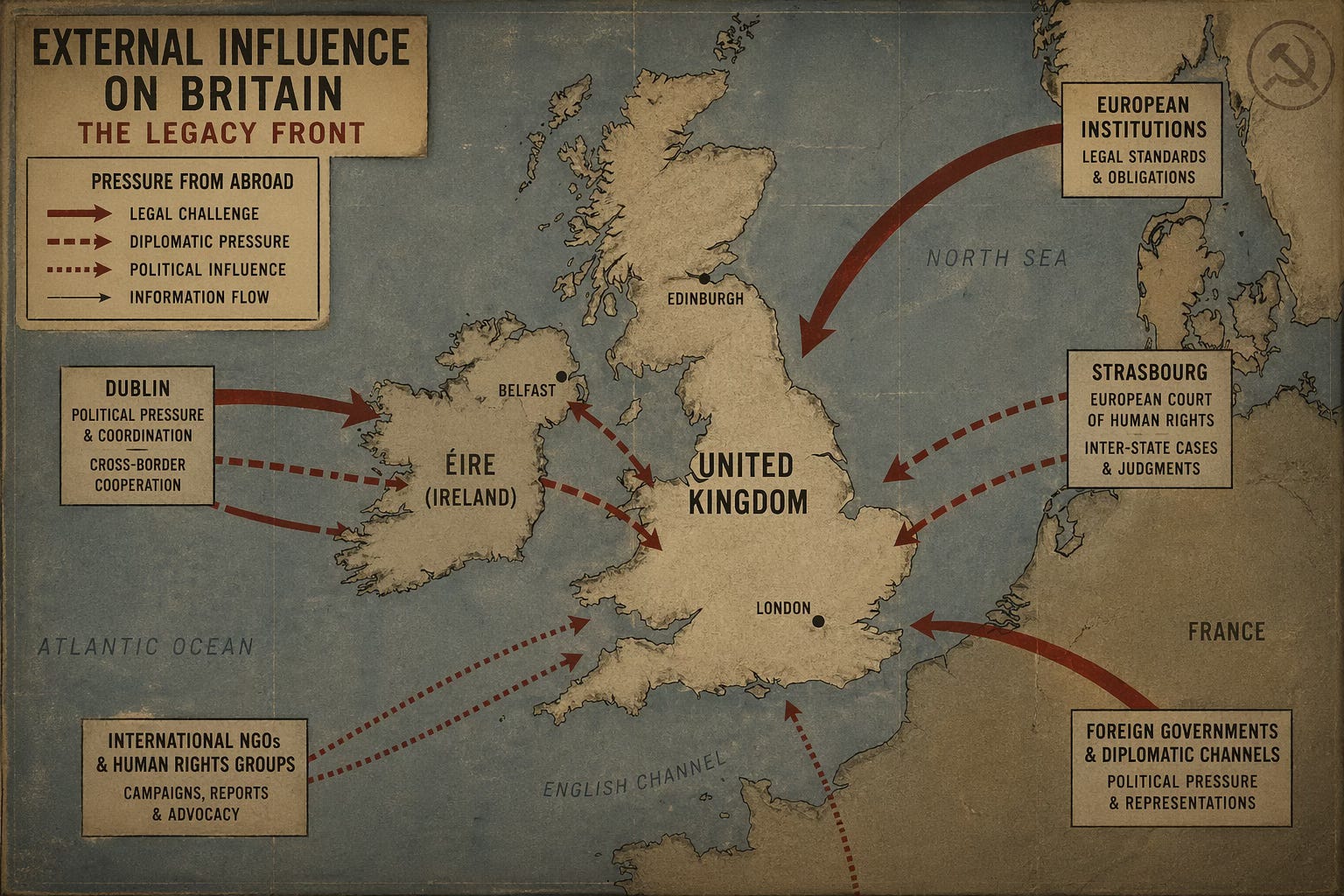
The Act was not challenged in Belfast alone. The Republic of Ireland escalated the matter by lodging an inter-State case against the United Kingdom at the European Court of Human Rights in January 2024.
This was pressure from two directions:
A High Court incompatibility finding in Northern Ireland
An inter-State challenge by Ireland in Strasbourg
The Government’s response was not to hold the line, but to concede ground.
Labour has since treated the matter as effectively settled.
It is not.
The clean position is this:
One judge found parts incompatible
The Government chose not to pursue the challenge
The Republic of Ireland internationalised the issue
The Government moved to replace rather than defend
That is not the same as saying the Act was “struck down” and nothing more could be done.
More accurately, the Legacy Act did not collapse under domestic law alone. It was squeezed from Belfast and Strasbourg. What followed was not legal inevitability, but a political decision not to resist.
And, there’s more.
Under the emerging replacement framework, Benn is moving toward structured cross-border involvement with the Republic of Ireland. To be sure, this is not a transfer of jurisdiction; UK cases will not be handed to Dublin.
But the system is being shaped to include:
Information sharing between UK and Irish authorities
Coordination on cross-border investigations
Access to evidence, witnesses, and records held in the Republic
Alignment with obligations under the European Convention on Human Rights
That distinction matters.
This is not about control.
It is about influence.
Once a framework is built in which:
Evidence flows across the border
Cooperation is required from Irish authorities, and
The system is designed to withstand external legal challenge
Then, the Republic becomes a participant in how cases are handled, even without formal authority.
That is the shift.
Not jurisdiction, but leverage.
Before anyone pretends that the Republic should have a standing role in the moral management of legacy cases, its own record regarding terrorism, collusion, and cross-border security deserves rather more honest attention.
The Republic of Ireland does not come to this issue with clean hands or an unimpeachable record. Its own history in relation to Northern Ireland terrorism includes failure, political caution, contested cooperation, and in at least one grave case, proven Garda collusion. That matters now that London treats Dublin as a credible partner in shaping the next legacy framework.
Ultimately, Benn’s entire claim rests not on a final contest of principle, but on an adverse ruling the Government chose not to appeal.
What is presented as legal certainty was, in fact, a decision to concede.
And what follows is not simply a domestic reset, but the construction of a system in which external influence is built in from the start.
In my comment today, I speak specifically about Special Forces personnel who served in Northern Ireland during Op Banner. The recent case where an SF soldier was acquitted for doing his job! As dictated by events on the ground and the quick thinking of the team preserved the life of a targeted victim! The operation was meticulously planned and executed professionally, as one would expect. I believe this current government, led by "a headless chicken!" fail to realise the damage they are doing, to both moral and trust. Our own Military is under attack from within! It's very difficult to trust a politician, many promises are given when it suits their agenda. But unfortunately , "the Winds of Change" quickly disperse them! To you Bastards in Downing Street! I say; "the Veteran Community will keep the pressure on You, to implement a just and fair policy that will protect us now and from any other persecution for our military brothers and sisters going into the future! 💪
The hands of the Republic of Ireland are dripping with the blood of both soldiers and citizens of the United Kingdom of Great Britain and Northern Ireland.