

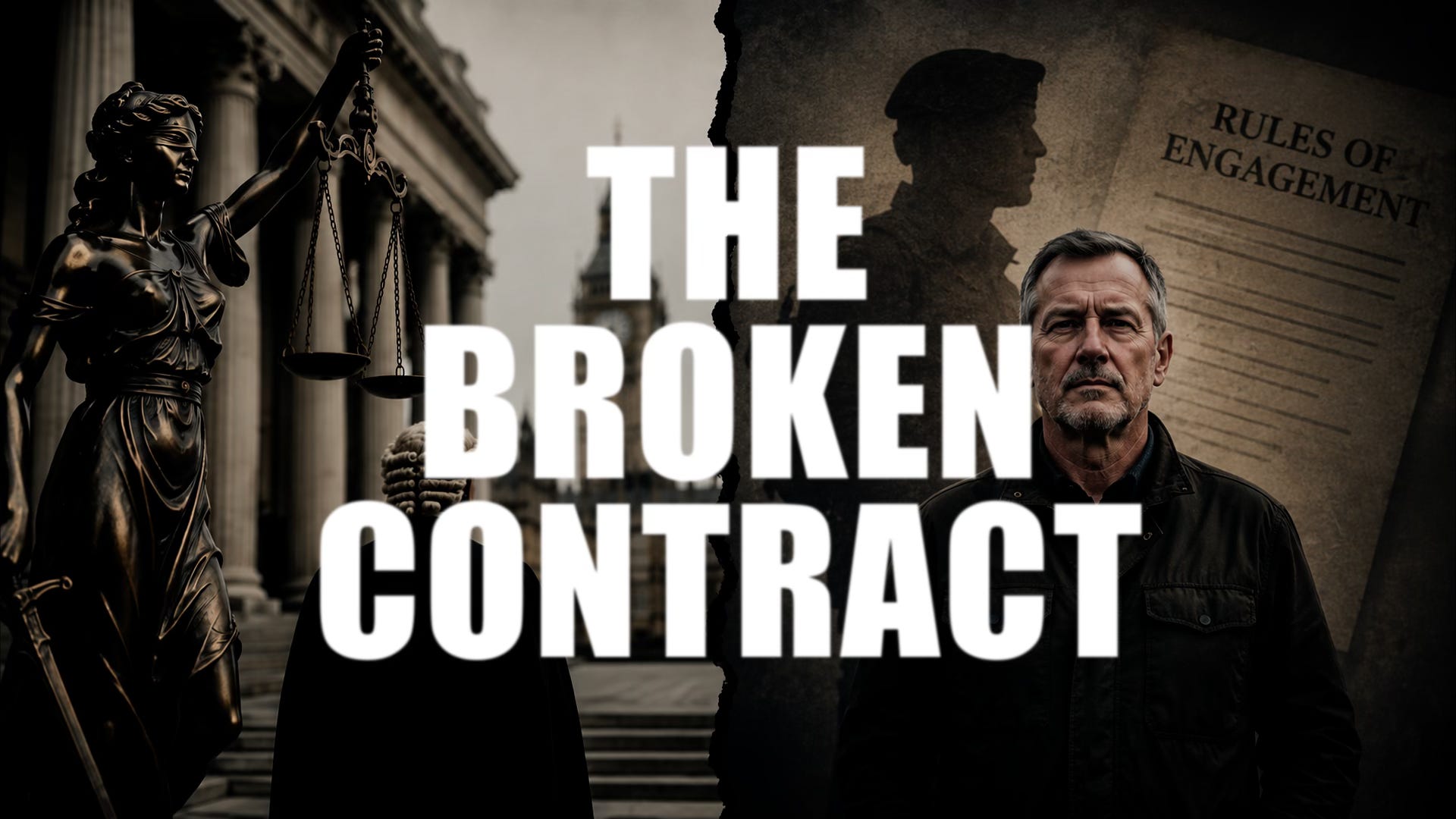
What does the state owe those it asks to fight on its behalf?
For Dr Robert Parr, former Royal Marine, Special Forces officer and Visiting Research Fellow at the Changing Character of War Centre, Pembroke College, Oxford, that question lies at the heart of Britain’s current debate about veterans, military operations and legacy investigations.
In his paper "Broken Contract," Parr argues that every serviceman and servicewoman enters into an unwritten agreement with the state.
They accept extraordinary obligations. They obey lawful orders, surrender freedoms unavailable to ordinary citizens and, when required, risk death on behalf of national policy.
In return, the state accepts obligations of its own.
Those obligations include providing proper legal authority, adequate equipment, clear rules, effective support and continuing protection throughout a veteran’s life.
Parr argues that this contract has progressively broken down.
His criticism is not primarily directed at lawyers or international courts. Instead, he argues that successive governments have failed in their duty of care by allowing military operations to take place within uncertain legal frameworks, only to later expose those who served to retrospective legal risk.
Operation Banner is not, in his view, an isolated case.
Rather, Northern Ireland represents the earliest and most visible example of a wider failure that later became apparent in Iraq and Afghanistan.
The consequences extend well beyond legal proceedings.
Parr points to the wider human cost carried by many veterans through post-traumatic stress, homelessness, suicide, moral injury and long-term uncertainty.
His proposed solution is equally broad.
First, he calls for a dedicated Military Operations Act providing clear legal protection for future operations.
Second, he argues that the Armed Forces Covenant should evolve into a genuine statutory “through-life contract” between the state and those who serve.
Whether readers agree with every conclusion or not, Broken Contract raises questions that reach far beyond Operation Banner.
What obligations endure after service ends?
What happens when governments change policy decades after military operations have concluded?
And how should a democratic nation honour those it asks to carry out its decisions?
These are questions Parliament—and the country—cannot avoid indefinitely.
Watch the interview:
Read Dr Robert Parr’s paper (click below):

A complete betrayal by the state. I will push for accountability by all of them. Hermer, Starmer, Bliar, all of them. Senior Snivel Serpents, anyone who have, and continue treachery. Include the vampiric lawyers
It's not "a contract' it goes beyond that, between the Government and the Armed Forces? 'A Duty of Care,' a responsibility that unfortunately has been broken and lost in the quagmires of political agendas and personal fears! The whole scenario is an absolute disgrace to British Politics and Shames all those political and law flawed personalities involved! The rights of veterans' both now and in the future needs to be born of a 'protective Shield' that is respectful, responsible and final in its application! We the Veteran Community, stand fast shoulder to shoulder on this issue! 'Always A Little Further!' 💪💪👊👊🌹🌹