

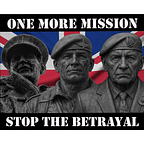
As the Government pushes through new Northern Ireland legacy legislation, a familiar figure stands at the centre of the controversy: Jonathan Powell, Tony Blair’s former Chief of Staff and a principal architect of the 1998 Good Friday Agreement, now serving as National Security Advisor at Number 10.
In our latest podcast, we examine Powell’s approach to negotiation, the lasting consequences of the Northern Ireland peace process, and what his return to power means for veterans, victims’ families, and the pursuit of justice.
The Continuing Thread
Our guest, former Para Lt. Col. Simon Barry, who served in Northern Ireland and has tracked the legislation closely, argues that Powell represents “the continuing thread” through nearly three decades of policy. “Twenty-seven years on, we are living with the effects of a peace process that hasn’t necessarily delivered a fair and lasting peace on a basis that most people could understand,” Barry observes.
Powell’s influence extends beyond historical legacy. The Government is now positioning the Northern Ireland peace process as a template for international conflicts, including Gaza. Yet Barry questions whether appeasement-based diplomacy offers genuine lessons for contemporary conflicts: “If the Israelis and even Hamas look deeply into the lessons of the Northern Ireland peace process, which most of us would now look back on with hindsight as appalling appeasement, you aren’t going to get the Israelis to appease Hamas.”
The Price of Peace
Central to Barry’s critique is what he describes as a two-tier justice system that emerged from the peace process. Over 300 suspected terrorists received comfort letters offering effective immunity from prosecution. Not one soldier or police officer received similar protection. This disparity now shapes current policy decisions in stark ways.
Barry points to recent government announcements: a new inquest into Loughgall, where eight terrorists were killed during an attempted attack on a police station, contrasted with the refusal to reopen inquiries into the Birmingham pub bombings that killed 21 innocent civilians. “There is absolutely no moral equivalence,” Barry states. “And yet this is the way this government is performing right now.”
Language and Reality
The podcast examines how terminology shapes political outcomes. The persistent use of “the Troubles” to describe what Barry characterises as an armed insurrection masks the true nature of the conflict. “Thousands and thousands of people died,” he notes. “That is not Troubles. That is a lot worse.”
This linguistic softening, Barry argues, serves a political purpose: it allows negotiators to claim moral courage for talking to violent actors while obscuring the strength of the position from which they negotiated. “The only reason they spoke is because they had no choice. They had been beaten, and they had been beaten comprehensively.”
The International Context
Powell’s career trajectory offers a revealing pattern. His involvement in the 1984 Sino-British agreement over Hong Kong, which Barry describes as “the Great Chinese Takeaway,” saw the UK surrender not just the leased New Territories but Hong Kong Island and Kowloon Peninsula, which had been ceded in perpetuity. The safeguards promised under “one country, two systems” have since collapsed.
Now, as National Security Advisor, Powell has been involved in the controversial Chagos Islands deal and maintains a role in UK-China relations. Barry questions whether Britain has “somebody who’s really got our back” given this track record.
The Republic of Ireland’s Role
The podcast addresses what Barry terms the Republic of Ireland’s role as an “active sanctuary” during the conflict. He argues that bomb-making, weapons storage, and operational planning could not have occurred without broader knowledge and tacit permission. The Omagh bomb, which killed 29 people and pressured the British government into final concessions, was “a fully Republic of Ireland-based operation involving dozens of people.”
Yet the Republic refused 90 per cent of extradition requests from the RUC throughout the Troubles, even when the evidence was overwhelming. This history, Barry suggests, should inform expectations about future cooperation.
A Path Forward
Barry proposes concrete measures that would demonstrate a genuine commitment to justice:
The Republic of Ireland acknowledging its role as an active sanctuary for IRA operations
Rescinding comfort letters, not merely declaring them legally invalid
Investigating the top ten outstanding IRA atrocities with transparent progress reports
A full inquiry into the Omagh bombing without political fudge
“Do something firm, stand up for something, and be seen to stand up for something,” Barry urges. “And guess what? You might get a bit more respect on the world stage.”
The Moral Question
The podcast concludes with the question Barry would pose to Powell directly: Can he explain the morality of a system that rewarded terrorists more than the soldiers and police officers who risked their lives to stop them?
“It goes beyond realpolitik,” Barry argues, “and gets into a very difficult ethical and moral area, which the government now finds itself in.”
As Parliament debates new legacy legislation, these questions deserve answers. The families of victims, the veterans who served, and the public at large are owed more than spin and international photo opportunities. They deserve a reckoning with what the peace process truly achieved and what it truly cost.
Listen to the full interview for Lt. Col. Barry’s detailed analysis of Powell’s methods, the downstream consequences of the peace process, and why the lessons of Northern Ireland may not travel as well as the Government hopes.
You can also listen on:


