

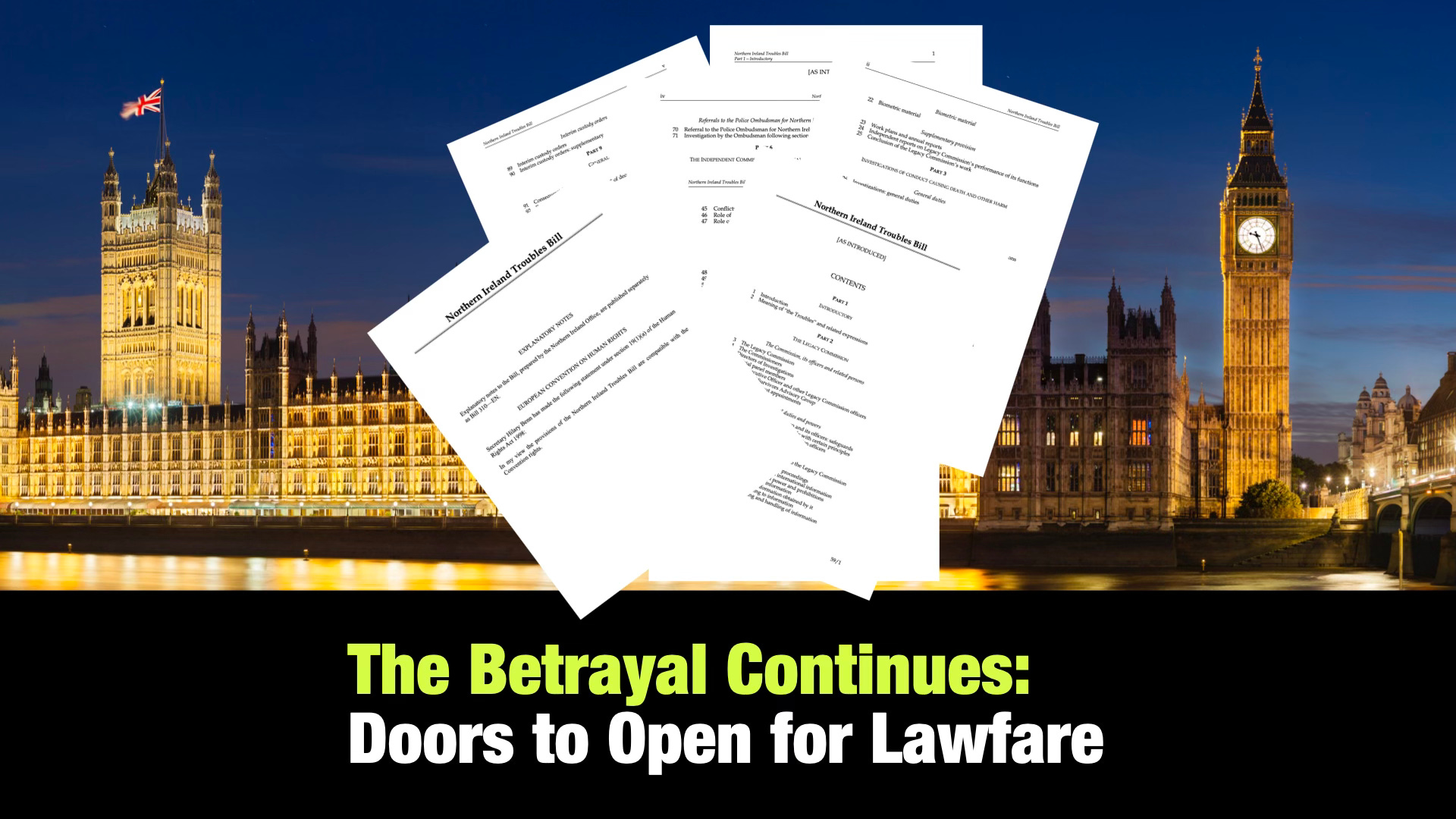
The Government appears to be planning to take the Bill through Committee of the Whole House and the remaining Commons stages, possibly on 24th March. Committee of the Whole House means the entire House of Commons examines the Bill clause by clause, allowing any MP to propose amendments.
If the Government secures approval that day, the Bill would then move to the House of Lords.
However, significant hurdles remain. The Bill must still pass all Lords’ stages, where controversial legacy legislation often faces heavy scrutiny and delay. With the parliamentary session expected to end in spring 2026, time is tight.
At the same time, the Government’s Legacy Act Remedial Order is stalled in the House of Lords pending the Supreme Court judgment in the Dillon case, which could reshape the legal framework governing Troubles investigations.
For now, the 2023 Legacy Act remains in force, and the overall legal framework for dealing with the past is still unsettled.
Longer Briefing
Current position
The Government’s Northern Ireland Troubles Bill is continuing its passage through Parliament, but the legislative landscape remains uncertain.
The Bill has passed Second Reading in the House of Commons and is now scheduled for Committee of the Whole House (COTWH) and remaining Commons stages, possibly on 24 March.
This is a significant step because it allows the entire Commons chamber to examine and amend the Bill in detail rather than sending it to a smaller committee.
If the Government succeeds in completing those stages, the Bill would then move to the House of Lords, where the entire legislative process—Second Reading, Committee, Report, and Third Reading — would begin again.
This means the Bill is still some distance from becoming law.
Time pressure
The current parliamentary session began in July 2024 and is expected to conclude in spring 2026.
Even if the Bill clears the Commons in March, it would still need to pass through the Lords before the end of the session. Legacy legislation relating to the Troubles is politically sensitive and historically attracts extensive scrutiny in the Lords.
That means progress there could be slow.
If the Bill does not complete all stages before the session ends, the Government would need to either carry it over to the next session or reintroduce it and begin again.
The Dillon case
Running alongside the Bill is the legal challenge known as Dillon and others v Secretary of State for Northern Ireland, currently before the UK Supreme Court.
The case concerns whether parts of the Northern Ireland Troubles (Legacy and Reconciliation) Act 2023 comply with the European Convention on Human Rights.
The Supreme Court heard the case in October 2025, and judgment is expected in 2026.
This ruling is potentially significant because it may determine whether key aspects of the current legacy framework—particularly those relating to investigations and accountability—are legally sustainable.
Remedial Order
In response to earlier court rulings, the Government introduced a Remedial Order intended to amend the 2023 Legacy Act.
The Commons approved this order earlier in 2026. However, the House of Lords has paused consideration of it pending the Supreme Court judgment in Dillon.
As a result, the order has not yet taken effect.
Practical implications
Taken together, these developments mean the overall legacy framework remains unsettled.
Three separate processes are now interacting:
Parliament is attempting to pass a new Troubles Bill.
The Remedial Order intended to amend the 2023 Act is stalled in the Lords.
The Supreme Court is considering the Dillon case, which may reshape the legal context for both.
Until one of these processes concludes, the 2023 Legacy Act remains the operative law.
In practical terms, this means the legal and political debate over how the United Kingdom addresses the legacy of the Troubles is ongoing.
The coming months — particularly the potential Commons debate on 24 March and the eventual Supreme Court decision in Dillon — will be critical in determining what direction that framework ultimately takes.
What is the Dillion case about?
For veterans and those concerned about the long-term effects of legacy litigation, the Dillon case has become pivotal.
Viewed through a lawfare lens, the Dillon case is not simply a legal dispute about victims’ rights or investigative standards. It becomes part of a broader strategic contest over how the history of the Troubles is interpreted, litigated, and politically leveraged decades after the conflict ended.
Lawfare, in this context, means the use of legal mechanisms as instruments of political or strategic pressure rather than purely as neutral tools of justice.
The case itself — Secretary of State for Northern Ireland v Dillon and others — has already been heard by the Supreme Court of the United Kingdom over three days from 14–16 October 2025. A judgment has not yet been issued. Decisions in complex constitutional cases typically take several months, so a ruling is widely expected in 2026. The timing matters because both Parliament and the Government are effectively waiting to see how the Court interprets the legal foundations of the current legacy framework.
What Dillon represents in that framework can be understood in several ways.
First, it reinforces the idea that the conflict can continue through the courts long after it ended on the ground. The Northern Ireland Troubles (Legacy and Reconciliation) Act 2023 attempted to close off multiple legal pathways—civil claims, inquests, and criminal investigations—and replace them with a single information-recovery mechanism. The Dillon challenge seeks to reopen or preserve those pathways. From a lawfare perspective, that means maintaining the legal battlespace indefinitely.
Second, the case strengthens the centrality of the European Convention on Human Rights in legacy litigation. Article 2 obligations—requiring effective investigation into deaths involving state actors—have become the primary legal lever used in Troubles-related cases. Each successful challenge reinforces the precedent that historic operations can be continuously re-examined under modern human-rights jurisprudence.
Third, Dillon illustrates the asymmetry inherent in many legacy cases. Most of the legal obligations under Article 2 rest with the state, not with non-state actors. Paramilitary organisations are not subject to the same investigative obligations under human-rights law. From a lawfare perspective, this creates a structural imbalance: the state remains legally accountable, while former terrorist organisations face far fewer equivalent legal pressures.
Fourth, the case demonstrates how judicial processes can influence political decision-making. The Government’s attempt to repair the Legacy Act through a Remedial Order has now been paused in the House of Lords, specifically because peers want to see the outcome of Dillon in the Supreme Court. In other words, a single case is now shaping the timing and direction of parliamentary legislation.
Finally, Dillon affects the narrative dimension of the conflict’s legacy. Court proceedings inevitably frame events in legal terms—victim, perpetrator, unlawful killing, investigative failure. Over time, repeated litigation can reshape public understanding of the conflict itself, particularly if most cases focus on state actions rather than those carried out by terrorist organisations.
From a lawfare standpoint, the significance of Dillon is therefore not limited to the legal technicalities of the Legacy Act. It helps determine whether the Troubles legacy remains an open legal battlefield for decades to come, or whether Parliament retains the ability to impose a political settlement on how that past is addressed.
In practical terms, the Supreme Court’s forthcoming decision will influence three things:
Whether the immunity framework and investigative structure created by the 2023 Act can survive
How far human-rights law constrain Parliament’s ability to close legacy litigation
Whether the legal route remains the dominant arena for contesting the Troubles narrative.
Need to keep up with what is happening?
Subscribe:

Or follow on:


Excellent and very comprehensive sitrep for the Bill and RO re Houses of Parliament.
Be interesting to see how the Adams court case pans out https://www.telegraph.co.uk/news/2026/03/12/gerry-adams-was-ira-de-facto-leader-court-hears/
Traitors one and all of them. Iraq Military base attacked by Iran and not a word from any of Labour MPs. Time for all the what we have left Military to stand down. This includes the bomb squad.