

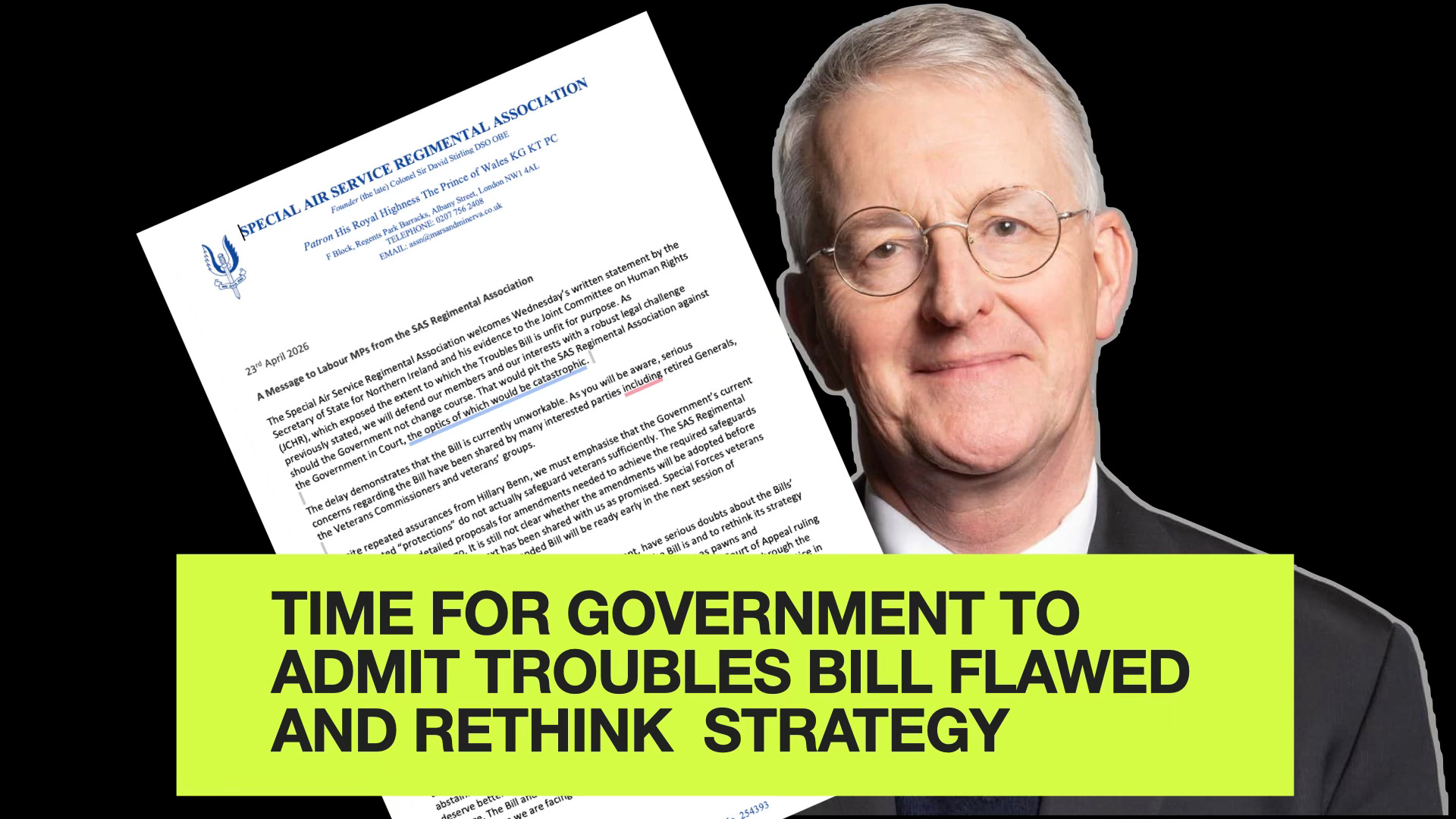
The Special Air Service Regimental Association has issued a direct appeal to Labour MPs following a written statement and evidence to the Joint Committee on Human Rights by Hilary Benn confirming delays to the Northern Ireland Troubles Bill and the introduction of further amendments.
In his statement to Parliament, Benn acknowledged that more must be done to “safeguard our veterans community” and confirmed that a “substantial package of amendments” will be brought forward, alongside additional time for scrutiny, with the Bill now delayed until the next Parliamentary session.
The Government maintains that the legislation will improve outcomes for victims and families, enable cooperation with Irish authorities, and draw a clearer distinction between state forces and paramilitary actors. It also insists the Bill avoids the “false promise” of immunity contained in earlier legislation and will comply with human rights obligations.
However, the SAS Regimental Association has made clear that these assurances have not translated into confidence among those most affected.
In its April 23 letter to MPs, the Association argues that the Bill remains fundamentally flawed, describing it as “unfit for purpose” and warning that the Government’s proposed protections do not, in practice, protect veterans.
Key concerns include:
· No draft amendments have been shared with key stakeholders despite earlier commitments
· Proposals submitted by the Association months ago have not been incorporated
· Continued uncertainty over whether meaningful safeguards will be in place at all
The delay, presented by Government as necessary for proper scrutiny, is instead interpreted by the Association as evidence that the legislation is not workable in its current form.
More significantly, the Association has drawn a line: if the Bill proceeds without substantive change, it is prepared to mount a legal challenge — setting up a direct confrontation between former Special Forces personnel and the Government.
The intervention also reflects a deeper divide over how legacy cases are being handled.
While the Government frames the Bill as a “final chance to get legacy right” and deliver answers for families, critics argue it risks entrenching a cycle of retrospective investigation and prosecution — what is increasingly described as lawfare.
The Association points to recent court rulings, including the collapse of the Coagh case, as evidence of a system that allows weak or unmeritorious cases to run for years at high personal and public cost.
Its message to MPs is direct: vote against carrying over the Bill, or abstain.
Behind that instruction lies a broader warning. This is not simply about resolving the past. The framework being built now will shape how future operations are judged — and whether those sent to carry them out can rely on the state to stand behind them when the political and legal climate shifts years later.
Do you're duty and get punishment but who sent you there in the 1st place ? Let's start looking at the politicians and passed PM's and present I detest and despises them all gutless Coward's and parasite's. Disabled ex service man 242 🇬🇧.
As an Irish patriot in the U.K. myself, this bill is grossly unfair towards British veterans who have served their country and did what they were asked - dragging them through the U.K. courts decades after their service was completed is totally unacceptable and is nothing more than a witch hunt designed to shift responsibility for what happened in Ulster all those years ago from government onto veterans, especially onto men and women who might be disabled and/or might be in advanced years - it shows a total lack of understanding of the realities of war, while at the same time, we are dealing with a much more vicious war with Islamists