

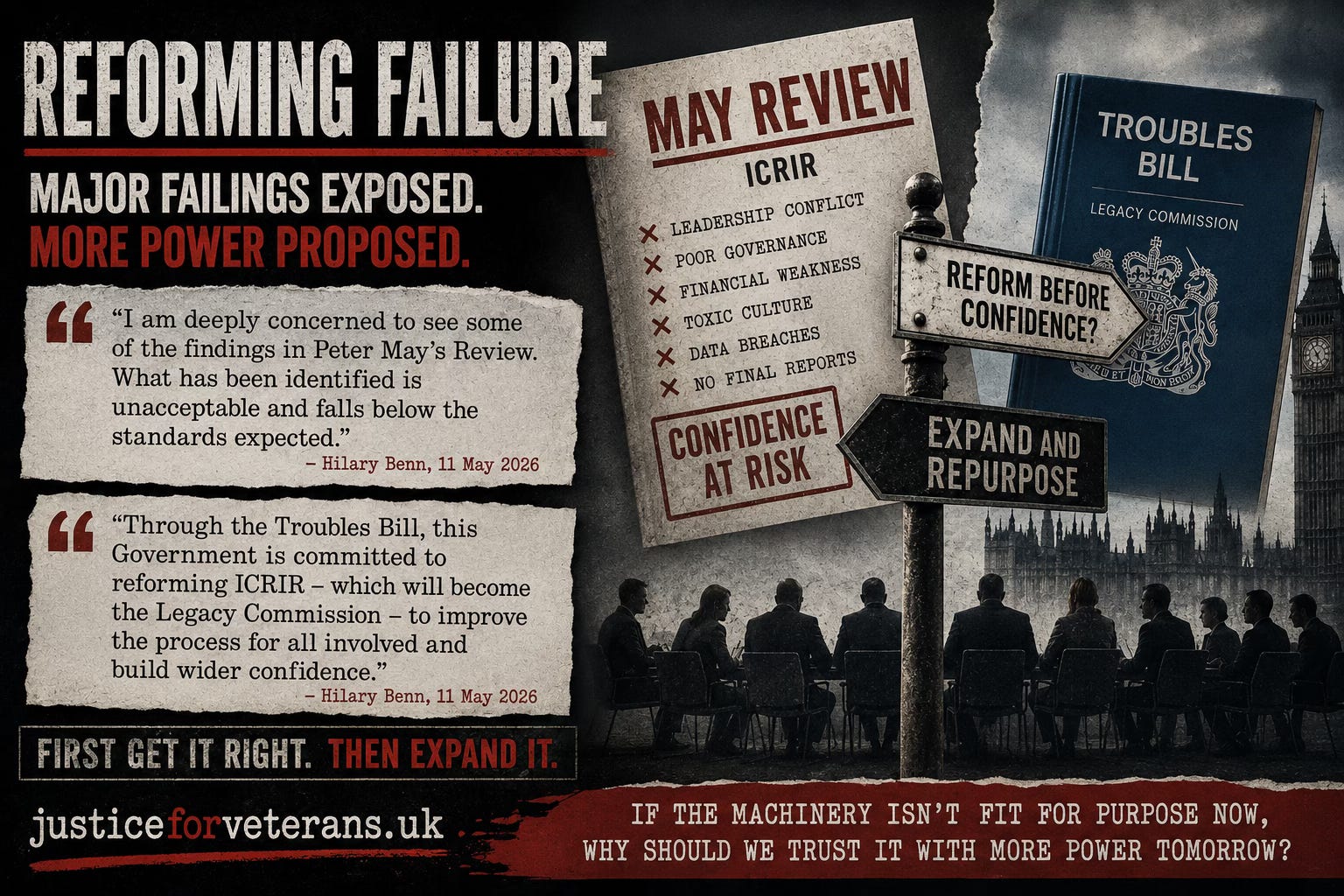
The publication of the Peter May Review into the Independent Commission for Reconciliation and Information Recovery (ICRIR) should concern anyone following the Legacy debate closely.
Not because troubled organisations are unusual. New institutions often struggle.
But because the Government’s response reveals something more important: instead of asking whether confidence can reasonably be placed in the machinery before it is expanded, the review is being used as an argument for expanding it.
That distinction matters.
The timing is also difficult to ignore.
The Review was commissioned after unnamed concerns were raised directly with the Northern Ireland Office.
Who raised those concerns? When were they first raised? Were they raised by ICRIR staff, Commissioners, former staff, auditors, requesting individuals, or another party?
The published material does not say.
Nor does it explain why concerns serious enough to trigger an independent review of the organisation’s culture and effectiveness remained undisclosed until now.
That does not prove orchestration.
But it does raise an obvious question: was this Review simply a diagnostic exercise into a struggling institution, or has it also become part of the political case for repurposing that institution under new legislation?
The Review itself is stark.
It identifies structural weaknesses, governance immaturity, financial management problems, leadership conflict, internal mistrust, and a culture described by staff as “toxic”, “divided”, and “disrespectful”.
It notes:
Fear among staff about speaking openly
Serious governance confusion
Weak financial controls
Data protection concerns
Internal friction damaging morale and operations
No final reports have yet been produced despite substantial expenditure
Most significantly, the Review identifies a lack of shared understanding between the Northern Ireland Office and ICRIR regarding what the legislation itself requires in practice.
That is extraordinary.
The organisation charged with handling some of the most politically and morally sensitive investigations in modern British history is itself unclear — alongside its sponsoring department — about how the system is supposed to function operationally.
Ordinarily, such findings would prompt caution.
Parliament might reasonably ask:
Is this body sufficiently mature?
Is governance stable?
Is the investigative structure workable?
Can confidence genuinely be placed in the process?
Should powers be expanded before these questions are resolved?
The Secretary of State himself acknowledged the seriousness of the findings, stating:
“I am deeply concerned to see some of the findings in Peter May’s Review. What has been identified is unacceptable and falls below the standards expected.”
That is not the language of minor administrative difficulty.
Yet almost immediately, the Government response pivots from concern to justification.
The same press release states:
“Through the Troubles Bill, this Government is committed to reforming ICRIR — which will become the Legacy Commission — to improve the process for all involved and build wider confidence.”
That is the central contradiction.
The Review identifies an organisation struggling with governance confusion, internal conflict, weak controls, cultural dysfunction, and operational uncertainty.
But instead of asking whether confidence should first be rebuilt before powers and responsibilities are expanded, the Review itself is being used to support the case for expansion.
The argument effectively becomes:
The current structure has weaknesses. Therefore the new structure proposed in the Bill is necessary.
But that avoids the harder question.
If the current machinery is already struggling under the weight of governance confusion, leadership conflict, investigative complexity, and confidence problems, why should Parliament assume that repurposing and expanding the same ecosystem will solve those problems rather than deepen them?
Especially when the Review itself warns that some proposed changes may create new risks.
This matters beyond institutional process.
Legacy mechanisms do not operate in an abstract administrative space. They operate inside human lives.
For veterans, especially, confidence is not a technical issue.
Many of the men drawn into these processes were young soldiers operating in violent and politically chaotic conditions decades ago. The state now asks them to trust investigative structures that are themselves described as internally fractured, operationally immature, and culturally troubled.
That does not automatically invalidate investigations.
But it does mean confidence cannot simply be declared into existence through legislation, press releases, or oversight committees.
It has to be earned.
The greater danger here is institutional momentum.
Once a mechanism exists, political systems tend to assume the answer is always refinement, expansion, or reform of the mechanism itself rather than asking whether the underlying assumptions remain sound.
That appears to be where the Legacy debate now sits.
The May Review should have triggered a pause for reflection.
Instead, it risks becoming an argument for acceleration.
Hello fellow veterans and supporters for our cause! The machinery is broken within this government. Defunct, worn out and outdated! It is not repairable under this current political party. Indeed, they have no understanding, respect, compassion or wisdom to do what needs to be done. Our American military cousins our enraged by the way that the veteran community is being treated. And cannot believe that our own government has betrayed us for the sake of "pacifying terrorists and their families!" So brothers and sisters, the word has spread far and wide, and shows the cracks and weaknesses in our British political system; run by politicians with no moral fibre. The "Despot Mentality" that pervades Downing Street and Westminster won't be there for much longer, and let's see a brightness of hope and reality for the veterans future! 🙏💪🇬🇧