

There are weeks when separate stories begin to align. This has been one of them.
A series of reports—across broadcast, print and specialist defence coverage—has converged on a single, uncomfortable truth: the United Kingdom still has no settled answer to what happens after it sends men to fight.
Start with the disclosures around the Attorney General. A detailed investigation by The Telegraph into Lord Richard Hermer’s role in the al-Sweady litigation is not a matter of speculation or political spin. It is rooted in documentary evidence—emails, legal notes, and years of proceedings.
The key point is not simply that the claims collapsed—they did—but that they ran for years despite mounting doubts about their credibility. The inquiry ultimately found the allegations to be “deliberate lies”. Yet the machinery of litigation continued to turn.
Alongside this, it has been widely reported that formal complaints have now been made to both the Bar Standards Board and the House of Lords Commissioners for Standards. The issue has moved beyond politics into professional scrutiny.
That is reinforced by the intervention of Ben Wallace, writing from direct experience of government and war. His account describes a pattern in which legal action, media pressure and institutional caution combine to produce sustained lawfare against British troops—something long observed within defence circles but rarely stated so plainly.
From there, move to the present.
Senior figures connected to the Special Air Service have publicly questioned whether the Attorney General is fit to oversee the Government’s Troubles legislation, warning of bias and a breakdown of trust. That concern has been echoed across multiple outlets and defence commentators, not confined to a single newspaper line.
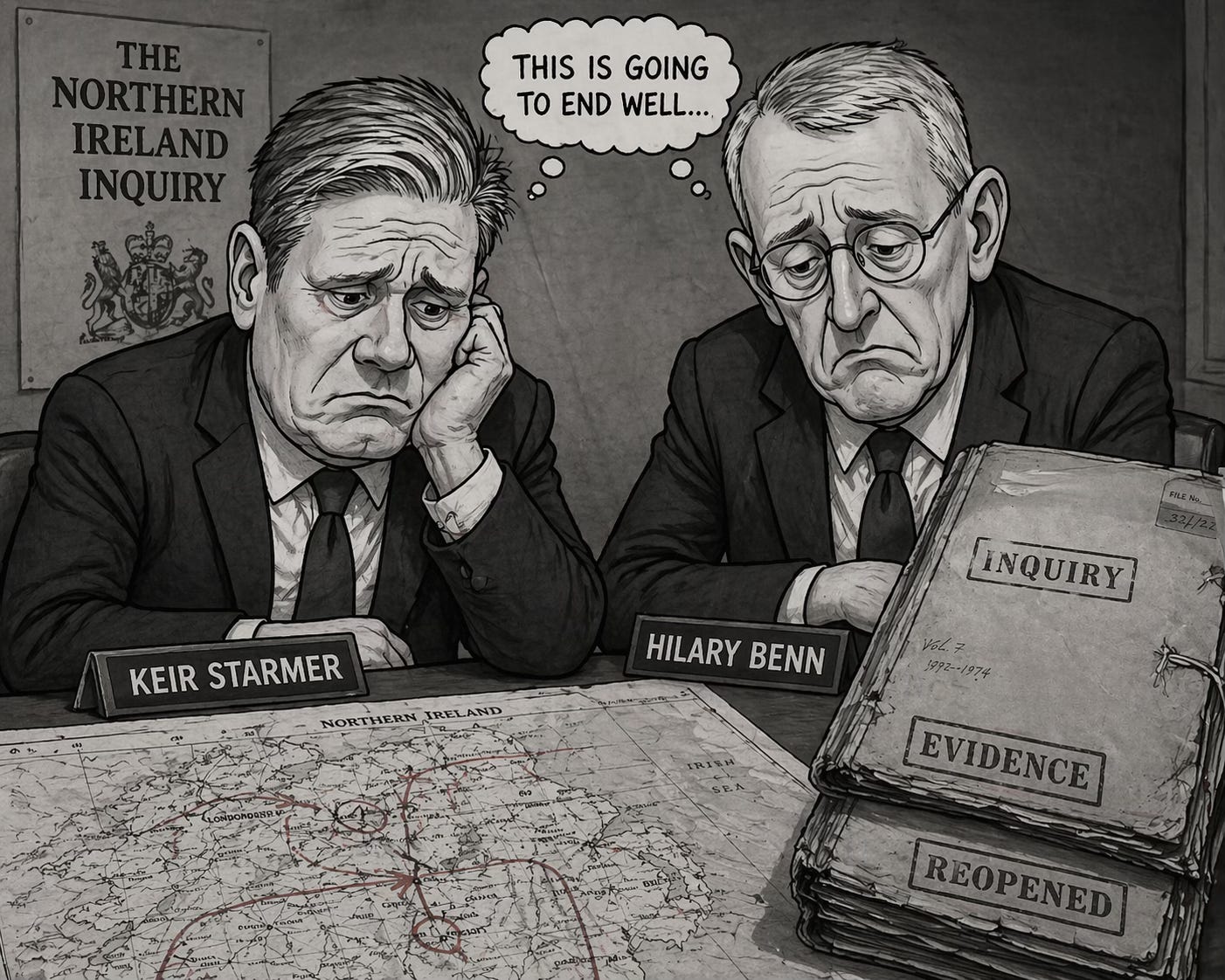
At the same time, the legislative position itself is shifting. Hilary Benn has already been forced to concede “substantial amendments” to the Troubles Bill after sustained pressure from veterans and senior officers. The accompanying Remedial Order has been paused following resistance in the House of Lords—an unusual and telling retreat.
None of this is happening in isolation.
Former Army chiefs, including Sir Peter Wall and Sir Nick Parker, have warned that the current trajectory risks opening the door to a new wave of “witch hunts”. The Special Air Service Regimental Association has gone further, signalling potential legal action and even a boycott of inquests.
At the same time, there are credible reports of experienced personnel leaving elite units, citing concern over retrospective legal exposure. Whether the numbers are large or small is almost beside the point. The direction of travel is what matters.
This is where Operation Banner stops being history and becomes precedent.
The sequence is now familiar:
Operations conducted under government authority
A later legal environment reshaped by evolving human rights frameworks
Repeated cycles of investigation and litigation
The gradual transfer of risk from the state to the individual
The al-Sweady case fits this pattern. So too do continuing efforts to reopen or reinterpret incidents from Northern Ireland, from inquests to long-running prosecutions linked to events such as Bloody Sunday.
The common thread is not conviction. It is process.
Cases collapse. Evidence fails. Courts acquit. But the years spent under investigation—the reputational damage, the uncertainty, the strain—remain. The process itself becomes the punishment.
This is the context in which the current Troubles Bill must be judged.
The Government insists that safeguards will prevent unjust prosecutions and that cases will only proceed where there is compelling new evidence. That assurance has been offered before. In practice, it has proved elastic. Evidence is rarely final in contested conflicts; it is revisited, reframed and, when necessary, rediscovered.
What is being constructed is not closure, but continuity.
And that continuity matters far beyond Northern Ireland.
Modern operations—whether counter-terrorism, expeditionary warfare or grey-zone conflict—depend on a clear understanding between the state and those it deploys. That understanding has traditionally been simple: act within the rules as they exist at the time, and the state will stand behind you.
It is that understanding which is now in question.
If today’s soldiers, drone operators and special forces personnel conclude that their actions will be judged decades later under different legal and political conditions—without firm backing from the state—then behaviour changes. Initiative narrows. Risk tolerance falls. In some cases, people simply leave.
The unease now being expressed within the special forces community is not emotional. It is rational.
This is why this week matters.
Not because it settles the argument around one Attorney General or one piece of legislation, but because it exposes the unresolved tension at the heart of British defence policy.
The country has not reconciled its commitment to expanding legal scrutiny with its need to maintain an effective fighting force.
Until it does, Operation Banner will not remain in the past.
It will continue to set the rules.
It might just occur to todays government and judges and previous governments and legal decisions that lawfare may in due course be turned on to them as individuals or collectively. They might want to consider their own position before they burn all of their boats...
I wonder if what has and continues to emerge of the Op Banner repercussions is why Starmer explicitly refused to commit to supporting the USA’s conflict against Iran.