

Every few weeks, Operation Banner returns to the surface. A new inquest. A fresh legal argument. Another round of commentary, familiar in tone and predictable in direction. Each side advances its case. Each claims the ground of justice. And yet, for all the movement, nothing settles.
That is the real problem.
Operation Banner is still spoken of as a legacy issue, as though it belongs to a closed chapter. It does not. It is the test case for how the British state treats those it sends to act on its behalf. The conclusions drawn now — in law, in practice, and in public understanding — will not remain confined to Northern Ireland. They will carry forward into Iraq, Afghanistan, and whatever comes next.
The question, then, is not whether Banner should be examined. It is how.
At present, the system produces activity without resolution. Investigations reopen ground once thought settled. Legal processes operate through frameworks that have shifted over time. Political voices enter the fray as required. Campaign groups apply pressure. The press does what the press does best: it amplifies conflict.
Each element has its place. None is capable of delivering a settled, credible judgment on its own.
What is missing is something more basic, a way of distinguishing between things that are not the same:
Criminal wrongdoing
Operational error
Lawful but politically contentious action
Retrospective moral judgment
Legal challenge driven by wider aims
These categories are regularly collapsed into one another.
The result is not clarity but confusion.
Actions taken in one context are judged in another. Decisions made under pressure are reassessed at leisure. The line between evidence and assertion begins to blur.
This is not justice. It is drift.
The deeper difficulty is structural.
The institutions currently doing the work are not designed to produce the kind of judgment required:
Courts decide specific legal points
Politicians signal positions
Campaigners pursue outcomes
Journalists surface and sharpen disputes
All of that generates heat. Very little, if any, of it produces settlement.
And, if truth be told, the arrangement suits most of those involved. Campaigns continue (and generate funding). Political capital is made. Legal processes roll on. Stories keep appearing. The system is self-sustaining.
The only party not well served is the public, which is left without a clear account of what happened, why it happened, and how it should now be understood.
That absence matters.
It creates a vacuum into which competing narratives rush, each claiming authority, none commanding it.
More importantly, it sends a message — not in words, but in practice — to those currently serving.
If this is how a long-concluded operation on British soil is handled, what confidence can those who served in Iraq or Afghanistan have that their actions will be judged coherently, consistently, and in context? Not in theory, but in fact.
And, what of all the chatter of deploying to Ukraine?
That question does not sit in a courtroom. It sits in the mind of anyone asked to act in dangerous, uncertain conditions, where decisions are made quickly — in the blink of an eye — and consequences unfold slowly.
Where confidence in the system is weak, behaviour changes.
Some will hesitate where decisiveness is required. Others will disengage from the idea that accountability is something real and not merely selective. Neither outcome serves the public. Both are entirely foreseeable.
None of this is an argument against scrutiny. Scrutiny is essential. But scrutiny without structure is not accountability. It is theatre.
What is required is not another round of reaction, but a form of judgment capable of doing the work properly.
That means a process that understands the operational realities, applies the law as it stood at the time, examines new evidence without arbitrarily reopening settled matters, and operates at a distance from both campaigning pressure and political expediency.
That is not a soft option. It is a serious one.
Without it, Operation Banner will continue as it is: not resolved, but replayed. Not understood, but argued over. Not concluded, but prolonged.
And if that becomes the settled pattern, it will not stop there.
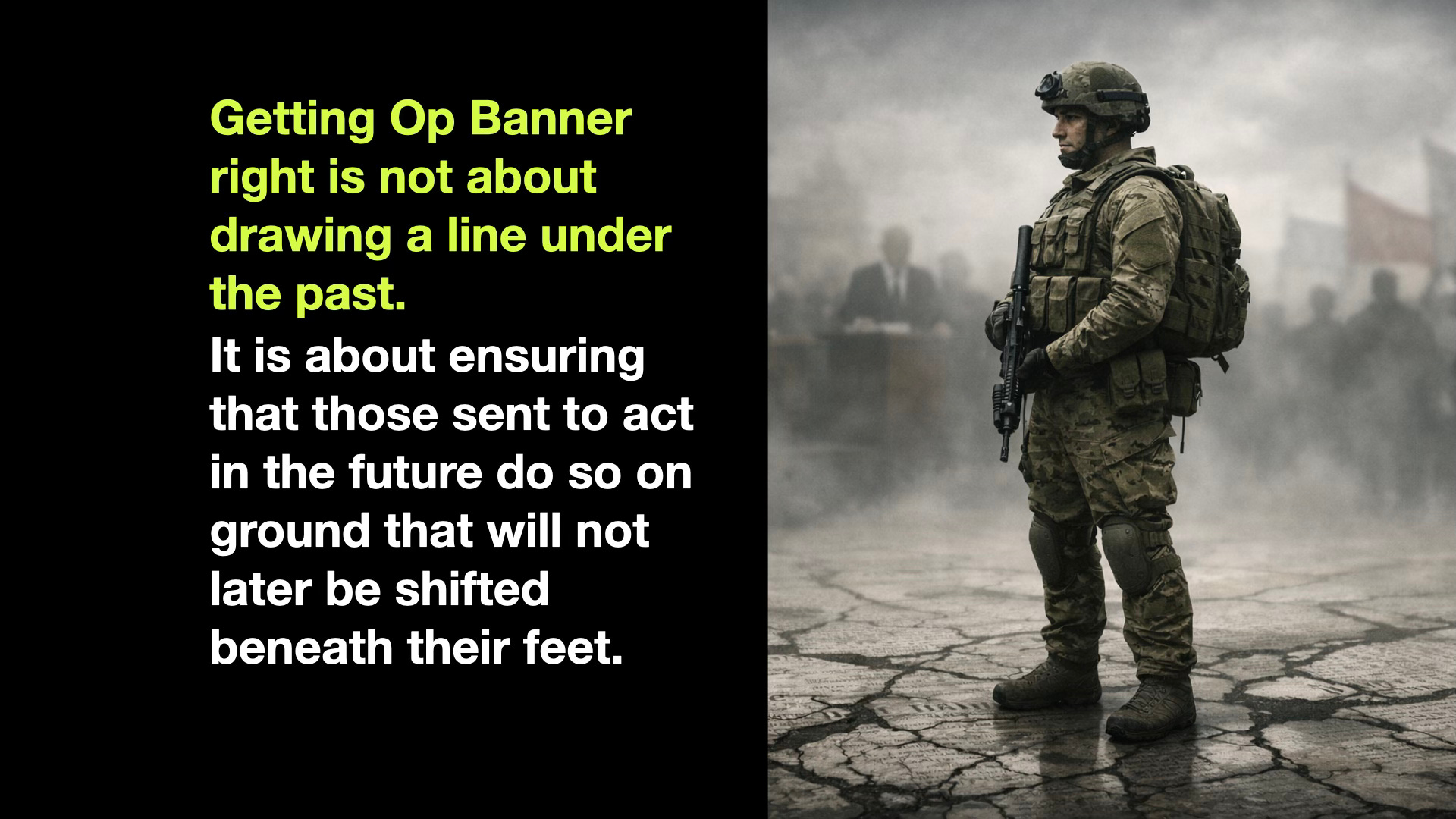
Getting Op Banner right is not about drawing a line under the past. It is about ensuring that those sent to act in the future do so on ground that will not later be shifted beneath their feet.
Outrage is easy. Judgment is harder. It is the latter that is required — and still absent.
I was part of Op Banner from 1971 to 1973 on a permanent posting. We had our rules of engagement and we followed them. It appears that is not enough for Benn he wants to put all of us under a bus.
I agree entirely with your comments. Op Banner was almost 57 years ago since British troops were first tasked to enter Northern Ireland to keep the peace between the Protestants and the minority Catholics. At that time (1969) I was serving and had some sympathy with the Catholic community who seemed to be under pressure from the B Specials and denied many job opportunities that were open to those of other faiths.
This changed as time went on and British soldiers came under increasing fire from both communities. Stuck in the middle of a peace keeping role that neither community wanted us to be present. But the politicians demanded that we should stay.
The consequences of this operation were foreseen by all who served. However, the politicians who ordered troops to risk their lives were never there to pick up the bodies.
After all these years we are faced with terrorists being given freedom from legal action for murder whilst British soldiers are pursued through the courts. Disgraceful.
If they continue to follow this path then every other action in which our army served over the past 60 years will be up for challenge.