

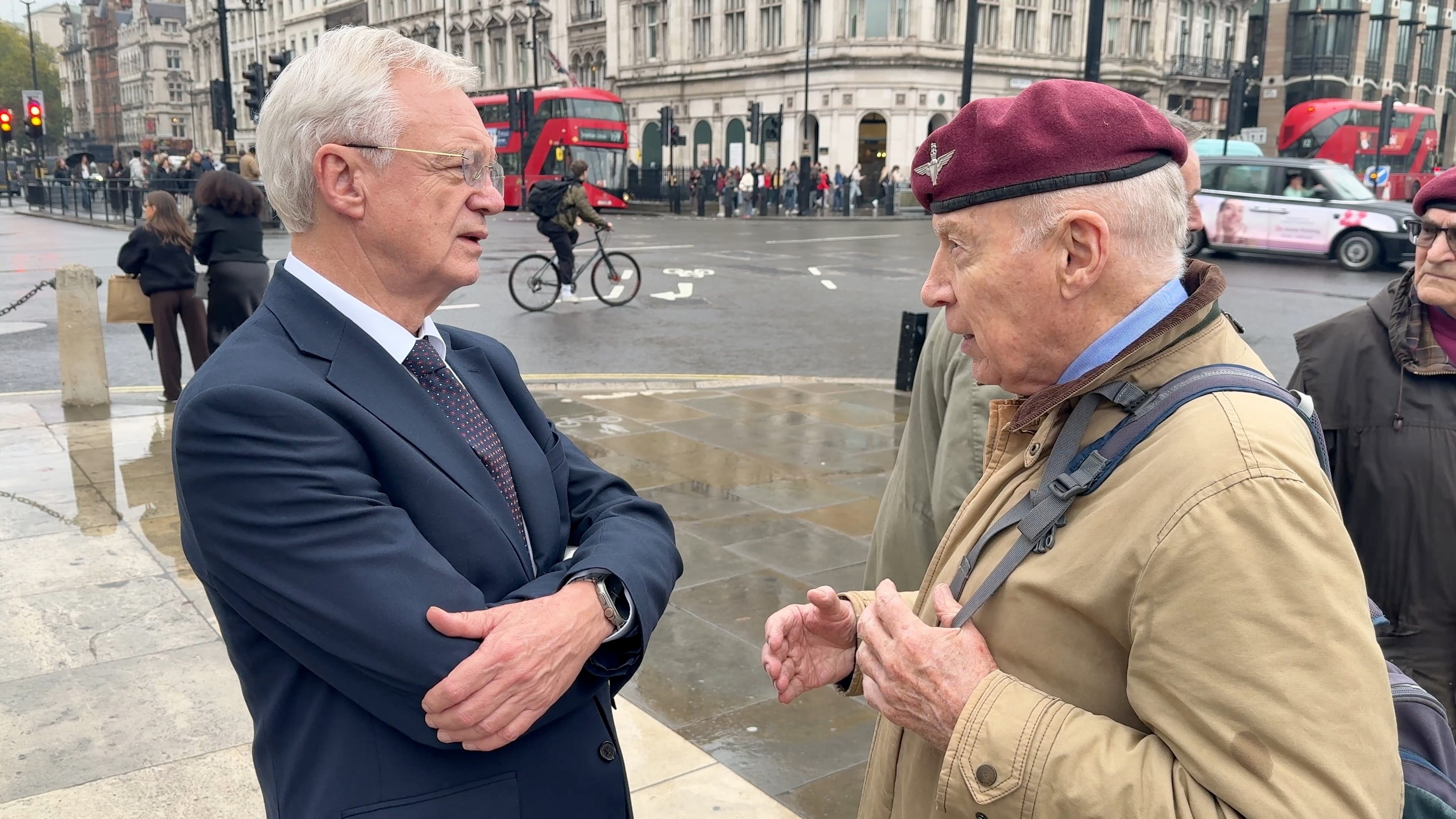
For six months, Maj Gen Dair Farrar-Hockley sat across the table from Government officials, trying to get a better deal for Northern Ireland veterans in the Troubles Bill.
He says they barely listened.
The former Parachute Regiment officer spoke to JusticeforVeterans.uk after MPs backed the Bill by 330 votes to 178 on 20 October.
His verdict on the talks is blunt.
“To be honest, no,” he says, when asked if the Government acted in good faith. “We have never felt that they’ve been honest with us about the scale of the amendments.”
Six amendments became 62
Ministers say the Bill’s 156 amendments were “developed in consultation with veterans” and give them strong and lasting legal protections.
“I would say that neither part of that statement is true,” says Farrar-Hockley. “Our involvement has been minimal.”
The talks began in April at Number 10, with the Northern Ireland Office, the Ministry of Defence and Downing Street’s own advisers. Veterans’ representatives, he says, were not allowed an agenda and weren’t told who they would be meeting.
He brought one anyway, and asked to start with the six Government amendments that had been published online.
“Aha, they say, in fact there are 62. And don’t worry, we shall meet regularly, and we shall share them with you.”
“Sadly, six months go by with not a word.”
The full list was published only a week before the vote, he says, so veterans’ groups still hadn’t had a proper look at it when MPs voted.
“It means nothing”
Veterans’ biggest fear is “rinse and repeat”: being investigated, cleared, and then investigated again.
The Government says the Bill will “significantly reduce” the chances of that happening. For Farrar-Hockley, that’s not good enough.
“This issue is binary,” he says. “Either there are no rinse-and-repeat investigations, or every soldier should have to do them. You can’t have ‘significantly reducing’ circumstances. It means nothing.”
Veterans want any new investigation to need compelling new evidence, with a Supreme Court judge, not the Attorney General, deciding whether it goes ahead. The Attorney General, he points out, is “a quasi-political appointment”.
He says Northern Ireland Secretary Sir Chris Bryant called the idea “ridiculous” in the Commons.
“It may seem ridiculous to him. But we have people who have waited years and years and years to go through different levels of court procedure, only at the end of it, five, six, sometimes longer, to be found not guilty. The stress for us and for our families is too great.”
“When most of us will be dead”
Under the Bill, he says, legal cases will be allowed to run for a further ten years, and cases already under way by then could carry on.
“So more like 15, when most of us will be dead.”
Flags on the bridge
Farrar-Hockley, who has acted as an international mediator and negotiated abroad for the Chartered Institute of Arbitrators, says a negotiation is about finding “a space on the bridge” where both sides can stand.
Instead, he says, veterans were told some of their red lines couldn’t be accepted because the Republic of Ireland wouldn’t like them.
“So metaphorically speaking, parts of the bridge have already got the Irish flag on them, and they are no-go areas for negotiation.
“To us that sounds less like a negotiation and much more of a capitulation.”
He has a question for the Prime Minister: “We volunteered to serve, prepared in the final analysis to lay down our lives, but crucially for our sovereign country, the United Kingdom. Why, Prime Minister, are you placating a foreign country at the expense of veterans from the RUC and the armed forces?”
His personal view, which he stresses could be wrong, is that the Government has decided “veterans are a worthwhile cost to improving their relationship with the Republic of Ireland”.
“I think that is shameful. I may yet be proved wrong, in which case I shall apologise.”
How are veterans feeling?
“I think they’re confused. They don’t think they’ve been listened to.”
He says that in the week before the vote, several people contacted veterans, some at home, to try to win their support. “But surely, if we can only do this, we can get you over the line.”
“By not showing us the amendments over six months, they’ve ended up with an idea that we may only have one or two issues that matter to us. In fact, there are more than a dozen issues that matter, if veterans are to sleep peacefully in their beds.”
What happens now?
The Bill is now in the House of Lords, and Farrar-Hockley hopes for “a more objective hearing” there, especially from crossbench peers who “will be forming their own views on the merits, or not, of the Government’s case”.
In a letter to Sir Chris Bryant after their final meeting on 1 October, he explained why veterans couldn’t support the Bill.
But he hasn’t walked away: “Our minds are not closed if there’s an opportunity to continue this discussion. But it’s got to be one which goes forward on a better basis than the one we’ve had since April.”
The Northern Ireland Office has been asked to respond.
Want to do something? Read why your MP still matters, and what to ask them:
The investigation IS the punishment

Imagine you were 19 when the Army sent you to Belfast. You’re 73 now. You’ve never been charged with anything. But every few years, the past knocks on the door again. A letter. A phone call. A request to “assist with enquiries” about a night half a…
This goverment has to be replaced for many many different reasons; As we have all been told that "Defence is the first priority of a British government" clearly then for that reason alone this government urgently needs replacing with one that understands this priority and acts to ensure that our British defence organisations are brought back to Combat Ready status in ALL respects. These witch-hunts through sucessive courts are undermining our British ability to recruit and retain our servicemen and others to defend our country's right to survive.