

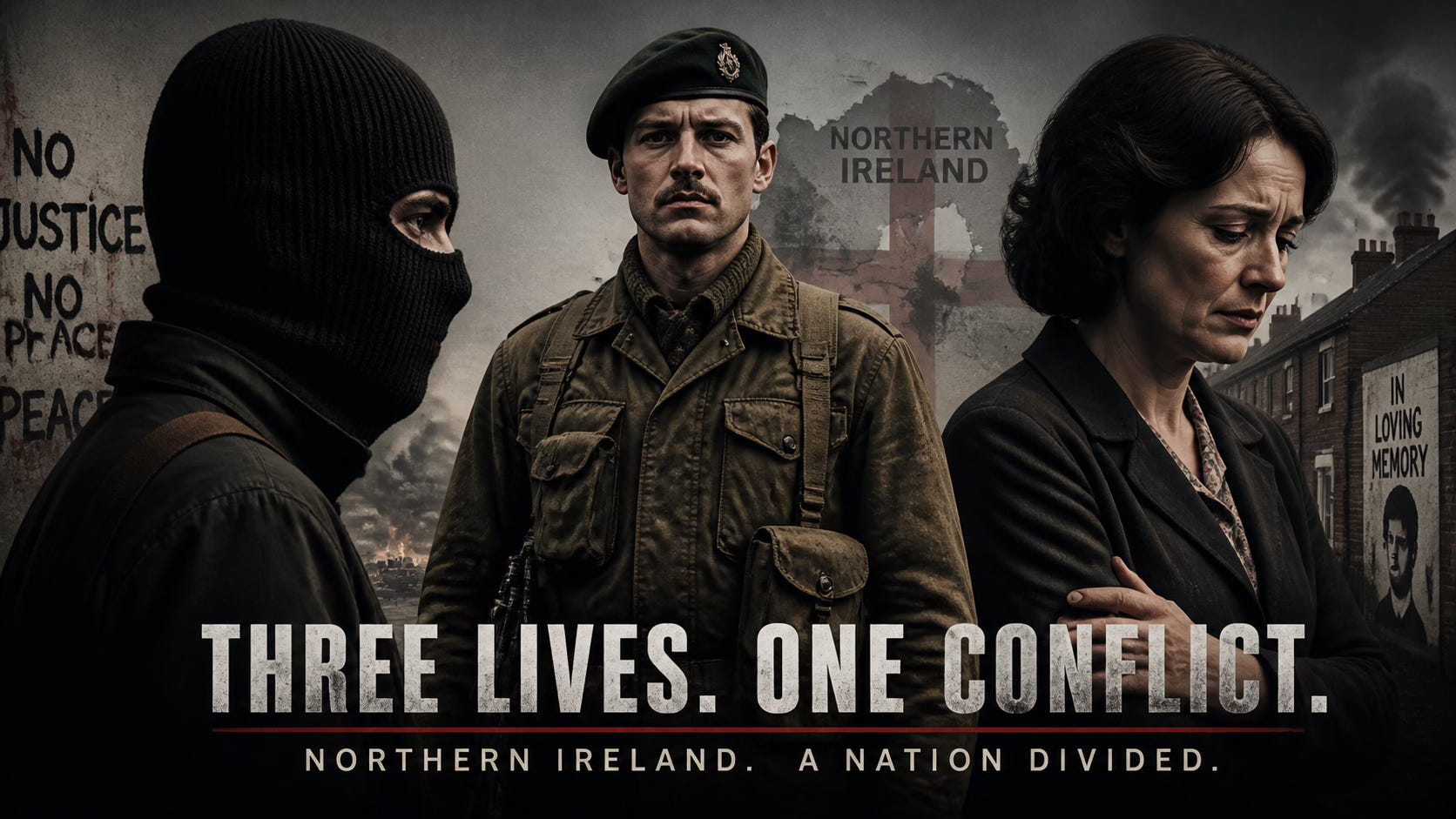
Northern Ireland’s legacy debate is still being conducted as though the central question is what can be proved in law. That is necessary, but it is not sufficient. Law matters. Evidence matters. But neither resolves the deeper issue when the process itself is experienced as morally selective.
Legacy is not only a legal problem. It is a contest over moral status: who is treated as a victim, who is treated as a perpetrator, and whether those who served the state are entitled to fairness as well as scrutiny.
That is why the veterans’ case needs to be taken seriously on its own terms.
The evidence given to the Northern Ireland Affairs Committee is consistent and measured. Veterans are not rejecting accountability outright. They are rejecting a system that appears to draw them repeatedly back into processes that feel one-sided and unending.
David Johnstone, the Northern Ireland Veterans Commissioner, described the gap between being “heard” and being “listened to.”
Dave Holmes of the Northern Ireland Veterans Movement made the operational reality plain: decisions taken in seconds, under lethal pressure, are now dissected decades later with the benefit of hindsight.
Chris Albiston, Northern Ireland Retired Police Officers Association, emphasised the importance of due process, particularly where reputations are at stake.
Axel Schmidt, Ulster Human Rights Watch, coming from a different standpoint, argued for clearer recognition of victims and a sharper moral distinction between those harmed by terrorism and those who carried it out.
These are not fringe views.
They are variations on the same concern: context, proportionality, and fairness have been weakened in the way legacy is now handled.
Dr Robert Parr, a visiting Fellow at Oxford University’s Changing Character of Warfare Centre, in his essay The Longest Betrayal, pushes that concern to its most forceful conclusion.
His argument is not subtle.
The system does not protect veterans; it processes them. It contains their grievances within a structure that is procedurally elaborate but politically shaped, and which, in his view, reflects a long pattern of the state trading veteran interests for political accommodation.
The language is deliberately provocative, but the grievance underneath it is widely shared. Veterans see an asymmetry.
Opponents of the state enter the legacy space with decades of narrative development, legal infrastructure and political backing.
Veterans enter it largely as individuals, reliant on limited institutional support, facing processes that revisit their actions without restoring the context in which those actions were taken.
Whether one accepts Parr’s conclusions or not, the sense of imbalance he describes is not difficult to recognise.
Ian McBride, historian and author, goes some way to explaining why this dispute does not resolve itself.
Northern Ireland does not lack facts.
There is no agreement on what those facts mean.
The past is not a closed record waiting to be read; it is contested terrain.
Competing narratives — republican, unionist, state — carry different assumptions about legitimacy, responsibility and moral weight. The British state, meanwhile, has largely withdrawn from attempting to impose any coherent account of its own role, leaving a vacuum in which other narratives expand.
That withdrawal matters.
It helps explain why many within the unionist and veteran communities feel that their experience — service, sacrifice, and loss — has never been fully integrated into the public understanding of the conflict.
It also explains why legacy mechanisms are asked to carry more weight than they can bear.
They are expected to produce legal clarity, moral judgment, historical explanation and political stability at the same time.
Those aims do not align.
The strongest version of the veteran argument is not a demand for immunity. It is a demand for honest judgment.
It rejects the idea that actions taken under lawful authority, in a context of sustained terrorist violence, can be assessed as though they were equivalent to that violence, stripped of context and reduced to a legal abstraction.
The witnesses before the Committee repeatedly returned to the same themes: context, fairness, memory, proportionality, and due process.
That is not an attempt to escape scrutiny.
It is an attempt to ensure that scrutiny reflects reality.
At the same time, other stakeholders are pursuing different aims.
Victims want truth and recognition. Human rights advocates seek consistent legal standards. Historians insist on complexity and resist simplified narratives. Politicians want a process that can contain all of this without destabilising the present.
The difficulty is that legacy cannot satisfy all of these demands simultaneously.
A system that maximises legal accountability may undermine perceptions of fairness.
A system that emphasises reconciliation may weaken legal clarity.
A system that seeks narrative balance may satisfy none of the competing constituencies.
That is why Northern Ireland’s past remains unresolved.
The central struggle is not only over what happened.
It is over who gets to define it, who is trusted to explain it, and whose suffering is allowed to count.
Judging by every conflict over the past century or so the ending has always attracted partisan views and disagreements on every facet of that conflict. What is new is the much greater power and politicisation in recent years of the lawyers pursuing cases on behalf of ‘victims’, a much expanded business enterprise coupled with a government that has totally lost its fundamental ethos of impartiality and judgemental balance. This has come about from one basic reason: very poor leadership qualities and timidity in the governance of our Nation, not helped by the impossibility of drawing a conclusion to any niggling matter.
Thank God we have, in our Western world, one leader who is not afraid to come to a judgement that supports the goals his Executive has for the benefit of his Nation as a whole.
It's the difference between those who left their homes/barracks with the intention of killing some people or to protect all of the people.