

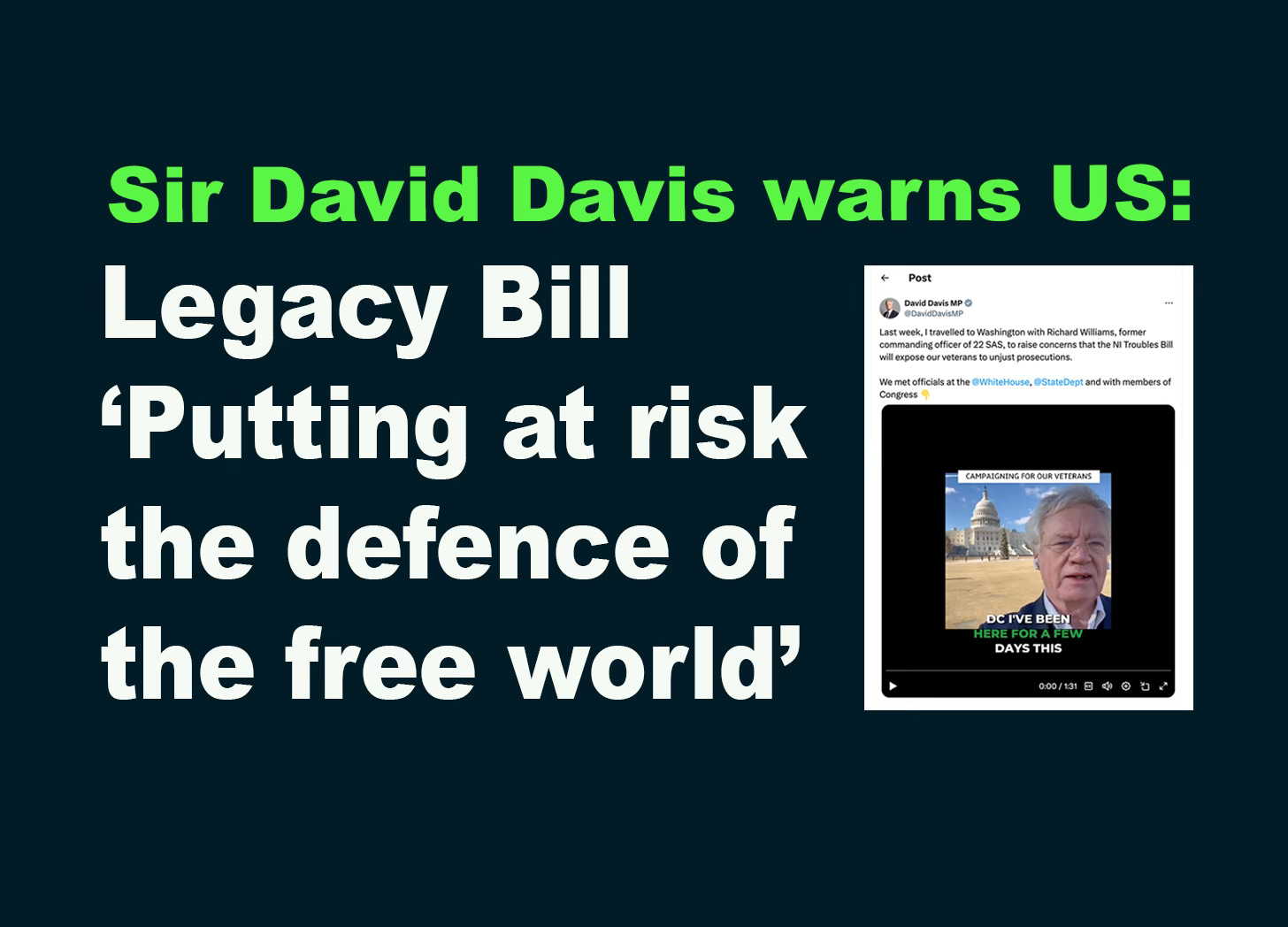
Sir David Davis MP, a staunch supporter of veterans in Parliament, has been in Washington warning of the dangers the Government poses to national security.
“I’ve been here for a few days this week with Richard Williams, the past Commanding Officer of 22 SAS, to talk to officials at the White House, officials at the State Department, member of Congress behind us here about what’s going to happen, or what is already happening with the Labour Government’s legislation to allow prosecutions and coroners inquests back into battles that took place back during the troubles,” says Sir David on X/Twitter.
“The aim, of course, of our opponents being to destroy or damage the reputations of the soldiers who fought heroically at that time. And of course, by doing so, they put at risk the future of all of our special forces,”
“And that matters to the Americans as the leaders of the free world. It matters to the whole Western world, because we provide about half of the what the Americans call Tier One Special Forces who are critical in the fight against terrorism, critical in the sort of grey wars that are taking place around the world now.
“And our main defenders, and these people are being threatened, legally threatened, for doing their duty, for being honourable, brave, patriotic soldiers, and as putting at risk the defence of the free world.”
Overseas operations — for example, in places like Iraq and Afghanistan — often see US-led special operations task forces where UKSF plugged in very tightly (shared targeting, intelligence fusion, raids, detainee handling, air mobility, comms, etc.). For example, Task Force Black/Task Force Knight in Iraq, commonly described as UKSF operating closely alongside — and in some respects under the broader umbrella of — JSOC’s task force system.
Such operations are critical when engaged in grey zone conflict — or, as Sir David puts it, “grey wars” — that the messy space between peace and open, declared war, i.e. hostile action below the threshold of direct state-on-state war — coercion, disruption, and intimidation designed to hurt or bend you without triggering an outright shooting war.
A key feature of such conflict is ambiguity and deniability: actors use proxies, “volunteers”, cyber operators, cut-outs, and influence operations — anything that muddies attribution and complicates retaliation.
To conduct these operations, a range of tools are employed short of open combat: cyberattacks, sabotage, disinformation, economic pressure, political interference, maritime harassment, lawfare, and targeted intimidation — often sustained over time.
Combating grey-zone campaigns demands precision and adaptability: counterterrorism, hostage recovery, intelligence raids, partner-force training, disruption, and covert or low-visibility operations. This is the ‘in-between’ realm—the kind of work entrusted to the SAS.
Last year, the Labour government announced it would repeal and replace the Northern Ireland (Legacy and Reconciliation) Act 2023. This act had shut down all historical inquests and prevented new civil cases from being lodged. Repealing will reopen inquests and potential prosecutions.
Raising awareness in the US comes on the back of nine retired four-star commanders warning in an open letter to Sir Keir Starmer that the Government’s new Northern Ireland Troubles Bill will undermine the Armed Forces and erode the moral compact between the state and those who serve.
Despite that, along with media commentary, the SAS Regimental Association’s threat of legal action, and a plea from the Opposition benches all called on Sir Keir Starmer to personally engage with his government’s Troubles Bill, the Prime Minister has shrugged off all concerns, saying that he was “absolutely confident that there will be no vexatious prosecutions”.
However, the clumsily but aptly named “Troubles Bill” creates more trouble for veterans than solace for victims or support for the British military, past, present and future.
The legislation allows more than 20 inquests to be reopened — including the infamous Loughgall operation — without requiring new evidence.
The Bill has passed its second reading and continues its progress through Parliament.
In the meantime, from a veteran’s perspective, reopening historic cases without new evidence is, by definition, a vexatious process.
TAKE ACTION: Meet your local MP to find out where they stand on this, then let us know.
It really does baffle me if Starmer does seriously believes that reopening closed cases in the long-ago Northern Ireland insurrection can have no effect on the veterans who fought the IRA all those years ago. And can he possibly believe that the Troubles Bill can have absolutely no damaging effects on morale, retention and recruitment of today’s soldiers? In my opinion only a fool or worse could believe that dangerous nonsense.