

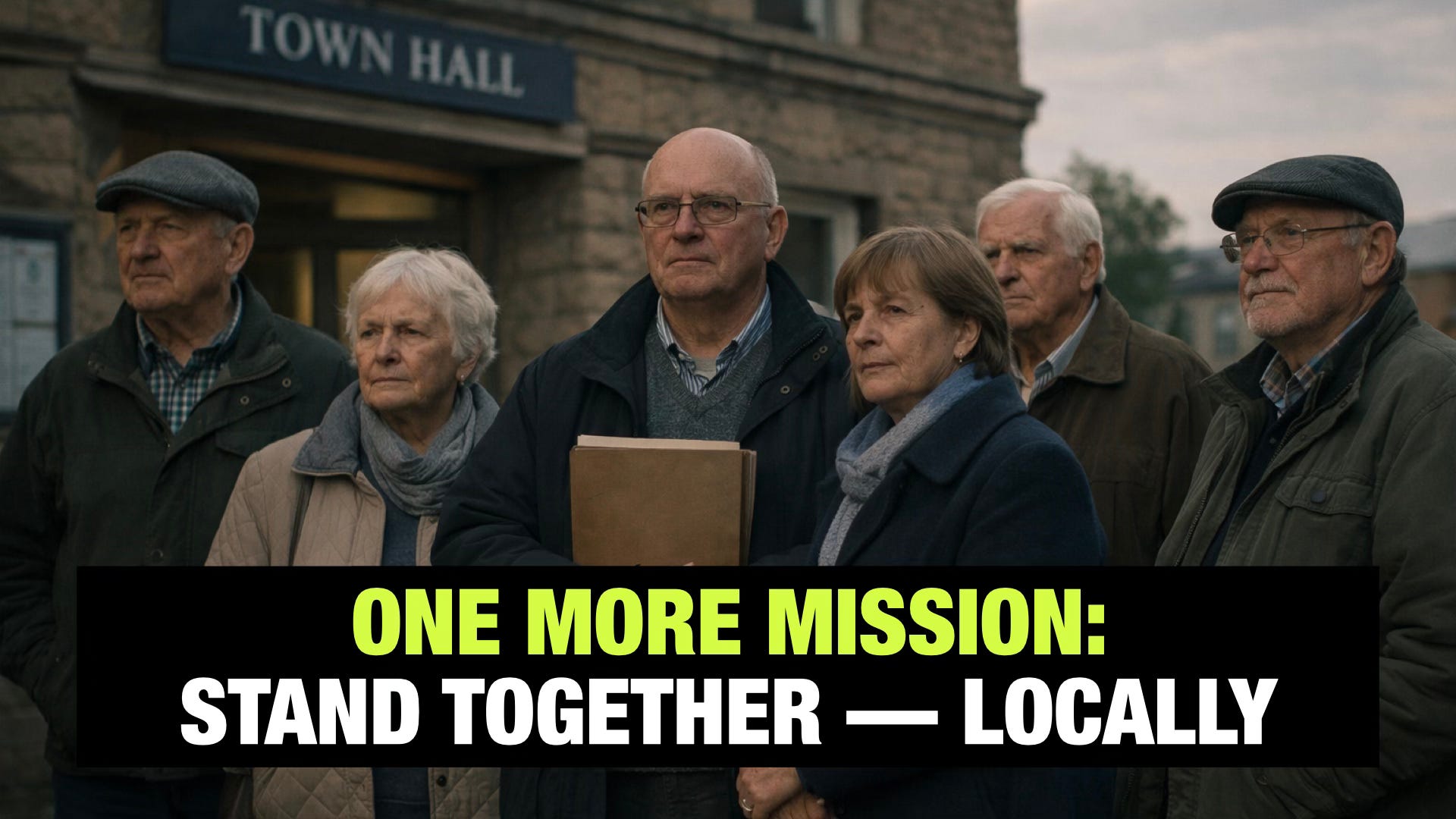
For the past year, many veterans have found themselves facing something they never expected: the need to step forward again.
Not to relive old battles. Not to fight yesterday’s war in the courts or the media. But to explain — calmly, clearly, and locally — what the new Troubles Bill and the Remedial Order actually mean in practice for those who served, and for the country that sent them.
One More Mission is not a slogan. It’s a description.
Veterans who thought they were done are being drawn back into public life — quietly, locally — because what is happening now has consequences for real people in real places.
What is changing is the way this mission is being carried out.
People have been asking what thye can do next.
Why this must happen locally
It’s important to be clear about what this effort is — and what it is not.
No one is issuing directions, orders, or instructions. There is no coordination, no central plan, and no expectation that people act in the same way or at the same time. That would undermine the very thing that gives local engagement its legitimacy.
What has happened is simpler. Many people — veterans, families, councillors, and community members — have asked a straightforward question:
What can I do, locally, that would actually help?
A playbook and letters have been written in response to that question. They are tools, not a kit.
A toolkit implies assembly instructions, completeness, and central design. This is not that. What’s being offered here is closer to a workbench with a few good tools left out — practical pieces that people can pick up, adapt, or ignore, depending on their local circumstances.
Use what helps. Leave the rest on the bench.
From national campaigning to local stewardship
The purpose of the playbook being shared is simple:
to enable veterans to engage locally, as constituents, in a way that is credible, measured, and difficult to ignore.
This is not a national campaign. There is no central command, no branding exercise, and no attempt to manufacture pressure.
Instead, it is a catalyst.
Each local group stands on its own feet:
speaking to its own MP,
working with its own council,
drawing on its own veteran community.
Cornwall has already shown that this works. A small group of veterans formed what they called a “Fighting Patrol” — not because they were looking for a row, but because they understood the job: small numbers, clear purpose, disciplined tone, and steady movement through local institutions.
Acting locally and on a cross-party basis, they secured a council motion backing concerns about the impact of legacy legislation on veterans’ wellbeing and legal certainty. That motion now sits on the official record and has been formally conveyed to ministers.
No spectacle. No outrage. Just steady, competent pressure.
What the playbook provides
The constituency playbook is deliberately practical. It includes:
guidance on identifying priority constituencies using a simple seat triage grid;
a recommended small-team approach for meeting MPs;
a one-page constituency briefing MPs can actually read;
a replicable route through councils via Armed Forces Champions; and
clear language discipline to keep the focus on finality, fairness, and duty of care.
Nothing in it requires permission, funding, or public visibility.
It is designed to look ordinary — because local democracy usually is.
What is needed now
This next stage does not need thousands of people doing the same thing.
It needs enough people, in the right places, doing it properly.
In practical terms, that means:
veterans willing to form small local groups (four to six people);
individuals prepared to request meetings with their MP as constituents, not activists;
councillors or Armed Forces Champions open to tabling calm, cross-party motions; and
a shared commitment to restraint, accuracy, and seriousness.
This is slower work. It is also more durable.
Your mission (what to do next)
If you are a veteran — or someone trusted by veterans in your area — here is the job.
A necessary clarification: this work is outside the chain of command. Many veterans were raised in an ethos of “say nothing and get on with it”. That instinct is understandable — but it leaves the narrative and the detail to others.
One More Mission matters because it reminds people of a basic point: as civilians and constituents, you are free to act — lawfully, respectfully, and locally — to ensure your representatives understand the consequences of their actions.
Form a small Fighting Patrol (4–6 people). Nominate a calm lead. Keep it local.
Map your ground. Identify your MP, their majority, and your council’s Armed Forces Champion.
Make contact. Request a meeting as constituents. Bring the one-page briefing. Keep it factual.
Work the council route. Ask the Champion (or a supportive councillor) to table a simple, cross-party motion.
Hold the line. Follow up, log commitments, and stay disciplined. No theatrics. No rants.
You are not being asked to become a campaigner.
You are being asked — once more — to stand with your community and ensure your representatives understand the consequences of what they are doing.
Quietly. Locally. Properly.
Practical materials (downloads)
For those who want to act locally, we’ve attached a small set of working documents:
a constituency playbook;
a short meeting request letter for MPs;
a short constituency briefing; and
a Lords-facing note MPs can forward without rewriting
They are provided in PDF for convenience in reading and downloading. If you would like an editable Word (.docx) version, email: playbook@justiceforveterans.uk.
These are not campaign materials and are not meant to be used unchanged. They are intended to be adapted locally — names, places, councils, and circumstances — and used by veterans and communities acting as civilians and constituents.
There is no copyright and no requirement to attribute these documents to any organisation or national effort. Use what is helpful. Ignore what isn’t. The aim is simply to support calm, informed, local engagement.

I have been waiting and expecting Labour to push through the bill. The LibDems backed the bill. I was thinking on an attack basic on how to confront this government and Westminster uni parties and embarrass them. One way is to boycott the Rememberance Sunday and hold the assembly at local remembrance day. The other is to Boycott the Invictus games. I do believe this would embarrassed them more than us the back bone. Military veterans.
This is exactly what's needed, Veterans standing side by side sharing experience and support. Its very frustrating when people who have not served talk about Army life and if you have served you understand that you don't know until you know, The army way of life can just not be understood unless you have lived it and integration back in to society is not easy. This is a great idea and would loved to be involved