

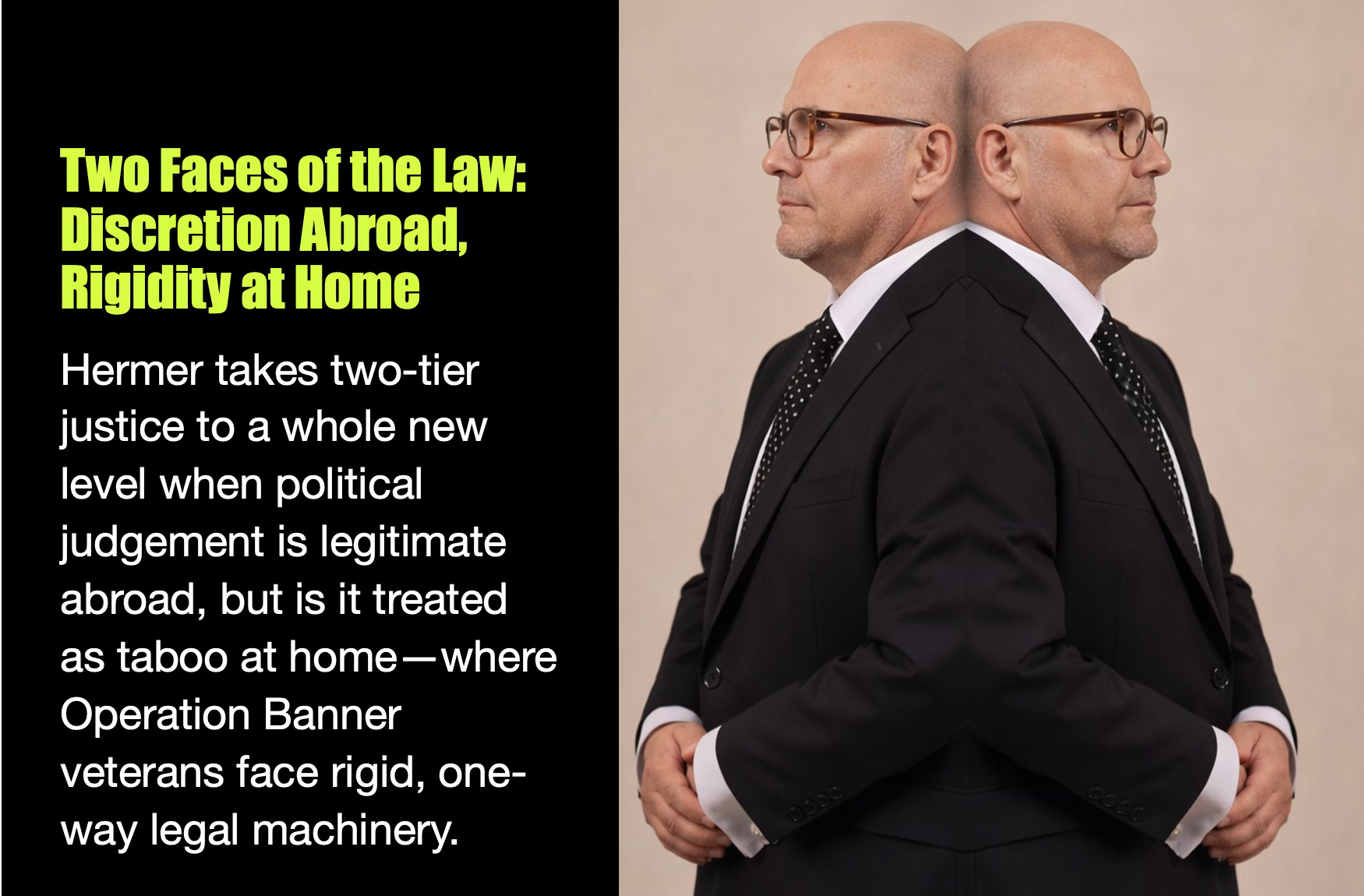
Lord Hermer’s recent remarks on international law were striking not for what they denied, but for what they openly conceded. The UK, he said, retains the right to weigh diplomacy and national interest before publicly accusing allies of breaches of international law. In other words, the law is not applied mechanically. It is filtered through political judgment.
That admission matters — because it exposes a contradiction at the heart of Britain’s approach to law.
In foreign affairs, ministers are perfectly comfortable acknowledging that law operates in the real world. Context matters. Alliances matter. Strategic consequences matter. Legal formalism is tempered by prudence, discretion, and the long view of national interest. This is not radical. It is how states have always behaved.
Yet when it comes to domestic legacy justice — particularly Operation Banner veterans — that same realism evaporates.
Here, law is presented as inexorable. Automatic. Above politics. Investigations must proceed, inquests must reopen, prosecutions must be contemplated, regardless of the time elapsed, degraded evidence, or the operational context in which decisions were made. Political judgment, we are told, has no place. To intervene would be “unlawful”. To draw a line would be “impunity”.
Veterans and critics are not arguing that the law should never apply. They are arguing that it is being applied without judgment — rigidly, selectively, and asymmetrically. Lawfare is not about the existence of law. Lawfare is using legal tactics as a one-way instrument: endlessly revisiting the actions of soldiers, while the political, terrorist, and command decisions that shaped the conflict remain largely insulated.
That contrast matters even more when set against Hermer’s comments.
If law may be tempered by political calculation when dealing with allies accused of breaching international law, why is no such discretion acceptable when dealing with British veterans acting under lawful orders during a counter-insurgency campaign authorised by Parliament?
The uncomfortable answer is that different arenas are being governed by different philosophies.
Internationally, law is treated as part of statecraft. Domestically, at least in legacy matters, it is treated as an abstract moral machine — detached from consequence, responsibility, or reciprocity.
The state reserves discretion for diplomacy, but denies it to its own servants.
That raises a deeper question. If international law is applied selectively — enforced against some, muted against others — can it meaningfully be called international at all?
Or is it, in practice, a European legal culture projecting itself outward, while quietly acknowledging that others do not, and will not, play by the same rules?
If so, honesty demands a reckoning.
Either law is a universal discipline, applied with judgement everywhere — including at home — or it is a regional legal framework that should be named as such, rather than mythologised as a neutral global order.
States have always balanced law and politics. The novelty today is not that this balance exists, but that we pretend it does not — except when it suits us to admit it.
Veterans notice. So do allies. And eventually, so will the public.
There is no such thing as ‘international law’.
He is an EVIL PERSON ! 👿
POINT OF FACT THE UNI PARTY ARE ALL EVIL !