

The latest Times coverage of the Northern Ireland Troubles Bill deserves careful reading — not only because of what it reports, but because of what it reveals.
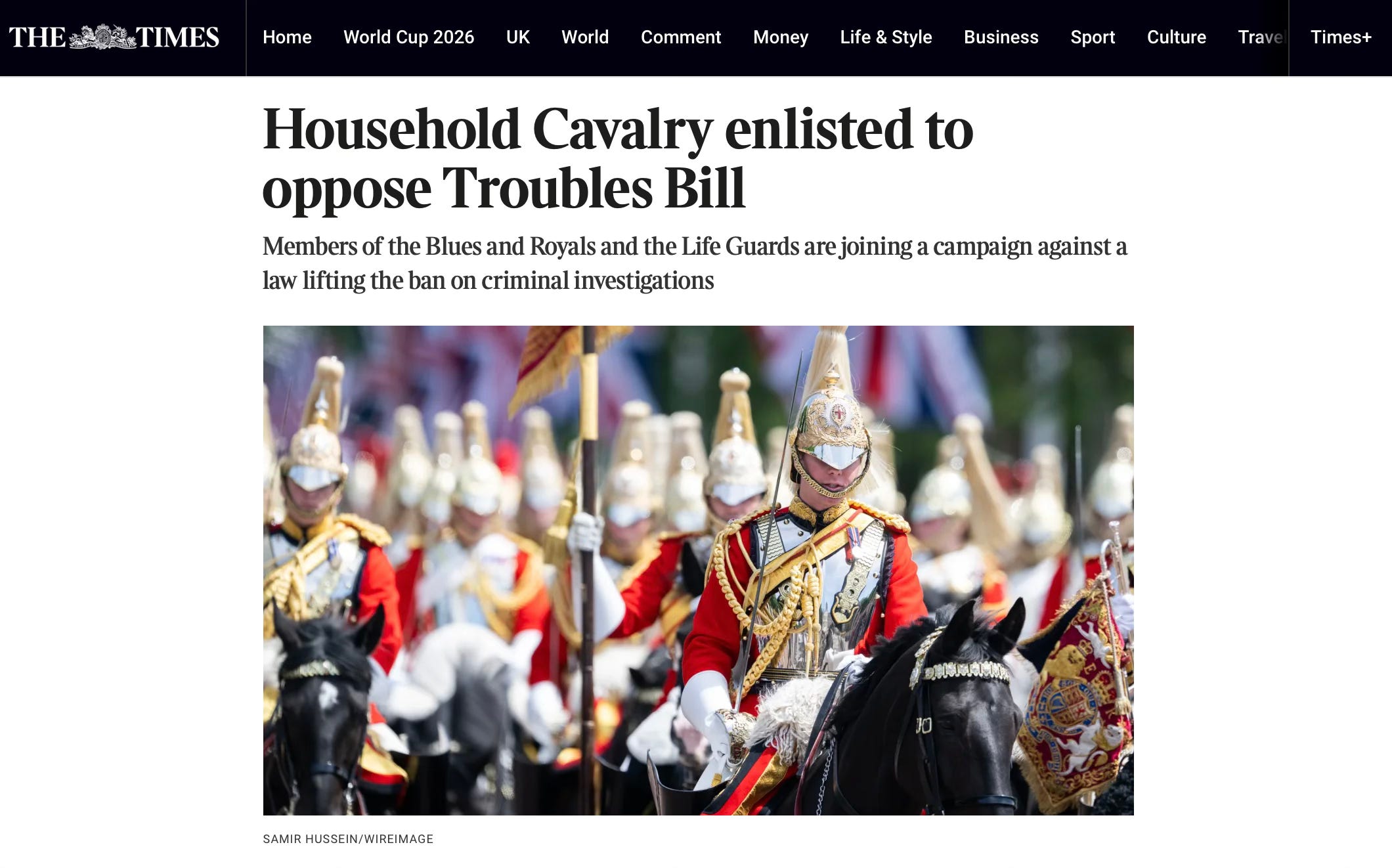
The headline is the decision by Household Cavalry regimental associations to encourage members to oppose the Bill. That matters.
Regimental associations exist primarily to support serving soldiers, veterans and their families. They rarely intervene in live political debates.
Their decision to do so suggests concern about the legislation has spread well beyond campaign groups into the wider military community.
The article also quotes Emma Norton, Director of the Centre for Military Justice:
“We know the vast majority of our service people served and serve with bravery and distinction. But there will always be a few who do not. There needs to be an effective system for investigating it.”
There is little in the first part of that statement that most veterans would dispute. No one should be above the law. Genuine criminal wrongdoing should be investigated.
The disagreement lies elsewhere.
The implication is that Britain lacks an effective investigative system.
Veterans ask a different question: How many investigations are enough?
Over the past fifty years, there has been no shortage of investigative mechanisms. Royal Military Police investigations. Royal Ulster Constabulary investigations. The Historical Enquiries Team. The Police Ombudsman. Coroners’ inquests. Public inquiries. Prosecutorial reviews. In many cases, individuals have been investigated repeatedly.
The question Parliament must answer is not whether allegations should ever be investigated. It is why cases that have already been examined, sometimes several times, should be reopened yet again, and what realistic prospect exists of producing different outcomes.
That is not an argument against accountability.
It is an argument for proportionality, legal certainty and finality.
The significance of this debate is therefore much wider than that of a single Bill.
One side begins with the proposition that justice requires another investigative mechanism.
The other asks whether justice can survive if investigations themselves become effectively open-ended.
That is the issue Parliament must resolve.
The growing involvement of regimental associations suggests many veterans believe it has yet to do so.
The Cavalry indeed! However, we don't see any Terrorists being tried for crimes against the State; Murder, Torture, Insurrection, Bombings of pubs and clubs on the British mainland and in Belfast??? Hey! What we do see is a 'pack of political wimps, lawyers and other low-life personnages trying to implicate brave and courageous soldiers with crimes that were NEVER COMMITTED! Based on fabricated lies and non existent evidence! This whole charade is has been conspired, to line the pockets of lawyers, and IRA families who claim that injustices were committed against their loved ones. 'Card carrying members of a prescribed Terrorist Organisation!!' May shame rest upon those who are intent on pursuing Warrior Veterans for doing an amazing job of mitigating, in preventing and saving countless lives! 'Veterans' Rule OK!' 🙏💪💪💪👊👊👊