

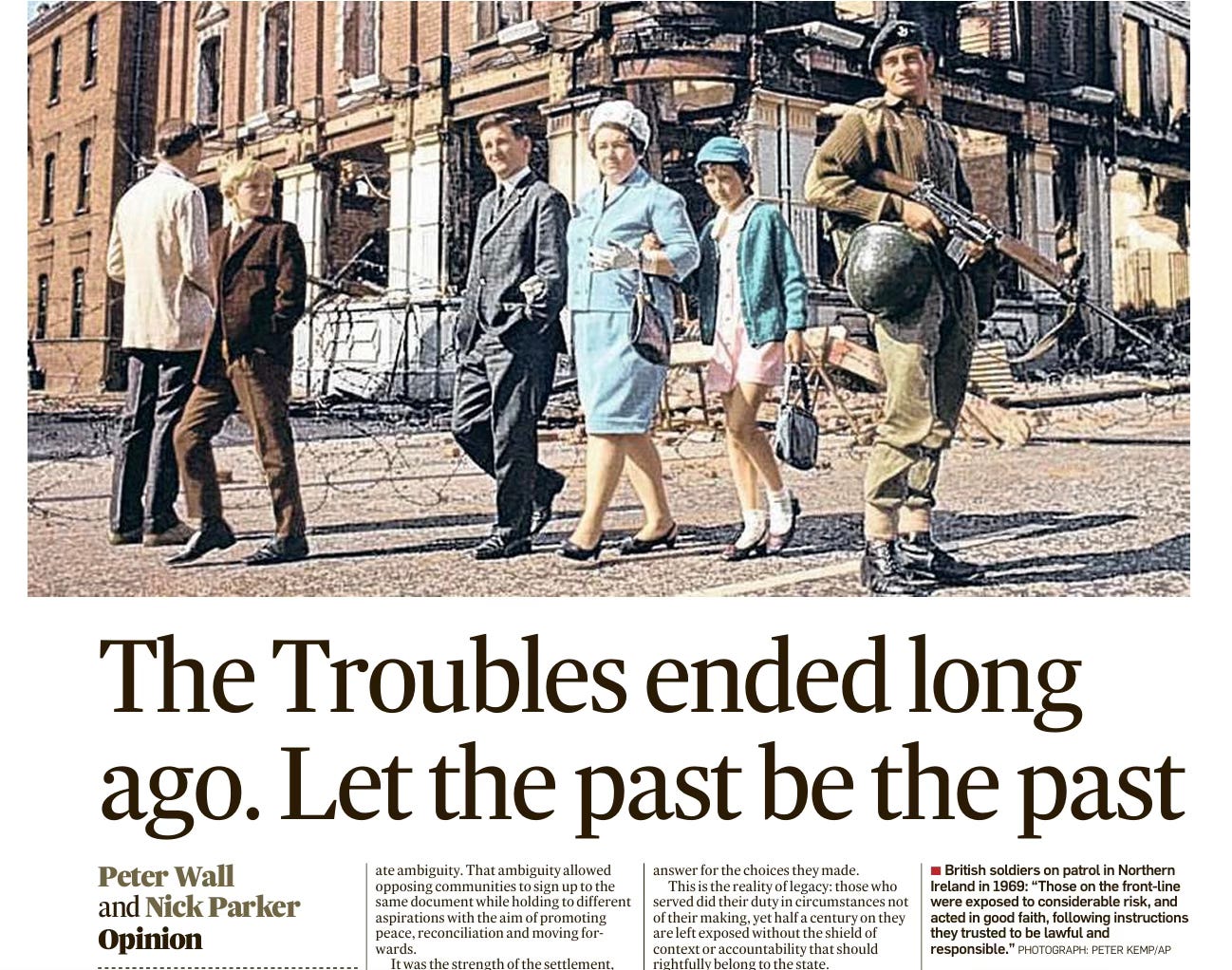
A significant intervention in the legacy debate has come this week from two of the most senior figures ever to command the British Army.
Writing in an Irish Times opinion piece, former Chief of the General Staff General Sir Peter Wall and former Commander-in-Chief Land Forces General Sir Nick Parker warn that the government’s current approach to Troubles legacy risks reopening legal battles that will achieve little while placing former soldiers back under threat of investigation decades after the events.
Their article appears at a particularly sensitive moment.
The Northern Ireland Troubles (Legacy and Reconciliation) legislation introduced by Northern Ireland Secretary Hilary Benn is continuing its passage through Westminster, while Prime Minister Keir Starmer is preparing to meet Irish Taoiseach Micheál Martin at an Anglo-Irish summit.
Against that backdrop, the two generals argue that Britain risks reopening the past rather than allowing Northern Ireland to move forward.
Their central argument is straightforward.
The conflict began 57 years ago, and the Belfast Agreement was signed 28 years ago. The previous 2023 Legacy Act, passed by the Conservative government, attempted to draw a line under the cycle of investigations and litigation that had continued long after the conflict ended. The new Bill, they argue, risks reopening that cycle.
The problem, they suggest, is both practical and political.
In many IRA-related cases, the relevant forensic evidence and records simply no longer exist. In the case of the security forces, they note, the archives have already been examined repeatedly over the decades. Re-examining the same incidents again and again is therefore unlikely to produce new facts, but it will continue to place former soldiers under legal pressure.
The generals also revisit the original logic of the 1998 Belfast Agreement.
That settlement succeeded, they argue, partly because it relied on deliberate ambiguity. Different communities were able to support the agreement while holding different political aspirations. That flexibility allowed peace to emerge after decades of violence.
But the same ambiguity can become a weakness if the political system repeatedly reopens arguments about the past.
Each time the legacy issue is revived, the old divisions inevitably resurface.
The article also raises a wider strategic concern that rarely appears in public debate.
Britain today faces a deteriorating international security environment and a military that has been significantly reduced in size. In those circumstances, they ask whether it makes sense for the country to devote significant political energy, legal resources, and public attention to events that occurred half a century ago.
For the authors, however, the most serious issue is the relationship between the state and those who served it.
During Operation Banner, soldiers deployed to Northern Ireland operated under orders issued through the chain of command and authorised by successive governments. They acted, the generals argue, in good faith under the assumption that the state would stand behind them.
That assumption formed an unwritten contract between the state and those prepared to risk their lives on its behalf.
Today, they argue, that contract is being quietly broken.
When veterans are summoned before inquests or investigations decades later, the ministers who authorised the deployment are no longer present. The commanders who issued orders are not standing beside them in court. Instead, individual soldiers are left to face legal scrutiny alone.
This situation, they warn, has consequences far beyond the legacy debate itself.
If soldiers believe that lawful actions carried out under government orders may be judged decades later without the protection of context or political accountability, the long-term trust between the armed forces and the state is weakened.
That is not merely a historical question. It affects the willingness of future generations to serve in difficult and dangerous circumstances.
The generals are also critical of the Anglo-Irish framework being discussed alongside the legislation.
In their view it has three major flaws:
• Risking diluting UK sovereign responsibility by presenting the announcement jointly with the Irish government
• Raising expectations of new truth-finding that cannot realistically be fulfilled after so many years
• Opening the door for the resumption of inquests and investigations involving veterans.
The Bill proposes a series of protections for former service personnel. But the authors argue these safeguards apply only after cases have already been reopened and are largely procedural protections that would apply to anyone in the legal system.
In practical terms, they believe the protections will do little to prevent the cycle of litigation from continuing.
The op-ed, therefore, ends with a broader warning to political leaders.
Legacy cannot be managed indefinitely through legal process alone. At some point, governments must decide whether the priority is endless retrospective litigation or maintaining the trust between the state and those who served it.
History, the generals suggest, will not judge today’s leaders on how carefully they administered legacy investigations.
It will judge whether they had the political courage to close a chapter of history and allow the future to move forward.
For veterans following the current Westminster legislation, the intervention of two former Army chiefs is significant.
It signals that concerns about the direction of the legacy debate are no longer confined to campaign groups or former soldiers themselves. Senior figures from the highest levels of the armed forces are now raising the same question publicly:
How long can a state continue to revisit the past without undermining those who were sent to fight its battles?
The Generals are correct. Northern Ireland is at boiling point just like Scotland and the Northeast. The routes are strong with.our families.
The State has already broken the Soldiers' Covenant! This Government is trying to take away every bit of power that protects our veterans and soldiers currently serving for the protection of the Homeland, and Great Britain's interests throughout the World. As long as the People of this 'Green and Pleasant Land' endures its 'Faceless, Woke Government,' then the positive changes needed, to protect all Veterans and indeed future Veterans will remain violated!