

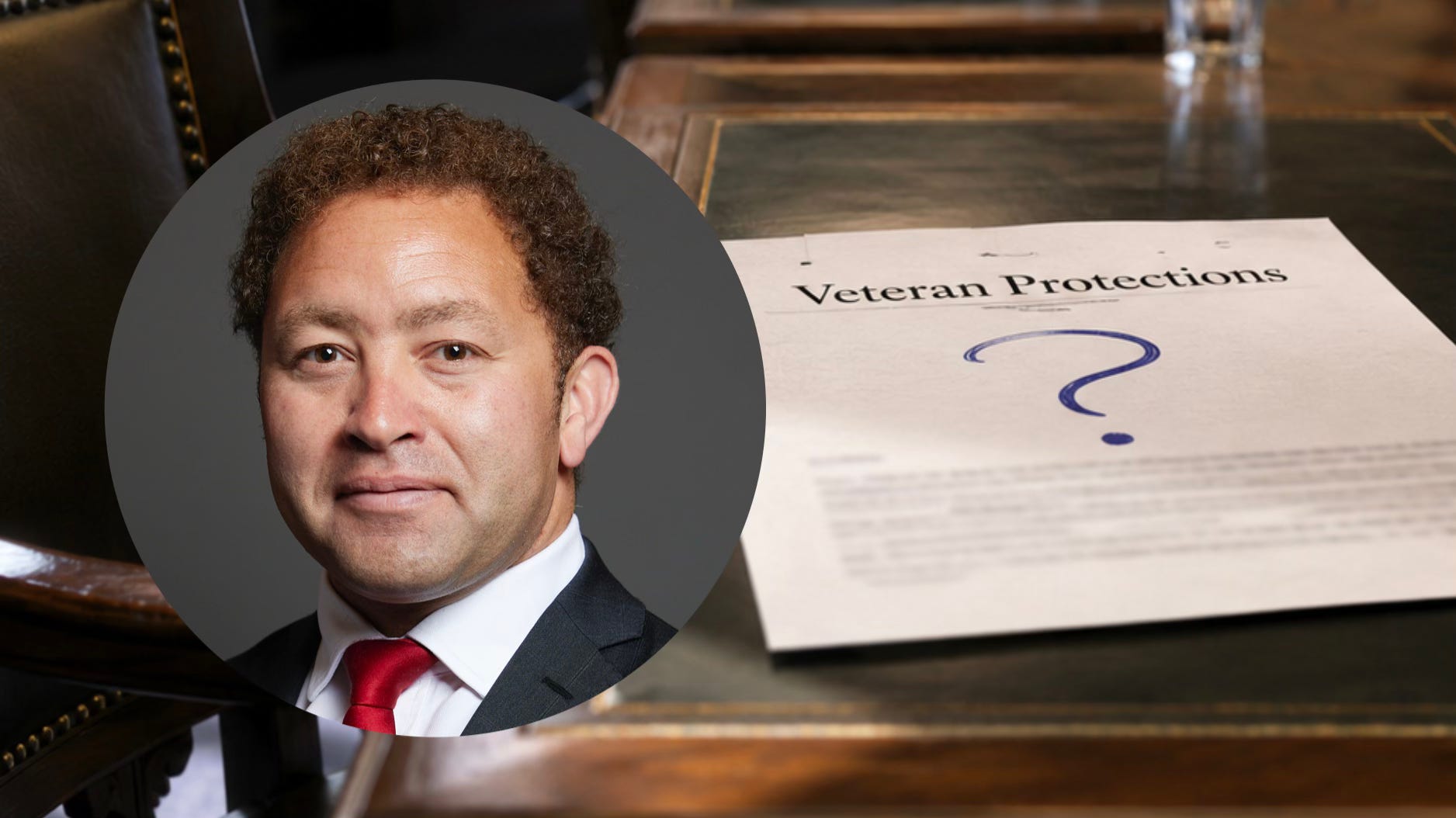
“No veteran should be dragged repeatedly through processes dealing with the same matter.”
Those were the words of Calvin Bailey before his appointment as Veterans Minister.
Many veterans would agree.
The question now is not what a backbench MP thinks.
It is what a minister intends to do.
Bailey, a former RAF officer, has publicly acknowledged concerns about repeated investigations and legal processes arising from events that took place decades ago.
He has argued that veterans should not be treated as morally equivalent to terrorists and has called for stronger protections.
At the same time, he supported the repeal of the Legacy Act, describing it as “a false promise that protected no one”.
That position creates an obvious question.
If the Legacy Act failed, what protections does the new Veterans Minister believe should replace it?
The question matters because one of the principal arguments used to justify repeal has become increasingly difficult to sustain.
Veterans were repeatedly told that the Legacy Act was fundamentally unlawful and could not survive judicial scrutiny. The Dillon judgment was widely presented as evidence that the legislation was fatally flawed.
Yet the Supreme Court subsequently upheld the immunity scheme itself.
That does not mean the Act survived intact. Nor does it mean every criticism of it was wrong. But it does mean that one of the central political arguments used to justify repeal—that immunity itself was incompatible with the Convention—proved far less certain than many were led to believe.
For veterans, that raises an obvious question.
If protections were removed on the basis of a legal case that later proved substantially weaker than advertised, what protections are being offered in their place?
Bailey has acknowledged the problem of repeated investigations.
Many veterans believe the current Bill does not solve that problem. Instead, they fear it risks reopening a process that imposes significant burdens on former soldiers while imposing no equivalent burden on former terrorists.
As Veterans Minister, Bailey is now in a position to do more than recognise those concerns.
He is in a position to address them.
Veterans will be watching closely to see whether his words are reflected in the legislation that emerges from Parliament.
The question is no longer whether veterans need protection.
The question is what protection means in practice.
Calvin was RAF.. another under Starmer who voted with the Government... but now, seeing the writing on the wall for Starmer speaks out. Never, ever, trust these fork tongued, ex military turncoats... Vile individuals who do what is political expedient...
Spot on, Peter... there interest is being a parliamentarian - get their hands on the tax payers funded trough