

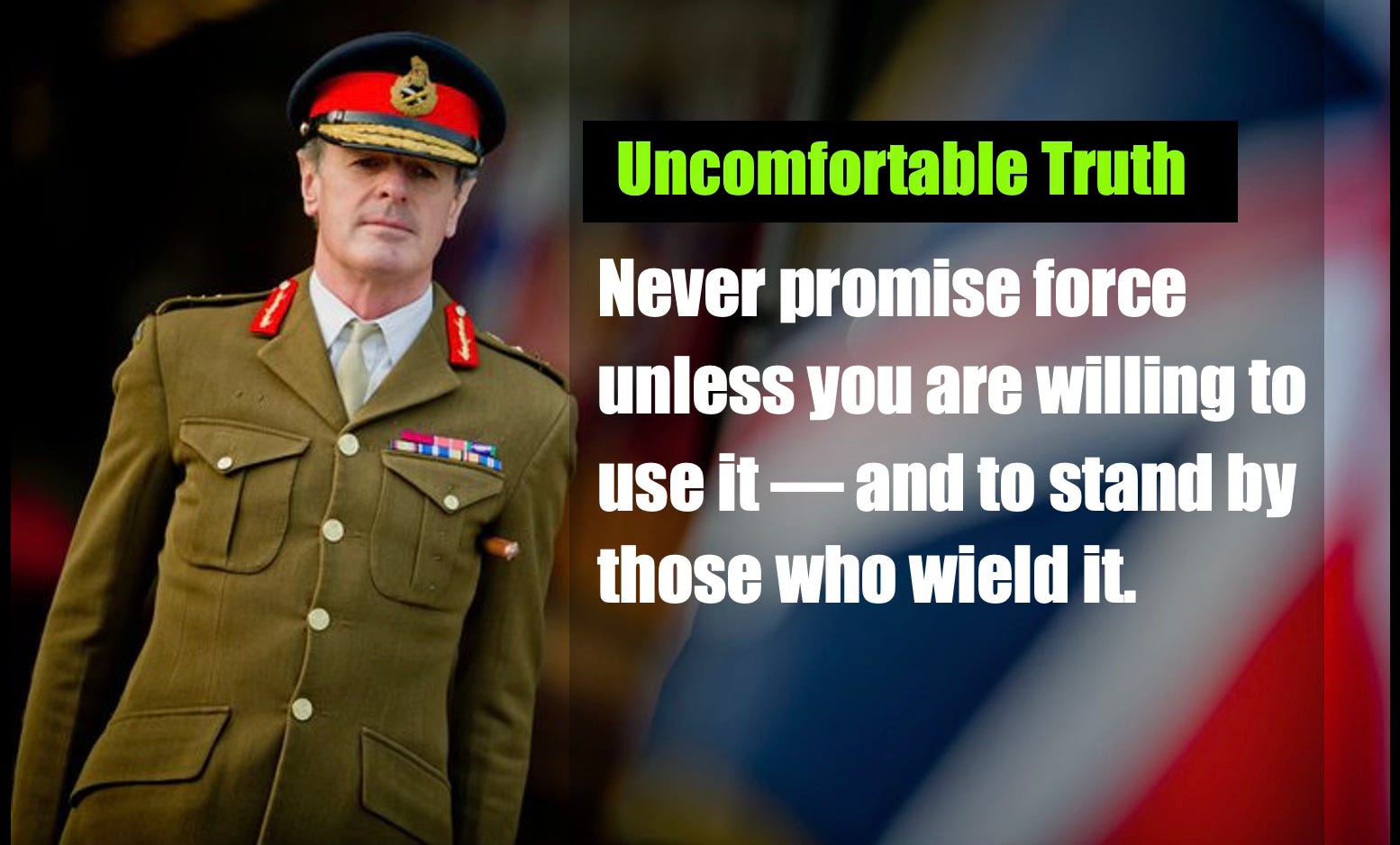
General Sir Richard Shirreff’s intervention in the Daily Mail today (8/1/26) cut through the fog in a way most ministerial statements do not. His argument was not ideological, nor anti-Ukraine. It was military realism of the old school: Britain does not currently have the manpower, equipment, funding, or political depth to sustain a serious peace-enforcement deployment in Ukraine — and it should stop pretending otherwise.
Sir Richard has earned the right to speak his mind. He rose to the highest ranks in the British Army and NATO, with over 37 years’ experience as an international leader and commander, and exceptional diplomatic, managerial, and political skills.
In other words, he is a man Sir Keir should be listening to, not just hearing from.
Sir Richard offers a straightforward warning. A “peacekeeping” force in Ukraine would not be symbolic or lightly armed. It would require readiness to fight Russian forces if the ceasefire collapsed. That means scale, logistics, rotation, and endurance. Britain could perhaps manage such a commitment for months, not years — and only by stripping capability from elsewhere. In short: if you are not prepared for war, do not make promises that assume it.
What followed in the comments section of the Daily Mail article, which, unlike the article, is not behind a paywall, matters just as much as the article itself. But before we look at that, we should first understand something about the Daily Mail readership.
The Daily Mail audience — who they are, and why it matters
The Daily Mail is often caricatured, but its readership is one of the most politically consequential demographics in Britain.
Broadly speaking, it skews:
Older than average, with a strong cohort over 45
Lower-middle to middle income, many homeowners
High representation of veterans, ex-police, reservists, and military families
Strong presence outside London and the South East
Historically small-c conservative rather than ideological
Crucially, this is the audience that:
Supplies disproportionate numbers of recruits and reservists
Forms the backbone of electoral consent for defence spending
Retains living memory of Northern Ireland, the Falklands, Iraq and Afghanistan
When this audience speaks with near unanimity, it is not noise. It is a warning light.
What the comments tell us
Strip away the insults and exaggeration, and several clear themes emerge — repeated hundreds of times.
1. No appetite for overseas deployment
There was overwhelming rejection of sending British troops to Ukraine in any capacity. This was not framed as sympathy for Russia, but as disbelief that the war is Britain’s to fight.
The dominant sentiment was simple: this is not a war the public consented to.
2. Borders before everything else
Again and again, commenters returned to the same moral hierarchy:
If the state cannot control its own borders, it has no legitimacy in claiming to defend someone else’s.
This is not a technical defence argument. It is about trust in the state’s priorities.
3. Deep distrust of political leadership
Starmer — and Macron — were widely viewed as posturing rather than leading. Many commenters believed the pledge was either:
A bluff that will never be honoured, or
A deliberate move designed to look strong while knowing Russia will refuse the terms
Either way, foreign policy was read as theatre, not intent.
4. Fear of lawfare and abandonment
This is where the comments intersect directly with Operation Banner and legacy prosecutions.
Many expressed a belief that:
Soldiers sent abroad today will be investigated tomorrow
Political leaders will disown them once the headlines change
Obedience is no longer matched by institutional loyalty
This is not abstract paranoia. It is a conclusion drawn from lived experience.
5. Collapse of the social contract
Calls for conscription, politicians’ children going first, or refugees being sent instead are not serious proposals. They are accusations.
They say: if elites want war, they should bear the cost.
That tells us something important. The public no longer believes sacrifice is shared.
Why this matters for veterans — and for national security
This reaction is not “Mail hysteria”. Historically, this is what a society looks like after strategic exhaustion.
The problem is no longer equipment or numbers alone. It is legitimacy.
A state cannot ask men and women to accept lethal risk if:
The war aims are unclear
The rules will be rewritten afterwards
Legal protection is absent
Moral responsibility flows only one way
Lawfare does not just damage veterans retrospectively. It poisons future deterrence.
When ordinary citizens assume — rightly or wrongly — that soldiers will be used and then sacrificed politically, the foundation of defence collapses quietly but decisively.
An uncomfortable truth
Sir Richard’s article resonated not because it was dramatic, but because it reaffirmed an old military principle: Never promise force unless you are willing to use it — and to stand by those who wield it.
The comments beneath his article suggest a public that instinctively understands this, and no longer trusts its leaders to honour it.
This is not a pro-Russia public.
It is a post-illusion public.
And unless the state restores trust with those who serve — past, present, and future — no declaration of intent will mean very much at all.
Thank you for relaying this to us.
The great scandal of the political class, which Starmer epitomises, is their cowardice. They have never led anyone, anywhere, outside their political parties. They have no political acumen beyond surviving the next ten days in Westminster. They take no personal responsibility, hiding behind cabinet and committee decisions. They have no honour, and cling on to positions after it has been proved they lied or misled the public.
I really believe that if the generals and commanders in chief had more prominent roles in Parliament - as in the Roman Senate where you were forbidden from becoming a senator unless you had commanded a legion and also had victory - the world would be a safer, better place.
Stalin, like all dictators, does not listen to anybody.
Agree with all points made in this post.
I feel saddened by the whole situation and ashamed of successive governments that have treated both serving military personnel and Veterans so shoddily. It is simply disgraceful.