

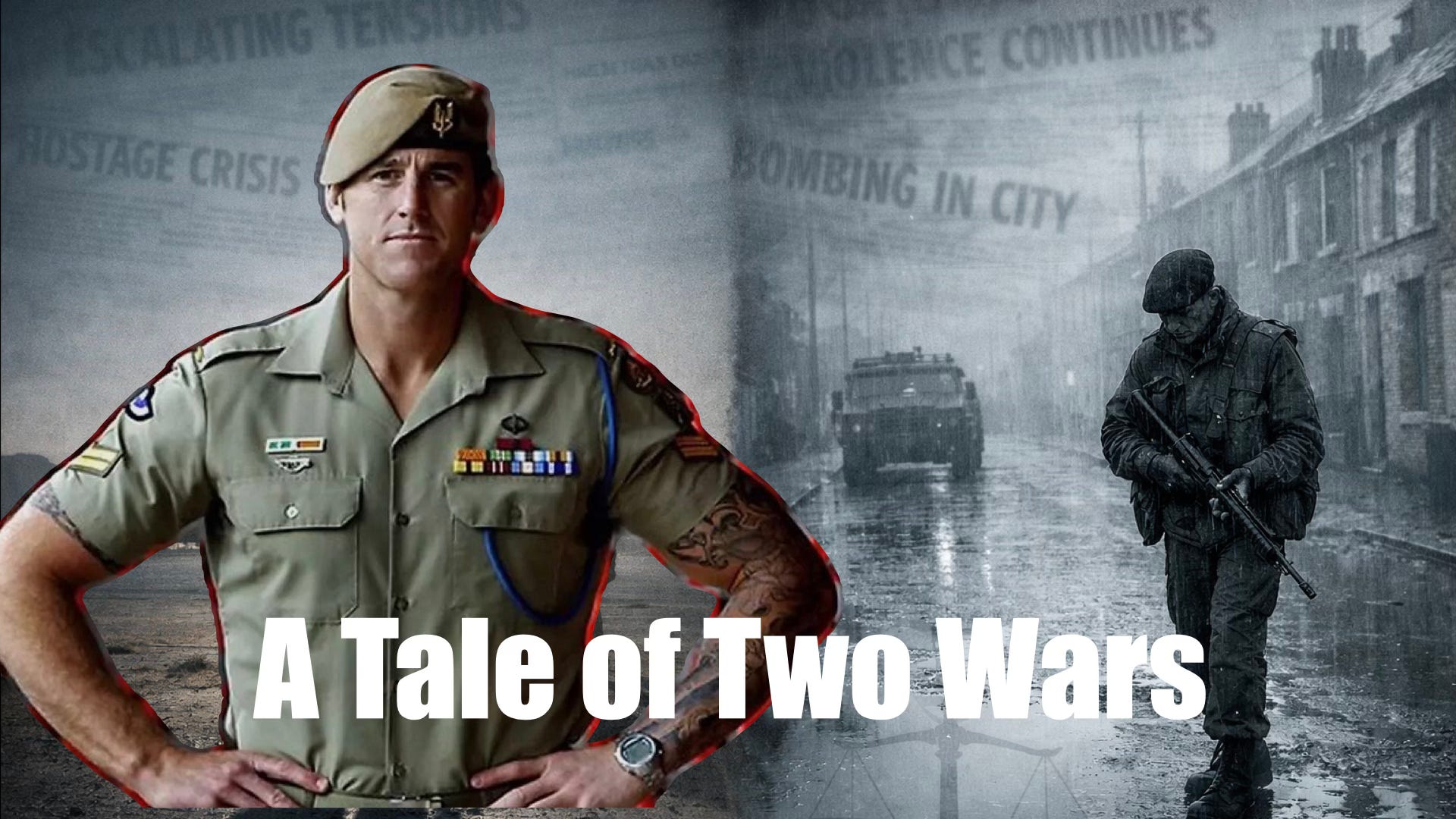
The arrest of Ben Roberts-Smith has triggered a familiar pattern. Not in the facts themselves — those will be tested in court — but in how those facts are presented, framed, and quietly turned into conclusions before any verdict is reached.
That is the real story. And it lands directly on the ground that British veterans are now standing on.
The case study makes a simple but uncomfortable point: two outlets, working from the same press conference, produced materially different impressions of guilt. One leans toward a conclusion; the other toward caution. The difference is not factual — it is editorial judgement.
That distinction matters far beyond Australia.
Because once editorial judgment begins to substitute for legal judgment, the presumption of innocence becomes conditional. And once it becomes conditional in one case, it becomes negotiable in all.
That is precisely the terrain Operation Banner veterans now find themselves operating on.
What is happening in the Roberts-Smith coverage is not an isolated media quirk. It is a demonstration of how narrative hardens ahead of due process:
Civil findings — made on the balance of probabilities — are presented with the weight of criminal proof
Allegations are repeated with increasing certainty over time
Context is selected not to inform, but to reinforce a settled view
The subject’s humanity becomes secondary to the narrative
The report is blunt about the mechanism: not fabrication, but curation — the selective arrangement of true facts to produce a particular conclusion.
That is exactly how lawfare operates in practice. Not through a single decisive act, but through accumulation.
And that accumulation is already visible in the Op Banner space.
Veterans are not facing a single trial. They are facing:
Historical investigations revisited repeatedly
Civil processes bleeding into criminal expectations
Media narratives that solidify long before any courtroom decision
A public audience primed to assume guilt before evidence is tested
The Roberts-Smith case shows how easily a civil judgment becomes, in the public mind, a criminal verdict in waiting. That same dynamic sits at the heart of the current legacy system.
Once that shift happens, the legal process no longer begins from neutrality. It begins from a presumption already shaped by years of reporting.
That is not justice. That is momentum.
The implications for Operation Banner veterans are straightforward and serious:
The battlefield is not only legal — it is informational
Time does not dilute allegations; it entrenches them
Silence is interpreted as absence, not restraint
Editorial framing can achieve what prosecution has not yet proved
This is where much of the current approach falls short.
There is still a tendency to treat media coverage as secondary — something to be responded to after the fact. That is a mistake. The Roberts-Smith case demonstrates that by the time charges are laid, much of the public judgment has already been formed.
In other words, the trial begins long before the courtroom.
Something else that should not be ignored is that the erosion of trust in mainstream outlets is not driven by technology alone. It is being driven by a growing sense that readers are being led rather than informed.
That creates an opening.
Not for shouting, campaigning, or competing narratives — that road leads nowhere useful — but for something more disciplined:
Clear, factual accounts rooted in testimony
A consistent insistence on the difference between allegation and proof
Local, constituency-level engagement where reputational narratives can be challenged directly
Material that treats the audience as capable of judgement, not as something to be steered
The answer is not to outgun the media. That cannot be done. The answer is to build an alternative record — steady, credible, and difficult to dismiss — that operates alongside it.
The Roberts-Smith case is not about whether he is guilty or innocent. That is for a court to determine.
What it shows, clearly, is how easily that determination can be pre-empted in the public mind.
And once that becomes normal practice, no veteran — British, Australian, or otherwise — can assume that the presumption of innocence will hold when it matters most.
That is the lesson worth taking seriously.
This also speaks to the increasingly vociferous progressive strand in our society. They seem to be far less concerned with the facts, or with fairness, than they are with opposing anything and everything that does not support their rather solipsistic world view. Many seem not to believe we should have Armed Forces and that, by definition, anything soldiers do is bad and wrong. In that sense these proceedings are pushing at an open door.
We have a second front, of course, as successive governments and the Civil Service have given every indication that are content for things to develop in this way. It is being suggested that Regimental Associations should be weighing-in, although quite what that would do is not clear when very senior officers are completely ignored. The only way forward is for individuals to refuse to take part in what are likely to be kangaroo courts. Quite what this will do for recruiting does not bear thinking about, but until politicians are prepared to honour the Military Covenant they will have to take the consequences.
The traitors who bring actions against those who would lay down thier lives for us are deeply misguided if they believe they are impervious to retribution. They are living in a fools paradise but politics and allegiance can turn in a dime. They may feel powerful now but that could change quickly and so shall the true exposure of their treason.