

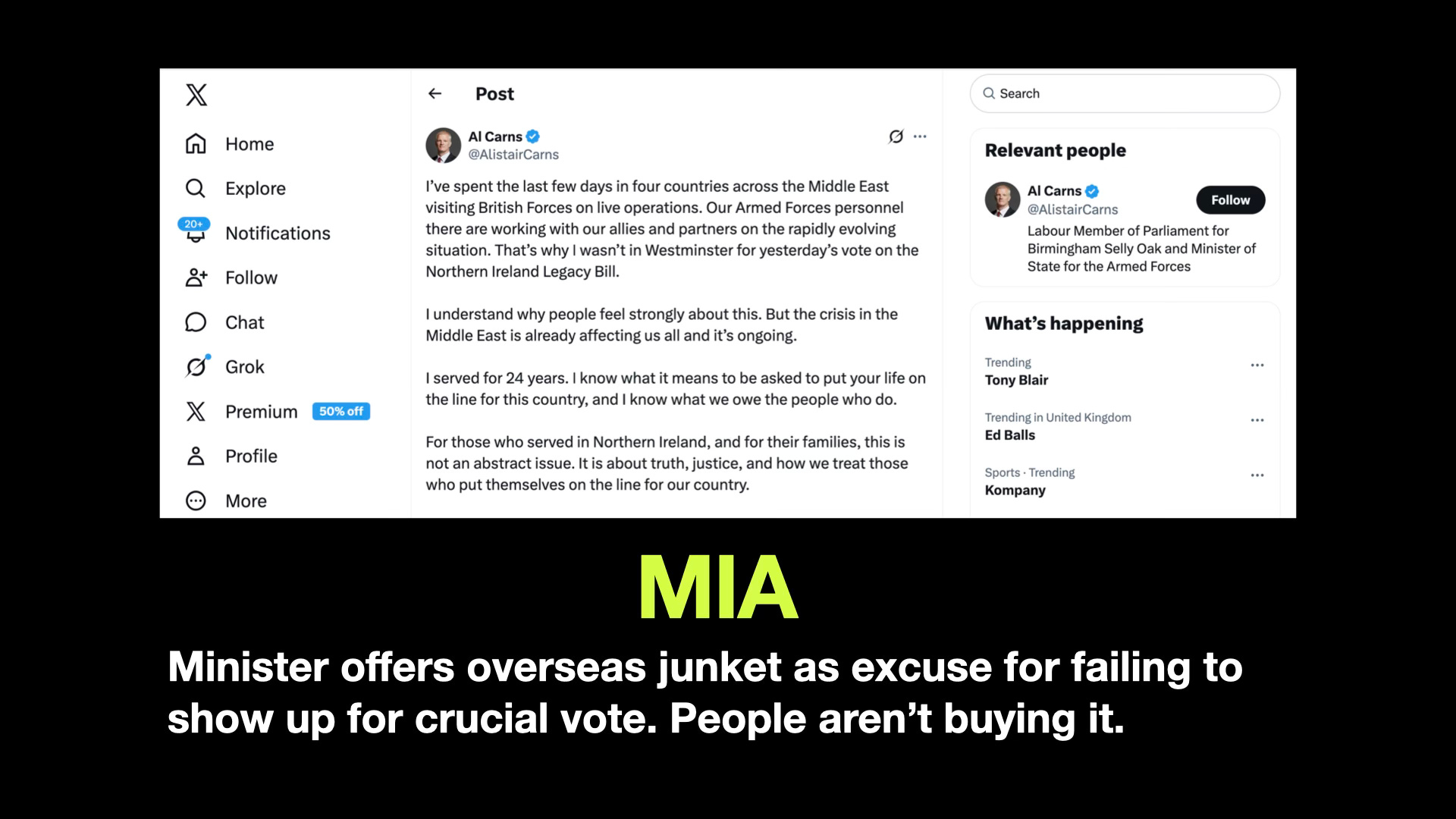
A post justifying a missed vote on legacy legislation has triggered a surge of hostile reaction online, with veterans questioning where Alistair Carns truly stands. The response is not about procedure, but about trust, loyalty, and a growing belief that the system is no longer on their side.
There is a mood hardening around Alistair Carns — and it is not marginal or isolated. It is visible, vocal, and gathering pace.
Within hours of the post, engagement ran into the thousands. Views quickly climbed past 10,000, and the replies and quote posts followed a clear pattern: high volume, high emotion, and overwhelmingly negative sentiment.
This was not a mixed reaction. It was a pile-on with a consistent theme.
The dominant accusation is simple: absence from the vote is being read as avoidance. Not an operational necessity. Not competing priorities. Avoidance.
Examples speak for themselves:
“That’s not the leadership I expect from a Bootneck… By avoiding the vote you’ve sided with the back stabbers. Where do you really stand?”
“Labour hate the military… You are an MP for the party of military persecution.”
The language is unvarnished. It is also revealing.
First, this is not a technical disagreement about legislation. Very few responses engage with the detail of the bill itself. Instead, they go straight to character, loyalty, and alignment.
Second, the reaction collapses the distinction between the individual and the system. Carns is not being judged as an MP navigating a difficult brief. He is being treated as a representative of a political machine associated with Keir Starmer and, by extension, figures such as Richard Hermer. Whether that is fair is almost beside the point. It is how he is being perceived.
Third, there is a clear sense of betrayal framed through identity. The reference to “Bootneck” is not casual. It is a standard being invoked. The criticism is not simply that he missed a vote, but that he failed to meet what people believe someone with his background should represent under pressure.
That matters more than party politics in this space.
There is also a conspiratorial edge in some responses, referencing figures like Phil Shiner and alleging coordinated efforts against veterans. That should not be overstated, but it should not be ignored either. It reflects a deeper collapse in trust, where institutional explanations are no longer accepted at face value.
Taken together, the responses point to something more serious than anger over a single decision.
They show:
A belief that the system is stacked against those who served
A perception that political representatives will not break ranks when it matters
A growing readiness to interpret ambiguity as bad faith rather than caution
This is the environment the original post has landed in.
Carns’ statement is measured. It speaks of balance, process, and working both publicly and privately. In a different context, that might have held. Here, it does not.
Because the audience is not asking for balance. It is asking for position.
That is the gap.
JusticeforVeterans.uk does not exist to inflame anger, but it cannot ignore it either.
If anything, this reaction reinforces the need for a different approach — one grounded in clarity, local engagement, and sustained pressure at the points where decisions are actually shaped.
The task now is to convert that energy into something that carries weight beyond social media:
Clear, localised engagement with MPs who may not yet understand the issue
Consistent framing of the core problem: process becoming punishment
Relentless emphasis on the practical realities — evidential decay, repeated investigation, and the imbalance in how accountability is being applied
The responses to this post are not noise. They are a signal.
And they are unlikely to fade unless the underlying concerns are addressed directly, in language that leaves no room for doubt about where people stand.
Great article, Al Carns has betrayed the Op BANNER veterans and the wider veterans community. He’s being touted as the next Labour leader and future PM, but veterans and the wider community want a leader they can trust, not someone who hides behind others, manipulates the facts for their own ends and dodges the tough choices. Carns promised that the ‘Troubles Bill’ would protect veterans and that he’d resign if it didn’t deliver. Now the Bill has been totally discredited he hasn’t resigned and chosen to absent himself rather than make a stand. Decorated Marine he might be. Principled politician with the potential to be the leader of the country he is not!
I'm too angry to write a thesis today! However, for FFKS! somebody get rid of.all these hopeless "Woke Traitors" in Westminster led by the "Devil Incarnate!!!" 👹👹