

Debate over the legacy of the Troubles continues to intensify, particularly as the UK Government explores new investigative frameworks that could involve the Republic of Ireland in examining the actions of British soldiers. For many veterans, this raises serious questions about history, accountability, and the political context of the conflict.
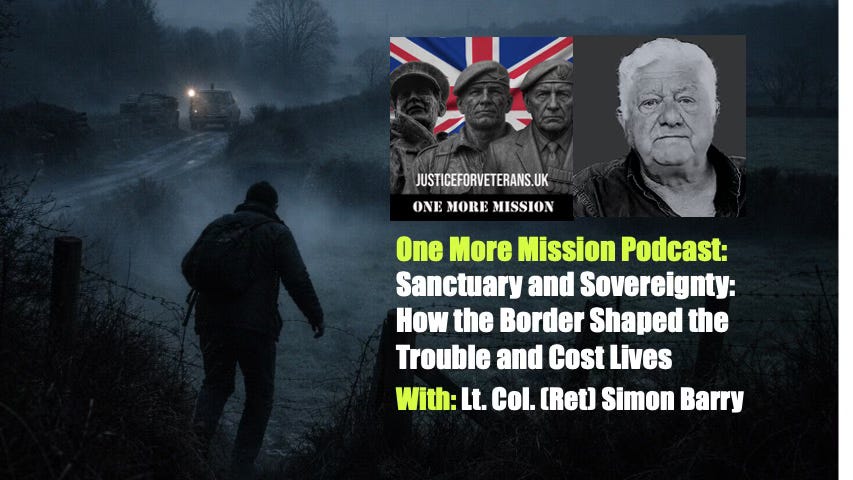
The latest episode of the One More Mission podcast explores these issues through the perspective of former Paratrooper Lieutenant Colonel Simon Barry, who offers a detailed account of how cross-border dynamics shaped the course and longevity of the IRA’s campaign.
At the centre of the discussion is the concept of “active sanctuary.” Barry argues that the IRA’s presence in the Republic went far beyond passive shelter. According to his account, southern territory provided a secure environment for planning operations, training personnel, developing weapons, and mounting attacks. The Republic, in this view, functioned as a rear base from which operations could be launched into Northern Ireland and beyond.
Barry describes how this sanctuary enabled a full operational cycle: reconnaissance, weapons preparation, attack, and withdrawal. The border itself, he explains, was highly porous. Away from a handful of customs checkpoints, it was often little more than a line on a map, easily crossed by road, river, or open terrain. This allowed attackers to carry out operations and retreat beyond the reach of British security forces.
The consequences were particularly evident in border regions such as South Armagh, Fermanagh, and Tyrone, where many killings occurred. Barry characterises these areas as effectively lawless zones, where security forces faced constant threat from attacks mounted from across the border. He also highlights the psychological impact on soldiers who, he says, often saw attackers detonate devices or escape to safety with little possibility of pursuit.
A further theme explored in the episode is the legal and political environment in the Republic during the conflict. Barry points to extradition practices and the classification of offences as political, arguing that these factors hindered efforts to bring IRA suspects to justice. He suggests that the lack of extradition requests granted had significant operational consequences.
The conversation also examines the IRA’s own strategic calculation in avoiding confrontation with southern security forces. Barry interprets this restraint as recognition of the Republic’s importance to the organisation’s survival. Maintaining access to this operational space, he argues, was critical to sustaining the campaign over decades.
Beyond operational details, the episode addresses broader questions of narrative and historical interpretation. The discussion considers claims that the Republic’s counter-terrorism approach evolved over time and assesses contemporary arguments for involving Dublin in legacy investigations. Barry remains sceptical of such proposals, questioning whether a state that he believes played a significant role during the conflict can act as a neutral partner in examining its aftermath.
The episode concludes with a counterfactual reflection: how might the conflict have unfolded if the Republic had treated IRA activity within its territory as an existential threat from the outset? Barry contends that without this cross-border sanctuary, the IRA would have struggled to sustain operations, and the violence would have ended sooner.
Barry’s views are a clear example of how veterans understand the conflict and why many remain deeply concerned about current policy directions. Whether one agrees with the conclusions or not, the perspective reflects a strand of experience that continues to shape contemporary debate around justice, reconciliation, and the legacy of the Troubles.
Listen to the complete episode of One More Mission to hear the discussion in full, here:


