

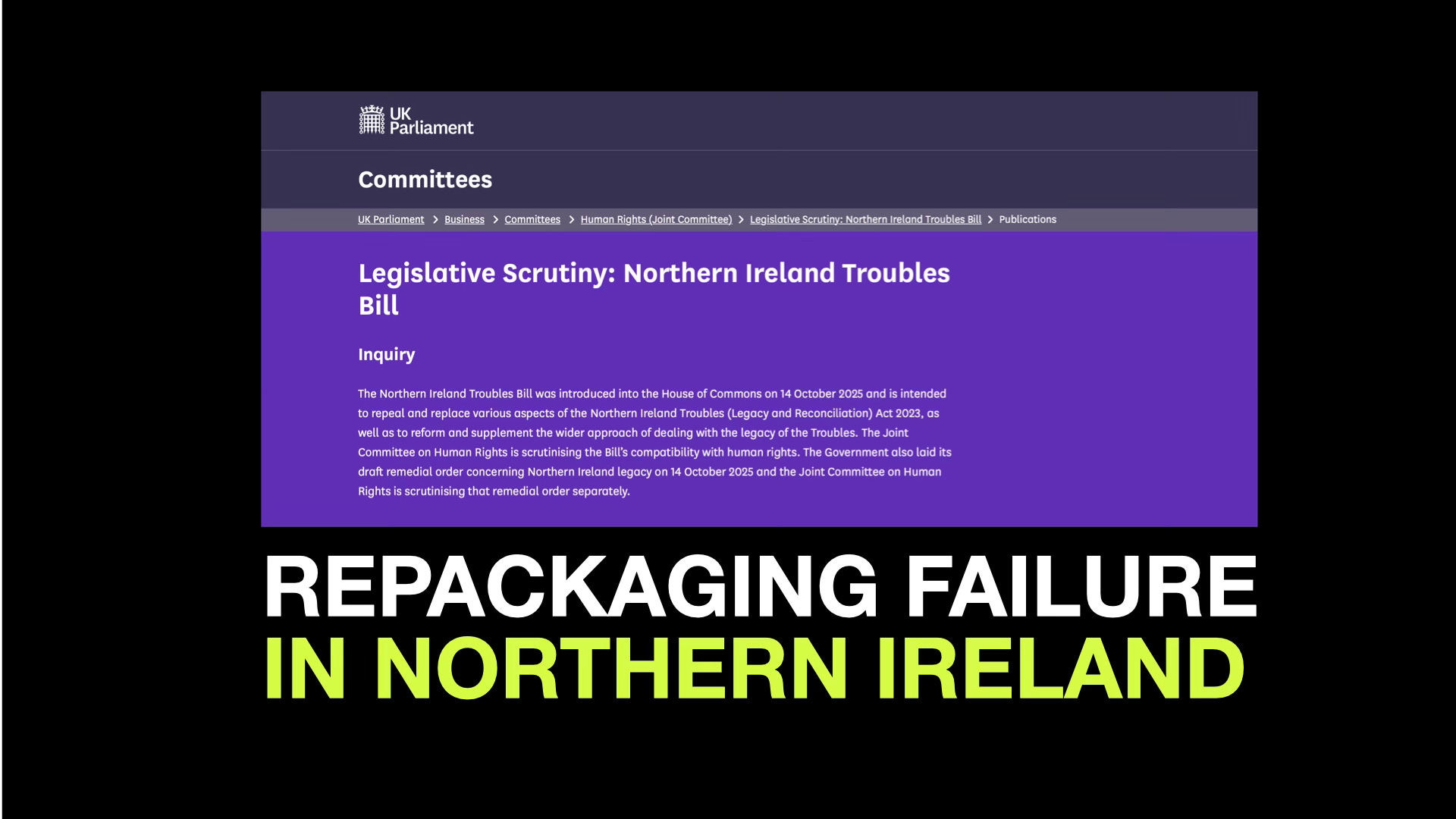
The Government’s troubled Troubles Bill has been waved through to the next Parliament. And, while the bill may have been slowed, it is far from dead.
For anyone who wants more than a few soundbites about veterans’ opposition to the Troubles Bill, the Joint Committee on Human Rights has now published the evidence it received.
It is worth reading.
Not because it settles the argument, but because it exposes it. What sits on that page is not a tidy collection of views. It is a record of a political system struggling to explain itself.
This is being presented as constitutional housekeeping. It is nothing of the sort.
It is a live contest over how the past is to be judged—and, more importantly, who will be made to answer for it.
Strip away the language of “reform” and “balance” and the underlying question becomes unavoidable: is this a process designed to deal with the past evenly, or one that—by design or default—keeps dragging the state’s own veterans back into the frame while others slip out of it?
That is the argument running through the evidence, whether it is stated directly or not.
The Government’s line is clear enough. There is “no equivalence” between the security forces and terrorist organisations. Safeguards are in place. The system is fair.
But the more that line is repeated, the less secure it sounds.
Because the practical reality is harder to dismiss. The state can investigate its own. It has files, chains of command, records, and living institutions that can be compelled to answer. Paramilitary organisations do not. They leave fragments, not systems.
So a process that looks neutral on paper begins to tilt in practice.
That is where the anger comes from.
The inquest system sits at the centre of it. In theory, it is a mechanism for truth. In practice, in this context, it is the most reliable route for reopening cases involving soldiers and police—because those are the cases where the evidence still exists and the institutions can still be reached.
Legally, that may be defensible. Politically, it looks like a one-way street.
And that perception is now doing the real damage.
“Veterans versus victims” is a crude phrase, but it has taken hold because it captures how the process feels to those watching it unfold. Not reconciliation. Not closure. Something closer to a rebalancing of blame—long after the events themselves.
Many veterans do not believe they are being asked to support a fair reckoning. They believe they are being asked to accept a rewriting in which those who enforced the law remain under scrutiny, while those who broke it fade from view.
Once that belief settles in, the rest becomes procedural detail.
The Government may be right that the previous settlement failed. It satisfied almost no one and resolved very little. But replacing one failed structure with another that produces the same practical imbalance is not progress. It is the same outcome, repackaged to meet the expectations of a political class that cannot admit the limits of what can be resolved — or that is answering to pressures it is unwilling to name.
That is the risk now.
Because the problem is not simply a legal one. It is structural. A system that depends on records will always find the state first. A system that relies on testimony will always struggle to reach those with nothing to gain from speaking.
That asymmetry cannot be wished away. But nor can it be ignored.
If the outcome is that soldiers are, in effect, the only people consistently drawn back into formal scrutiny, then the claim of even-handed justice will not survive contact with reality.
And if that claim collapses, so does the legitimacy of the entire process.
That is why the JCHR evidence matters. It shows, in plain terms, that this is not a settled issue being tidied up. It is an unresolved argument being pushed forward under the cover of process.
Read it closely enough, and the pattern is difficult to miss.
The language is careful. The conclusions are not.
And so they voted yesterday. Either those that voted for the Bill to be carried forward to the next parliamentary session believe wholeheartedly in this wrecking-ball legislation, or they are cannon fodder in a system that enables the lead players in government to duck the issue. Truth be told, I find it hard to believe in this kind of democracy now that the reality of what is to come affects my comrades-in-arms past, present and future.
It occurs to me that the left-wing globalist ideologues who head-up the Labour Party may well actually WANT the demise of our armed forces. No money. Endless constraints. And above all, a diminishing of the sort of influence veterans have, for example, gained over the exposure of Hermer re Iraq. He should not be allowed anywhere near the legislation but he is up to his neck in it. A self-appointed commissar.