

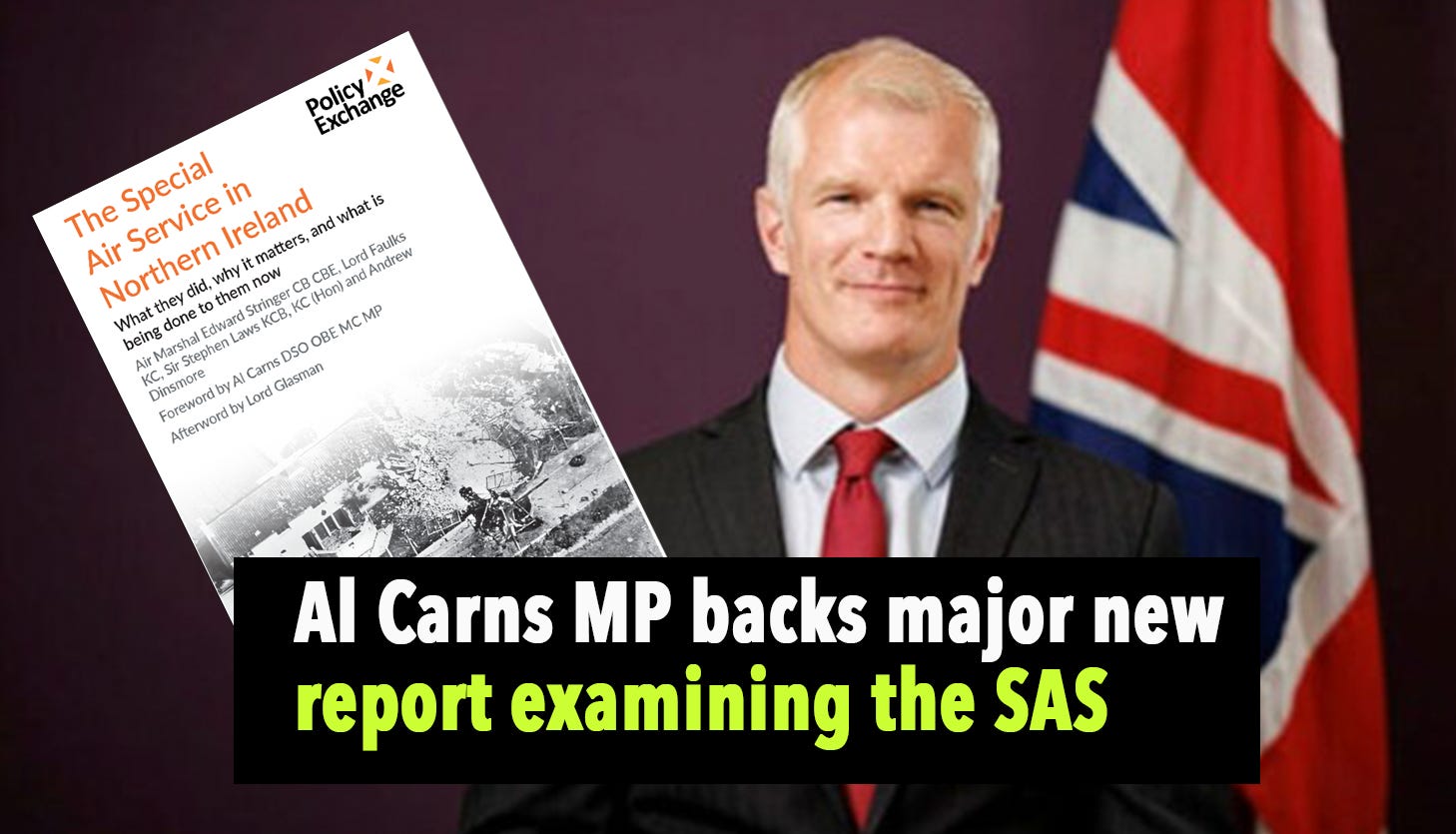
A major new report examining the role of the Special Air Service during the Northern Ireland Troubles has received the backing of former Armed Forces Minister Al Carns MP, who writes the foreword to The Special Air Service in Northern Ireland: What they did, why it matters, and what is being done to them now.
The report brings together contributions from Air Marshal Edward Stringer, Lord Faulks KC, Sir Stephen Laws KC (Hon) and Andrew Dinsmore, with a foreword by former Armed Forces Minister Al Carns MP.
The report is important because it addresses two linked questions.
First: what was the SAS actually doing in Northern Ireland?
Drawing on original interviews with SAS veterans, the report examines the operational reality of service during the Troubles: confronting a determined and heavily armed terrorist organisation, operating under political direction, supporting the civil power, and making decisions in circumstances where seconds could determine life or death.
The report argues that the SAS was deployed by successive governments as part of the state’s response to terrorism. Its members operated under the Army’s rules of engagement and the criminal law framework that existed at the time, with the objective of preventing attacks, protecting life and, where possible, making arrests rather than using lethal force.
Second: how should a democracy deal with the legacy of conflict decades later?
The report examines the growth of the modern legacy process and the impact of applying later legal interpretations to events that occurred decades earlier. It argues that veterans now face renewed investigations into decisions made in an entirely different operational and legal environment.
The central issue is not whether anyone should be above the law.
The issue is whether justice can be served by repeatedly reopening historic cases without a clear route to finality — particularly when memories have faded, witnesses have died and the legal framework has changed.
The report argues that accountability and fairness are not opposing principles. A credible legacy process must seek truth, recognise victims and families, but also treat fairly those who were sent by the state to confront violence.
It concludes with a challenge for policymakers: how to establish a process that provides answers without leaving veterans facing indefinite legal uncertainty.
For Justice for Veterans, this report represents an important contribution to a debate that has too often become polarised.
Understanding the past requires looking at the whole picture: the violence that occurred, the decisions made by governments, the experiences of victims, and the realities faced by those tasked with restoring order.
The legacy of Northern Ireland deserves nothing less than an evidence-based approach.
Read the report: The Special Air Service in Northern Ireland: What they did, why it matters, and what is being done to them now.
#JusticeForVeterans #NorthernIreland #OperationBanner #SAS #Veterans #Legacy
Legacy has a begining and the NI legacy was the desire by HMG to send the army to NI to assist law enforcement in the Province. HMG wrote the specific conditions that soldiers must operate within. Therefore the owner and responsible persons of this 'Legacy' can only be HMG.
Dicky, ,well said Pilgrim. We stick together like glue! The Battle Plan has been forged and it will succeed! No change of direction ,with the "New Clown" who's the head of the Labour Party Circus! Dig in brother! Always A Little Further'💪💪👊👊👈